


Obverse
Description:
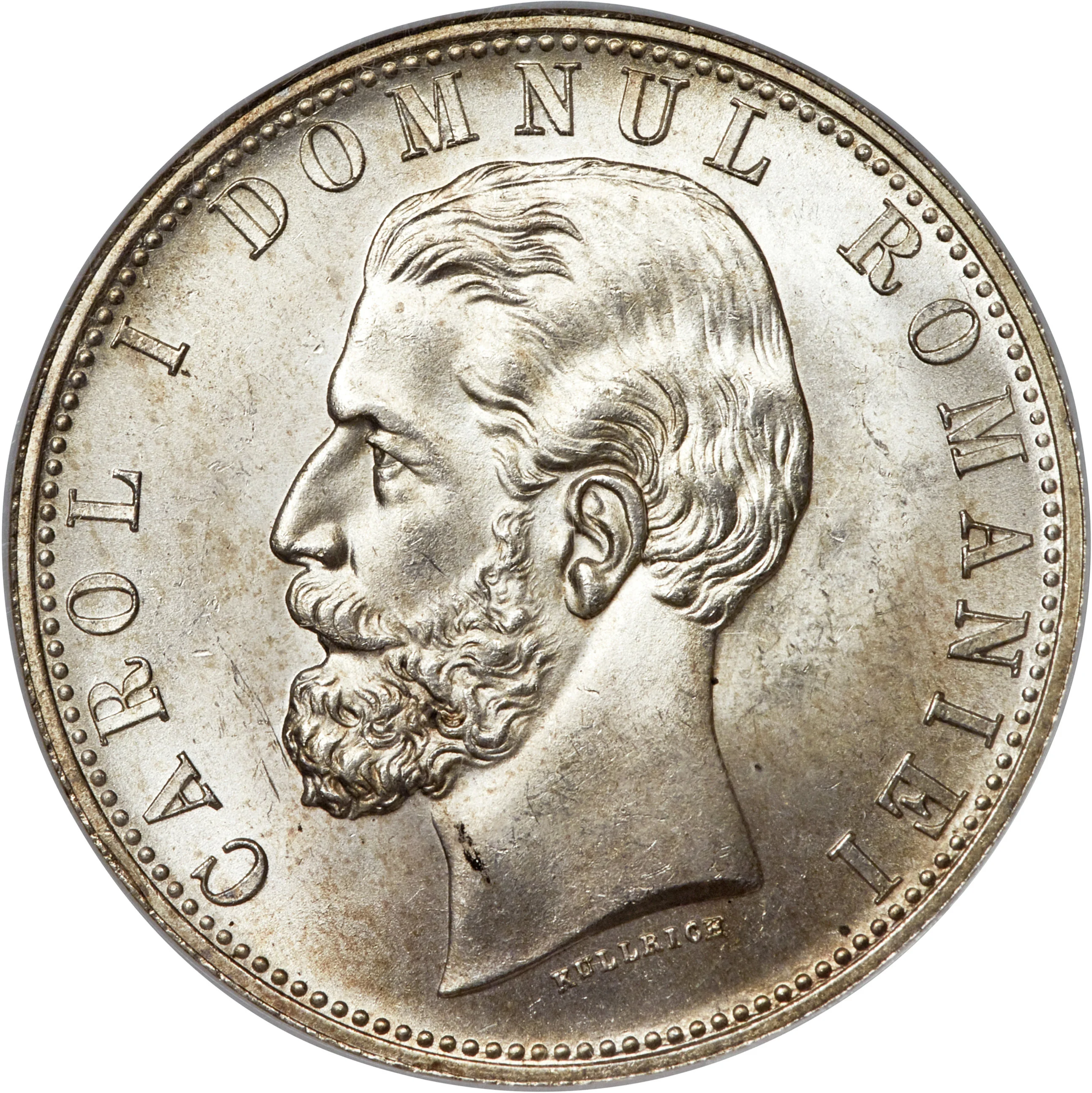
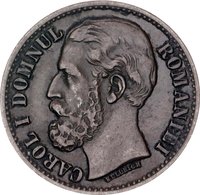
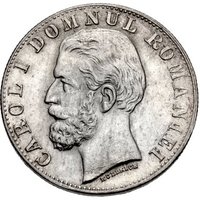
Left profile of Prince Carol I. Engraver's name below neck truncation. Romanian legend on periphery. External denticles.
Inscription:
CAROL I DOMNUL ROMANIEI
KULLRICH
KULLRICH
Translation:
CAROL I LORD OF ROMANIA
KULLRICH
KULLRICH
Script: Latin
Language: Romanian
Engraver: Friedrich Wilhelm Kullrich
Reverse
Edge
Milled
Categories
| Symbols> Coat of Arms |
| Person> Monarch |
Mints
| Name | Mark |
|---|---|
| State Mint | B |
Historical background
In 1880, Romania existed within a complex monetary landscape, a direct legacy of its recent independence and the economic influence of great powers. Following the Russo-Turkish War of 1877-78, the country had just gained full sovereignty from the Ottoman Empire, but its economy remained deeply intertwined with those of its neighbors. The currency in daily circulation was a chaotic mixture of Ottoman gold liras, Austrian-Hungarian florins (gulden), Russian rubles, and French francs, reflecting centuries of political and commercial ties. This multiplicity of coins created significant challenges for trade, state finance, and everyday transactions, as exchange rates fluctuated and counterfeiting was rampant.
The official currency, established by Prince Alexandru Ioan Cuza in 1867, was the leu (lion), subdivided into 100 bani. However, this was largely a unit of account rather than a physical reality. The state minted limited quantities of silver coins (5-lei pieces) and smaller denominations, but these were insufficient. The true foundation of the monetary system was the French franc, to which the leu was pegged at a fixed parity of 1 leu = 1 franc, as per Romania's adherence to the Latin Monetary Union in 1867. This peg provided international stability but did not solve the domestic shortage of standardized coinage.
Consequently, the key monetary issue of 1880 was the pressing need for a unified, tangible national currency to consolidate economic sovereignty and simplify commerce. The government, led by Prime Minister Ion Brătianu, was actively planning for the introduction of a full national coinage system and, more ambitiously, the establishment of a national bank. This effort would culminate in 1880 with the founding of the Banca Națională a României (National Bank of Romania), which received the exclusive right to issue paper money. The bank's first notes entered circulation in 1881, marking the decisive step toward a modern, unified monetary system for the young kingdom.
The official currency, established by Prince Alexandru Ioan Cuza in 1867, was the leu (lion), subdivided into 100 bani. However, this was largely a unit of account rather than a physical reality. The state minted limited quantities of silver coins (5-lei pieces) and smaller denominations, but these were insufficient. The true foundation of the monetary system was the French franc, to which the leu was pegged at a fixed parity of 1 leu = 1 franc, as per Romania's adherence to the Latin Monetary Union in 1867. This peg provided international stability but did not solve the domestic shortage of standardized coinage.
Consequently, the key monetary issue of 1880 was the pressing need for a unified, tangible national currency to consolidate economic sovereignty and simplify commerce. The government, led by Prime Minister Ion Brătianu, was actively planning for the introduction of a full national coinage system and, more ambitiously, the establishment of a national bank. This effort would culminate in 1880 with the founding of the Banca Națională a României (National Bank of Romania), which received the exclusive right to issue paper money. The bank's first notes entered circulation in 1881, marking the decisive step toward a modern, unified monetary system for the young kingdom.
🌱 Common