

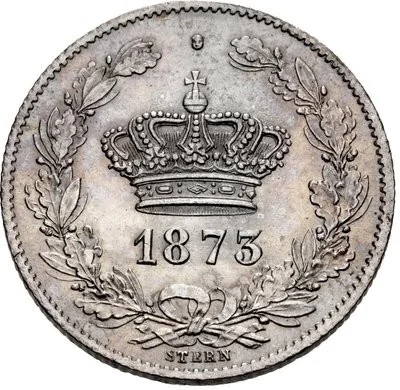
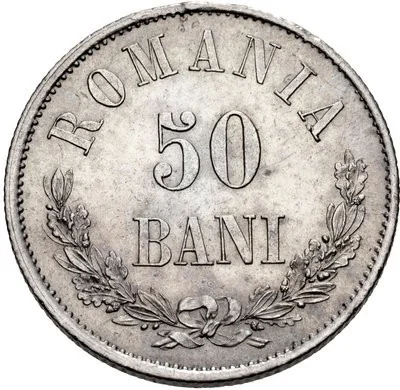

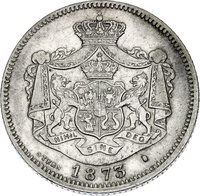
Reverse
Edge
Reeded
Mints
| Name | Mark |
|---|---|
| Royal Mint of Belgium | — |
Mintings
| Year | Mint Mark | Mintage | Quality | Collection |
|---|---|---|---|---|
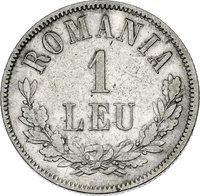
| 1873 | — | 4,810,000 | ||
| 1876 | — | 2,116,980 |
Historical background
In 1873, Romania was navigating a complex monetary landscape as a newly autonomous principality under Ottoman suzerainty. The country lacked a unified national currency, leading to a circulation of diverse foreign coins, primarily the Ottoman lira (or gold pound), Austrian florins and kreuzers, and Russian rubles. This multiplicity created significant challenges for trade, state finance, and everyday transactions, highlighting the need for a stable, sovereign monetary system to support economic development and assert national identity.
The foundational step toward reform had already been taken with the Law of 1867, which adopted a bimetallic standard based on the French franc, defining the Romanian leu as equal to one franc. However, the actual minting of national coinage was delayed. Consequently, in 1873, the leu existed largely as a unit of account, while physical transactions relied on the unstable mix of foreign specie. This period was one of active preparation, as the government worked to establish the necessary institutions, including the eventual founding of the Banca Națională a României in 1880.
Therefore, the currency situation in 1873 was characterized by transition and anticipation. It was the quiet before the tangible realization of monetary sovereignty, which would begin with the minting of the first Romanian gold coins (the 20-lei and 10-lei "Pol") in the following year, 1874. The year 1873 thus represents a pivotal moment of laying the final groundwork, with the principality on the cusp of replacing its chaotic monetary mosaic with a unified national currency tied to the Latin Monetary Union standards.
The foundational step toward reform had already been taken with the Law of 1867, which adopted a bimetallic standard based on the French franc, defining the Romanian leu as equal to one franc. However, the actual minting of national coinage was delayed. Consequently, in 1873, the leu existed largely as a unit of account, while physical transactions relied on the unstable mix of foreign specie. This period was one of active preparation, as the government worked to establish the necessary institutions, including the eventual founding of the Banca Națională a României in 1880.
Therefore, the currency situation in 1873 was characterized by transition and anticipation. It was the quiet before the tangible realization of monetary sovereignty, which would begin with the minting of the first Romanian gold coins (the 20-lei and 10-lei "Pol") in the following year, 1874. The year 1873 thus represents a pivotal moment of laying the final groundwork, with the principality on the cusp of replacing its chaotic monetary mosaic with a unified national currency tied to the Latin Monetary Union standards.
🌟 Uncommon