

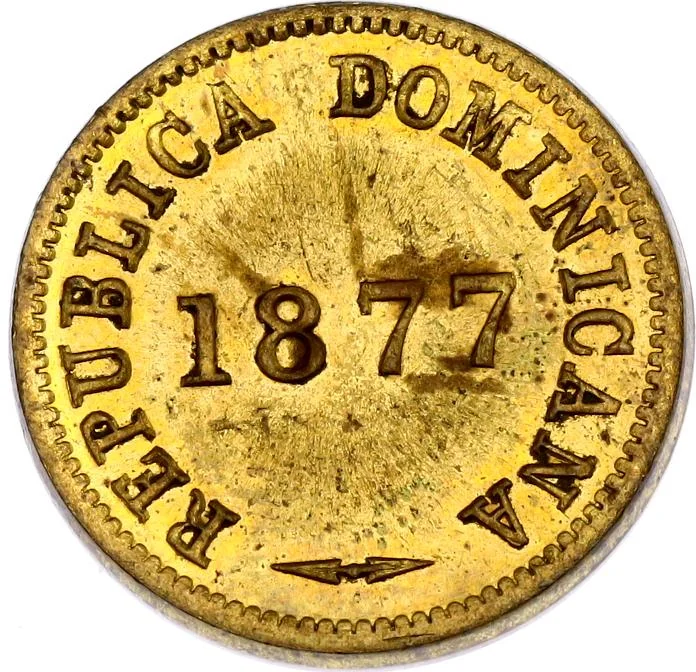
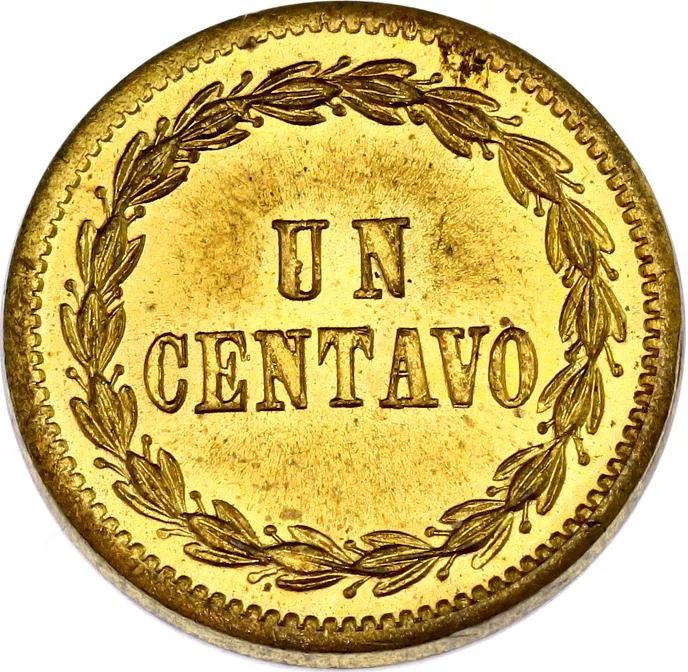
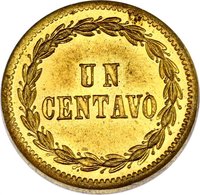
1 Centavo – Dominican Republic
Dominican Republic
Context
Year: 1877
Issuer: Dominican Republic 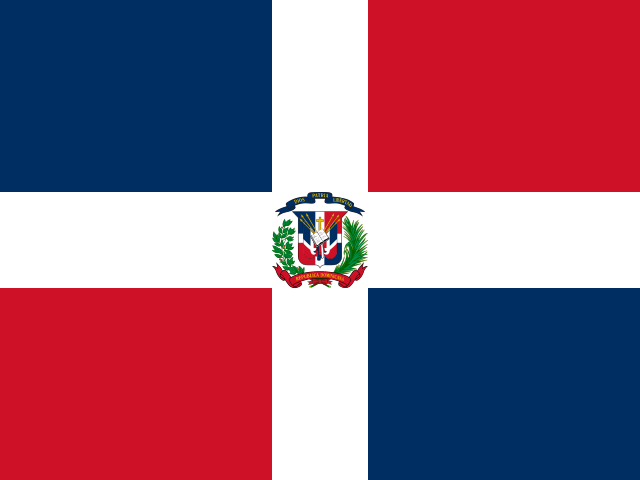
Period:
(1863—1916)
Currency:
(1844—1905)
Demonetized: Yes
Total mintage: 1,000,000
Material
References
KM: #Click to copy to clipboard3
Numista: #20530
Obverse
Edge
Mints
| Name | Mark |
|---|---|
| Scovill Manufacturing Company | — |
Mintings
| Year | Mint Mark | Mintage | Quality | Collection |
|---|---|---|---|---|
| 1877 | — | 1,000,000 |
Historical background
In 1877, the Dominican Republic was grappling with a complex and unstable currency situation, a legacy of political turmoil and economic dependency. Following the restoration of sovereignty in 1865 after a brief annexation by Spain, the nation's monetary system was fragmented. Multiple forms of money circulated simultaneously, including worn Spanish colonial coins, privately issued banknotes from various commercial banks, and even direct barter in some regions. The lack of a strong, centralized national currency undermined government finances, complicated trade, and created widespread confusion in everyday transactions.
This monetary chaos was exacerbated by the government's chronic fiscal deficits. To finance its operations, the state often resorted to issuing large amounts of low-value copper coins or authorizing private banks to print paper money with insufficient metallic backing. The result was frequent depreciation and a severe lack of public confidence in paper banknotes. Merchants and the public preferred silver pesos, leading to a classic case of Gresham's Law, where "bad money" (depreciating paper and copper) drove "good money" (silver coin) out of circulation, either into hoarding or for use in foreign trade.
The situation in 1877 existed within a broader context of seeking economic stability and foreign investment. Just a few years prior, the country had signed a controversial commercial reciprocity treaty with the United States (1867) and was actively, though unsuccessfully, pursuing annexation or protectorate agreements with various foreign powers to address its debts and instability. The disordered currency was both a symptom and a cause of the nation's fragile economic state, hindering internal commerce and demonstrating the urgent need for monetary reform that would only begin to be addressed in the subsequent decades.
This monetary chaos was exacerbated by the government's chronic fiscal deficits. To finance its operations, the state often resorted to issuing large amounts of low-value copper coins or authorizing private banks to print paper money with insufficient metallic backing. The result was frequent depreciation and a severe lack of public confidence in paper banknotes. Merchants and the public preferred silver pesos, leading to a classic case of Gresham's Law, where "bad money" (depreciating paper and copper) drove "good money" (silver coin) out of circulation, either into hoarding or for use in foreign trade.
The situation in 1877 existed within a broader context of seeking economic stability and foreign investment. Just a few years prior, the country had signed a controversial commercial reciprocity treaty with the United States (1867) and was actively, though unsuccessfully, pursuing annexation or protectorate agreements with various foreign powers to address its debts and instability. The disordered currency was both a symptom and a cause of the nation's fragile economic state, hindering internal commerce and demonstrating the urgent need for monetary reform that would only begin to be addressed in the subsequent decades.
🌟 Limited