

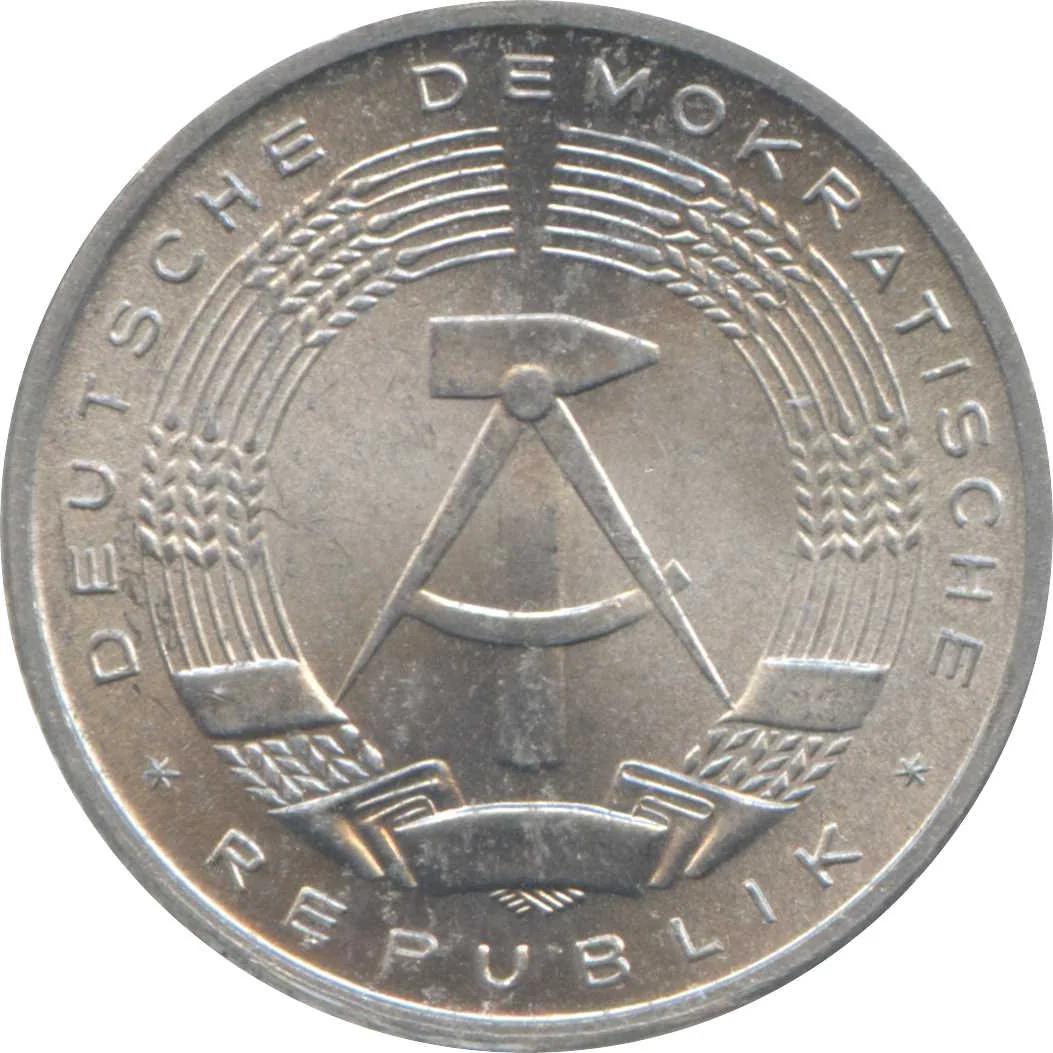
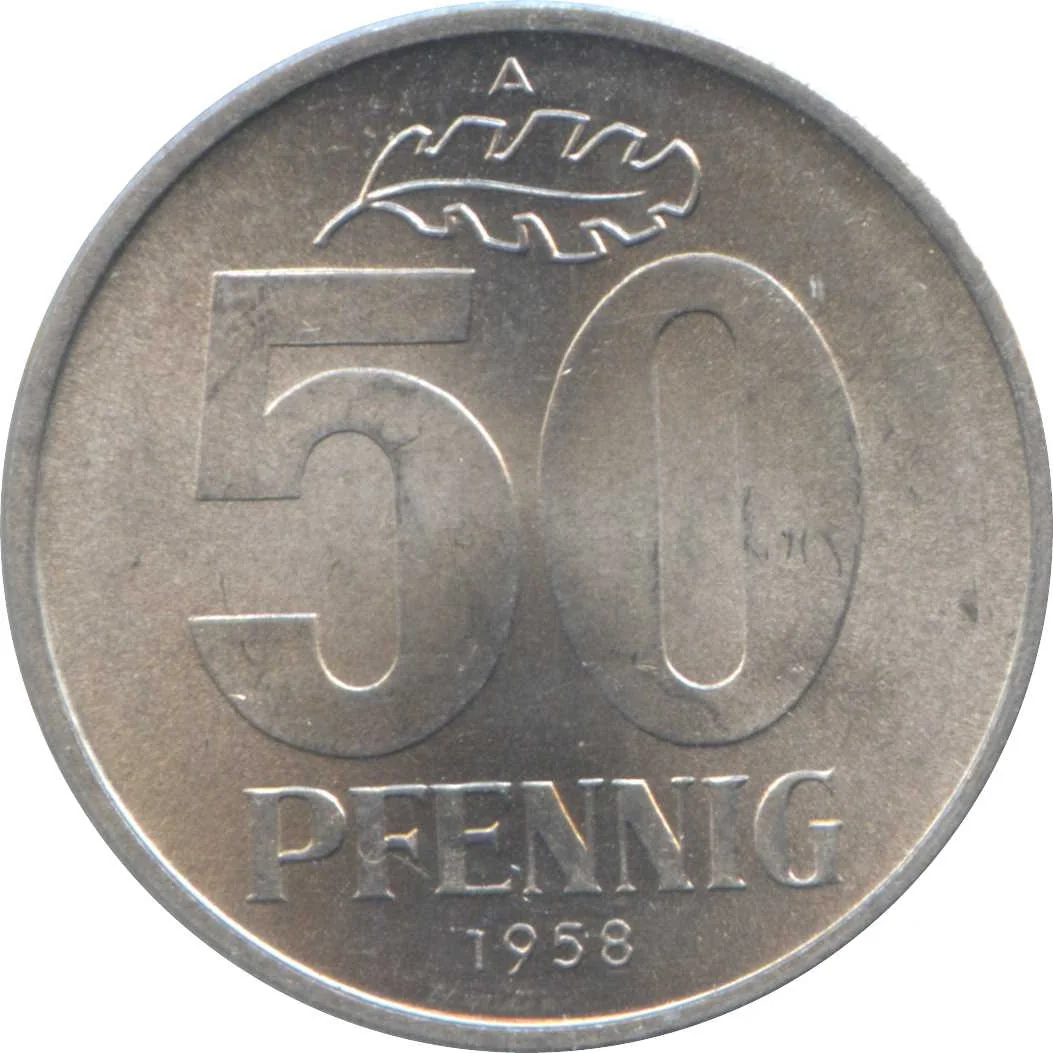
50 Pfennigs – German Democratic Republic
Germany
Context
Years: 1958–1990
Country: Germany 
Issuer: German Democratic Republic 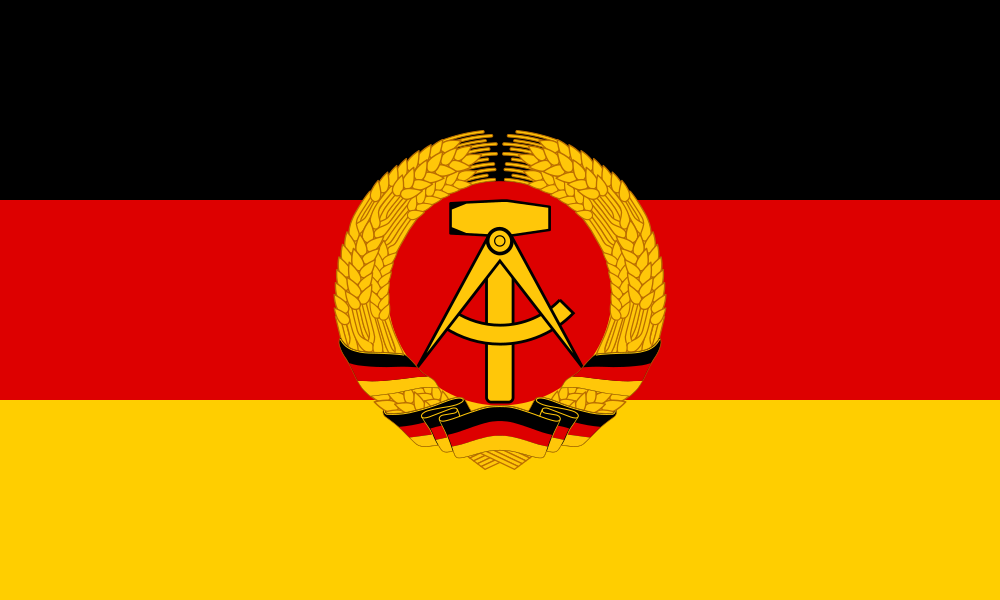
Period:
(1949—1990)
Currency:
(1948—1990)
Demonetization: 1 July 1991
Total mintage: 268,222,693
Material
References
KM: #Click to copy to clipboard12
Numista: #2032
Value
Exchange value: 0.50 DDM
Inflation-adjusted value: 2.92 DDM
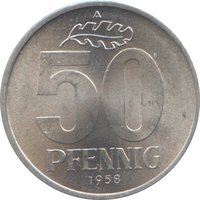
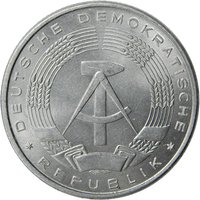
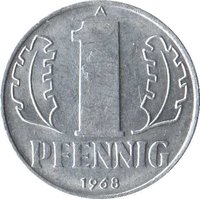
Obverse
Reverse
Edge
Reeded
Mints
| Name | Mark |
|---|---|
| Berlin | a |
Mintings
| Year | Mint Mark | Mintage | Quality | Collection |
|---|---|---|---|---|
| 1958 | A | 101,605,933 | ||
| 1968 | A | 19,860,400 | ||
| 1971 | A | 35,829,130 | ||
| 1972 | A | 8,117,258 | ||
| 1973 | A | 6,530,456 | ||
| 1979 | A | 1,027,000 | ||
| 1979 | A | — | Proof | |
| 1980 | A | 1,118,000 | ||
| 1980 | A | — | Proof | |
| 1981 | A | 10,546,050 | ||
| 1981 | A | 40 | Proof | |
| 1982 | A | 79,832,250 | ||
| 1982 | A | 2,500 | Proof | |
| 1983 | A | 2,550 | Proof | |
| 1983 | A | 1,308,550 | ||
| 1984 | A | 5,000 | ||
| 1984 | A | 3,015 | Proof | |
| 1985 | A | 1,565,000 | ||
| 1985 | A | 2,816 | Proof | |
| 1986 | A | 776,000 | ||
| 1986 | A | 2,800 | Proof | |
| 1987 | A | 2,345 | Proof | |
| 1987 | A | 21,000 | In sets | |
| 1988 | A | 15,000 | In sets | |
| 1988 | A | 2,300 | Proof | |
| 1989 | A | 2,300 | Proof | |
| 1989 | A | 31,000 | ||
| 1990 | A | 14,000 | In sets |
Historical background
In 1958, the currency situation in the German Democratic Republic (GDR) was defined by a strict division between its internal economy and external trade, managed through a dual-currency system. Internally, the official currency was the East German Mark (Mark der DDR, or M), which was non-convertible and isolated from international markets. Its value and circulation were tightly controlled by the state and the Deutsche Notenbank (from 1968, the Staatsbank der DDR), primarily serving as a tool for the planned economy rather than a freely traded medium of exchange. For the populace, this meant a stable but constrained monetary environment, with prices and wages set administratively, though purchasing power was limited by chronic shortages of desirable consumer goods.
Externally, the GDR conducted its foreign trade and dealings with Western countries using a separate, artificial accounting unit: the Valutamark. This was not a physical currency but a bookkeeping device pegged to the value of the West German Deutsche Mark (DM) at a 1:1 ratio. This system was crucial for the GDR, as it allowed the state to earn hard currency through exports and the controversial practice of political prisoner ransoms, while insulating the domestic economy. The stark disparity between the two systems was evident at government-run Intershops, established in the 1960s, where privileged citizens and Western visitors could purchase high-quality imported goods using hard currencies, creating a visible two-tier economy.
Underpinning this monetary architecture was a deep-seated economic vulnerability. The GDR suffered from a persistent shortage of hard currency, which was desperately needed to import critical technology and consumer items from the West. This "valuta gap" placed immense pressure on the state's finances and contributed to the policy of rigorously restricting the movement of people and capital, most notoriously through the Berlin Wall, erected just three years later in 1961. Thus, the 1958 currency situation was not merely a financial framework but a fundamental pillar of the GDR's efforts to maintain political control and economic viability amidst systemic weaknesses and the overwhelming gravitational pull of the West German economic miracle.
Externally, the GDR conducted its foreign trade and dealings with Western countries using a separate, artificial accounting unit: the Valutamark. This was not a physical currency but a bookkeeping device pegged to the value of the West German Deutsche Mark (DM) at a 1:1 ratio. This system was crucial for the GDR, as it allowed the state to earn hard currency through exports and the controversial practice of political prisoner ransoms, while insulating the domestic economy. The stark disparity between the two systems was evident at government-run Intershops, established in the 1960s, where privileged citizens and Western visitors could purchase high-quality imported goods using hard currencies, creating a visible two-tier economy.
Underpinning this monetary architecture was a deep-seated economic vulnerability. The GDR suffered from a persistent shortage of hard currency, which was desperately needed to import critical technology and consumer items from the West. This "valuta gap" placed immense pressure on the state's finances and contributed to the policy of rigorously restricting the movement of people and capital, most notoriously through the Berlin Wall, erected just three years later in 1961. Thus, the 1958 currency situation was not merely a financial framework but a fundamental pillar of the GDR's efforts to maintain political control and economic viability amidst systemic weaknesses and the overwhelming gravitational pull of the West German economic miracle.
🌱 Very Common