

1 Pfennig – German Democratic Republic
Germany
Context
Years: 1960–1990
Country: Germany 
Issuer: German Democratic Republic 
Period:
(1949—1990)
Currency:
(1948—1990)
Demonetization: 1 July 1991
Total mintage: 3,077,758,713
Material
References
KM: #Click to copy to clipboard8
Numista: #1004
Value
Exchange value: 0.01 DDM
Inflation-adjusted value: 0.06 DDM
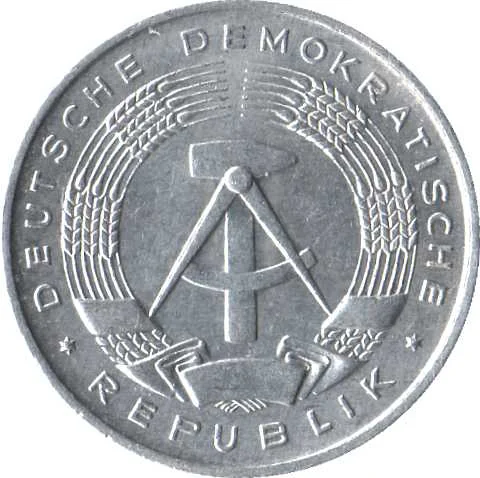
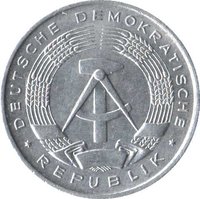
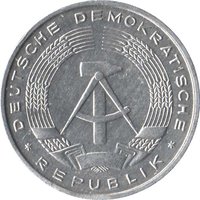
Obverse
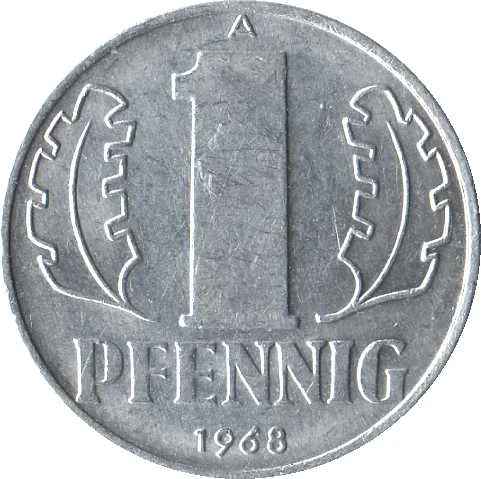
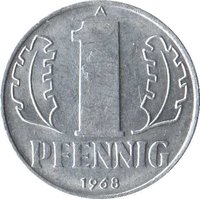
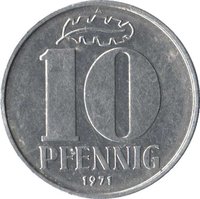
Reverse
Description:
Face value with oak leaves and mintmark above, date below.
Inscription:
A
1
PFENNIG
1968
1
PFENNIG
1968
Script: Latin
Engraver: Rudi Högner
Edge
Plain
Mints
| Name | Mark |
|---|---|
| Berlin | A |
| Saint Petersburg | A |
Mintings
| Year | Mint Mark | Mintage | Quality | Collection |
|---|---|---|---|---|
| 1960 | A | 101,807,993 | ||
| 1961 | A | 101,775,914 | ||
| 1962 | A | 81,459,160 | ||
| 1963 | A | 101,401,582 | ||
| 1964 | A | 98,967,334 | ||
| 1965 | A | 38,584,510 | ||
| 1968 | A | 813,680,000 | ||
| 1972 | A | 4,800,734 | ||
| 1973 | A | 5,517,600 | ||
| 1975 | A | 202,752,200 | ||
| 1977 | A | 61,560,000 | ||
| 1978 | A | 200,050,000 | ||
| 1979 | A | 100,640,000 | ||
| 1979 | A | — | Proof | |
| 1980 | A | 153,000,020 | ||
| 1980 | A | — | Proof | |
| 1981 | A | 200,436,000 | ||
| 1981 | A | 40 | Proof | |
| 1982 | A | 99,200,000 | ||
| 1982 | A | 2,500 | Proof | |
| 1983 | A | 150,000,000 | ||
| 1983 | A | 2,550 | Proof | |
| 1984 | A | 137,600,000 | ||
| 1984 | A | 3,015 | Proof | |
| 1985 | A | 125,060,000 | ||
| 1985 | A | 2,816 | Proof | |
| 1986 | A | 2,800 | Proof | |
| 1986 | A | 73,900,000 | ||
| 1987 | A | 50,015,000 | ||
| 1987 | A | 2,345 | Proof | |
| 1988 | A | 75,450,000 | ||
| 1988 | A | 2,300 | Proof | |
| 1989 | A | 84,410,000 | ||
| 1989 | A | 2,300 | Proof | |
| 1990 | A | 15,670,000 |
Historical background
In the German Democratic Republic (GDR) of 1960, the currency situation was defined by a strict division between two separate monetary circuits, a system designed to control the economy and protect it from Western influence. The official currency was the East German Mark (Mark der Deutschen Demokratischen Republik, or M), which was non-convertible and could not be traded on international markets. Its value was administratively set by the state, divorced from market forces, and its primary purpose was to facilitate the state-planned economy within the borders of the GDR and other Comecon bloc nations.
Alongside this, a parallel currency system existed due to the unique circumstances of divided Berlin. The West German Deutsche Mark (DM) circulated unofficially but widely, functioning as a powerful hard currency. It was highly sought after by the population to purchase high-quality or scarce goods in special stores known as Intershops, which were established by the state in 1962 to capture this foreign exchange. This created a two-tiered society: those with access to Western DMs (often from relatives or remittances) could obtain luxury goods and imported items, while those reliant solely on the East Mark faced a more limited selection of often substandard domestic products.
This dual-currency reality underscored the fundamental weaknesses of the GDR's economy. The state's need for hard currency led it to tacitly encourage the inflow of DM, even as it officially condemned Western influence. The disparity between the two currencies visibly demonstrated the higher productivity and consumer power of West Germany, fueling dissatisfaction and a sense of relative deprivation among East German citizens. By 1960, this monetary divide was a entrenched feature of daily life, highlighting both the regime's attempts to stabilize its planned economy and the persistent gravitational pull of the West.
Alongside this, a parallel currency system existed due to the unique circumstances of divided Berlin. The West German Deutsche Mark (DM) circulated unofficially but widely, functioning as a powerful hard currency. It was highly sought after by the population to purchase high-quality or scarce goods in special stores known as Intershops, which were established by the state in 1962 to capture this foreign exchange. This created a two-tiered society: those with access to Western DMs (often from relatives or remittances) could obtain luxury goods and imported items, while those reliant solely on the East Mark faced a more limited selection of often substandard domestic products.
This dual-currency reality underscored the fundamental weaknesses of the GDR's economy. The state's need for hard currency led it to tacitly encourage the inflow of DM, even as it officially condemned Western influence. The disparity between the two currencies visibly demonstrated the higher productivity and consumer power of West Germany, fueling dissatisfaction and a sense of relative deprivation among East German citizens. By 1960, this monetary divide was a entrenched feature of daily life, highlighting both the regime's attempts to stabilize its planned economy and the persistent gravitational pull of the West.
🌱 Very Common