

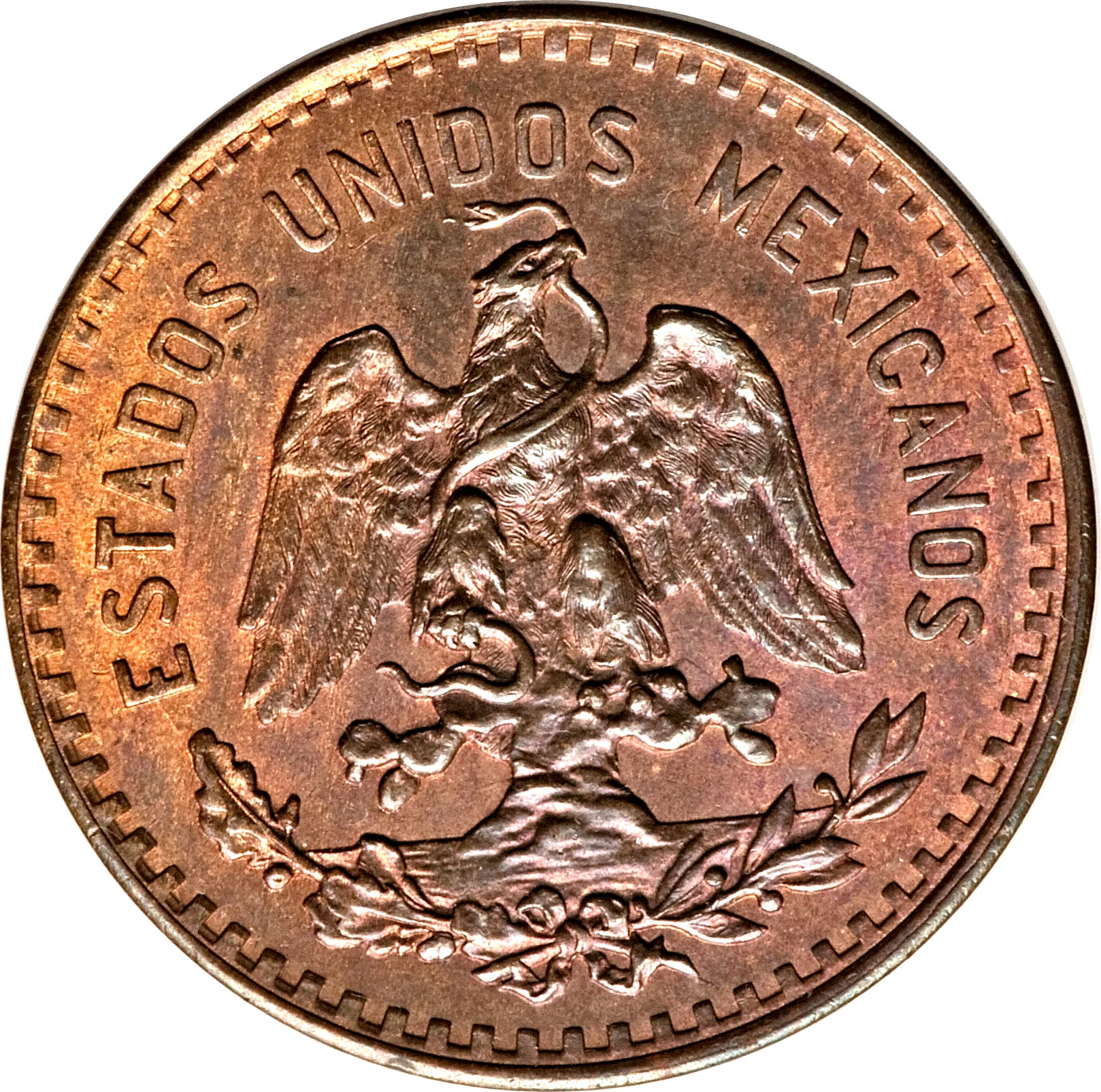
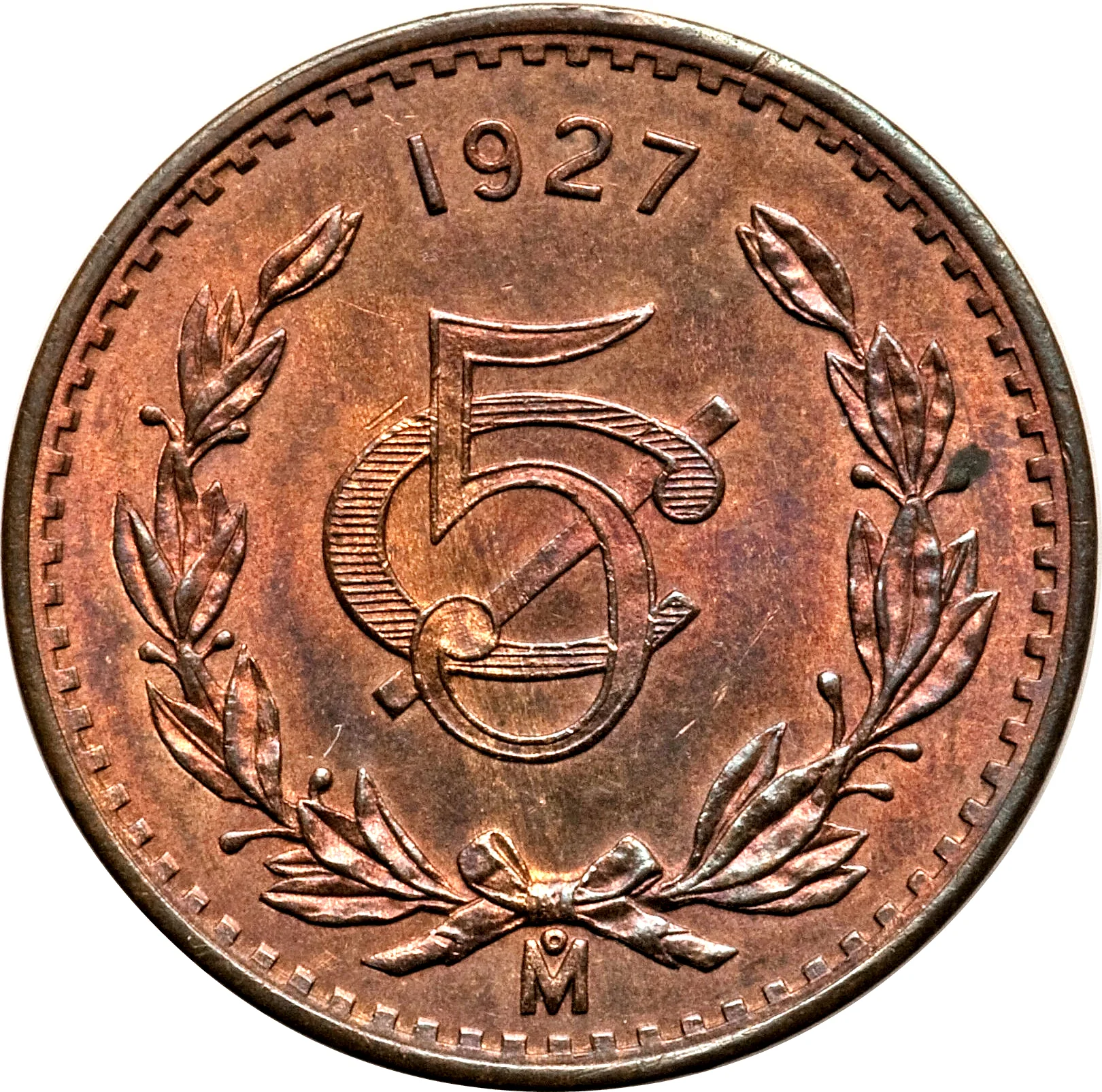
5 Centavos – Mexico
Mexico
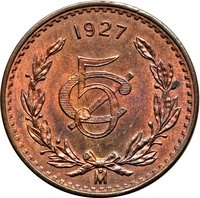
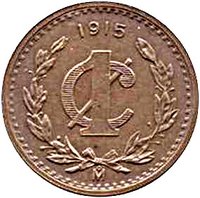
Obverse
Reverse
Edge
Plain
Mints
| Name | Mark |
|---|---|
| Mexican Mint | (Mo) |
Mintings
| Year | Mint Mark | Mintage | Quality | Collection |
|---|---|---|---|---|
| 1914 | Mo | 2,500,000 | ||
| 1915 | Mo | 11,424,000 | ||
| 1916 | Mo | 2,860,000 | ||
| 1917 | Mo | 800,000 | ||
| 1918 | Mo | 1,332,000 | ||
| 1919 | Mo | 400,000 | ||
| 1920 | Mo | 5,920,000 | ||
| 1921 | Mo | 2,080,000 | ||
| 1924 | Mo | 780,000 | ||
| 1925 | Mo | 4,040,000 | ||
| 1926 | Mo | 3,160,000 | ||
| 1927 | Mo | 3,600,000 | ||
| 1928 | Mo | 1,740,000 | ||
| 1929 | Mo | 2,400,000 | ||
| 1930 | Mo | 2,600,000 | ||
| 1931 | Mo | — | ||
| 1933 | Mo | 8,000,000 | ||
| 1934 | Mo | 10,000,000 | ||
| 1935 | Mo | 21,980,000 |
Historical background
In 1914, Mexico's currency system was in a state of profound crisis and fragmentation, a direct consequence of the violent phase of the Mexican Revolution. The overthrow of President Francisco Madero in 1913 and the subsequent civil war against the usurper Victoriano Huerta plunged the nation into chaos. With the central government's authority collapsing, the financial discipline of the Porfirio Díaz era completely unraveled. The Constitutionalist forces under Venustiano Carranza, along with various regional revolutionary factions like those of Pancho Villa and Emiliano Zapata, began issuing their own paper money to fund their military campaigns. This led to a proliferation of unbacked, inconvertible banknotes, known as bilimbiques, which flooded the economy with no precious metal reserves to guarantee their value.
The result was hyperinflation and a complete loss of public confidence in paper currency. Prices skyrocketed, and the various revolutionary notes traded at wildly fluctuating and deeply discounted rates against each other and against the older, more trusted Porfirian banknotes or coins. In many regions, the economy regressed to barter or the use of pre-Revolutionary silver coins, which were hoarded for their intrinsic value. The monetary anarchy mirrored the political fragmentation, as the validity of a banknote depended entirely on which army controlled the territory one was in, and its fortunes on the battlefield.
By late 1914, even as Carranza's forces gained ascendancy after the Convention of Aguascalientes failed, the currency situation remained disastrous. Carranza's government, recognizing the need for economic stability to consolidate power, began to take steps to assert monetary control. This included attempts to recall and cancel competing issues, particularly the widely circulated Villa money, and to establish its own paper currency as the sole legal tender. However, these efforts would take years to fully implement, meaning that for ordinary Mexicans in 1914, the currency was unstable, unreliable, and a daily reminder of the nation's deep turmoil.
The result was hyperinflation and a complete loss of public confidence in paper currency. Prices skyrocketed, and the various revolutionary notes traded at wildly fluctuating and deeply discounted rates against each other and against the older, more trusted Porfirian banknotes or coins. In many regions, the economy regressed to barter or the use of pre-Revolutionary silver coins, which were hoarded for their intrinsic value. The monetary anarchy mirrored the political fragmentation, as the validity of a banknote depended entirely on which army controlled the territory one was in, and its fortunes on the battlefield.
By late 1914, even as Carranza's forces gained ascendancy after the Convention of Aguascalientes failed, the currency situation remained disastrous. Carranza's government, recognizing the need for economic stability to consolidate power, began to take steps to assert monetary control. This included attempts to recall and cancel competing issues, particularly the widely circulated Villa money, and to establish its own paper currency as the sole legal tender. However, these efforts would take years to fully implement, meaning that for ordinary Mexicans in 1914, the currency was unstable, unreliable, and a daily reminder of the nation's deep turmoil.
🌱 Common