

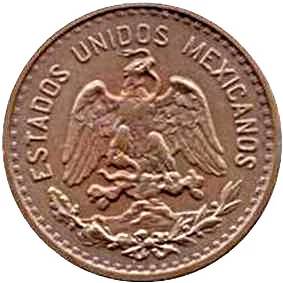
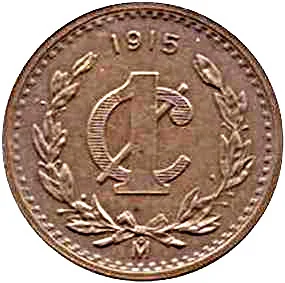
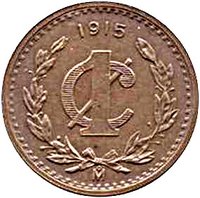
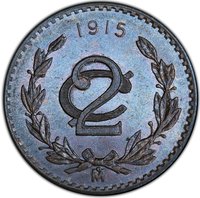
Obverse
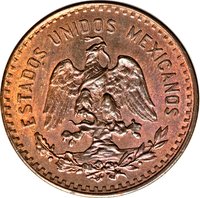
Reverse
Edge
Plain
Mints
| Name | Mark |
|---|---|
| Mexican Mint | Mo |
Mintings
| Year | Mint Mark | Mintage | Quality | Collection |
|---|---|---|---|---|
| 1915 | Mo | 179,000 |
Historical background
In 1915, Mexico was engulfed in the most violent phase of its decade-long Revolution, and the national currency system collapsed under the strain. The Constitutionalist faction, led by Venustiano Carranza, controlled Mexico City but faced immense financial pressure to fund its armies against the rival forces of Pancho Villa and Emiliano Zapata. With foreign credit exhausted and tax revenues in chaos, Carranza's government resorted to the unrestrained printing of paper money, known as bilimbiques (a term derived from "Billings, Montana" and later used derisively for any unstable currency). This led to catastrophic hyperinflation, as the public, having seen previous revolutionary issuances become worthless, lost all confidence in the paper notes.
The monetary landscape became a chaotic patchwork of competing currencies. Not only did the central government flood the economy with its own devalued notes, but various revolutionary commanders, state governments, and even municipal authorities issued their own makeshift paper money, further undermining any unified monetary standard. In this environment, hard currency—especially silver pesos from the Porfirio Díaz era and gold coins—vanished from circulation, hoarded by the public. Barter became a common means of exchange for basic goods, as paper money was often refused outright or accepted only at a tiny fraction of its face value, devastating wages and savings.
This financial disintegration had dire consequences for the population. Prices for essential goods like corn and beans skyrocketed daily, leading to widespread hunger and social desperation in cities. The currency crisis starkly illustrated the collapse of state authority and economic order, forcing Carranza to eventually acknowledge the failure of forced paper currency. By the end of 1915, as his military position strengthened, he began planning a radical monetary reform, which would culminate in 1916 with the withdrawal of all paper money and the eventual introduction of a new, gold-backed currency—a painful but necessary step to restore basic economic function to a shattered nation.
The monetary landscape became a chaotic patchwork of competing currencies. Not only did the central government flood the economy with its own devalued notes, but various revolutionary commanders, state governments, and even municipal authorities issued their own makeshift paper money, further undermining any unified monetary standard. In this environment, hard currency—especially silver pesos from the Porfirio Díaz era and gold coins—vanished from circulation, hoarded by the public. Barter became a common means of exchange for basic goods, as paper money was often refused outright or accepted only at a tiny fraction of its face value, devastating wages and savings.
This financial disintegration had dire consequences for the population. Prices for essential goods like corn and beans skyrocketed daily, leading to widespread hunger and social desperation in cities. The currency crisis starkly illustrated the collapse of state authority and economic order, forcing Carranza to eventually acknowledge the failure of forced paper currency. By the end of 1915, as his military position strengthened, he began planning a radical monetary reform, which would culminate in 1916 with the withdrawal of all paper money and the eventual introduction of a new, gold-backed currency—a painful but necessary step to restore basic economic function to a shattered nation.
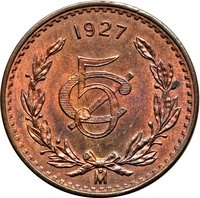
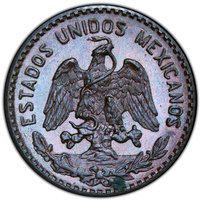
🌟 Limited