

5 Francs – Switzerland
Switzerland
Context
Years: 1924–1928
Issuer: Switzerland 
Period:
(since 1848)
Currency:
(since 1850)
Demonetization: 1 February 1934
Total mintage: 5,036,000
Material

References
KM: #Click to copy to clipboard38
Numista: #19999
Value
Exchange value: 5 CHF = $6.46
Bullion value: $63.96
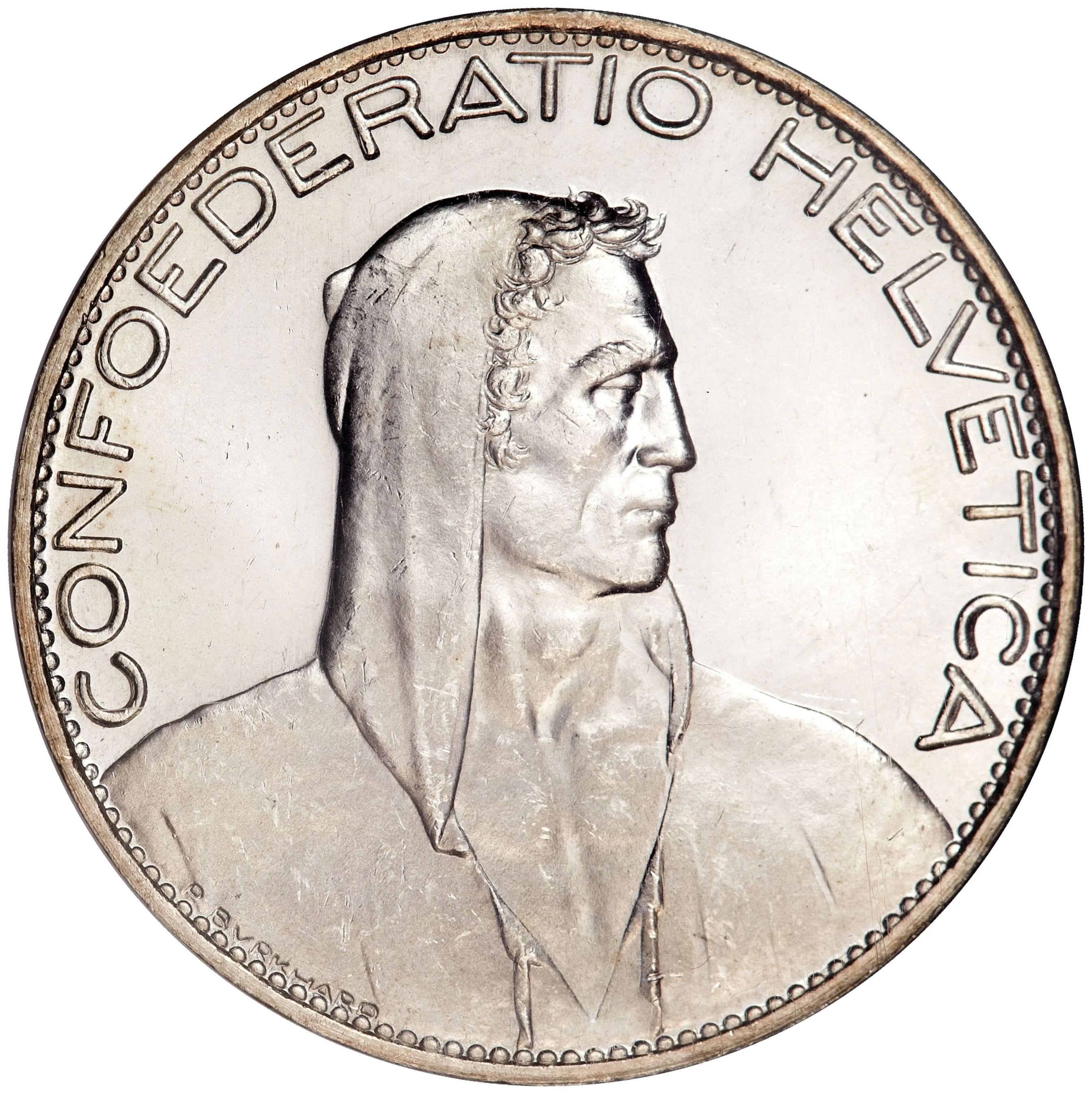
Obverse
Description:
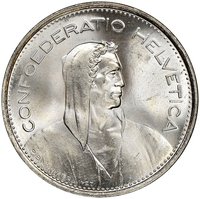
Bust of a curly-haired herdsman in a hooded shirt, facing right; commonly misidentified as William Tell.
Inscription:
CONFOEDERATIO HELVETICA
P. BVRKHARD
P. BVRKHARD
Translation:
SWISS CONFEDERATION
P. BURKHARD
P. BURKHARD
Script: Latin
Designer: Paul Burkhard
Reverse
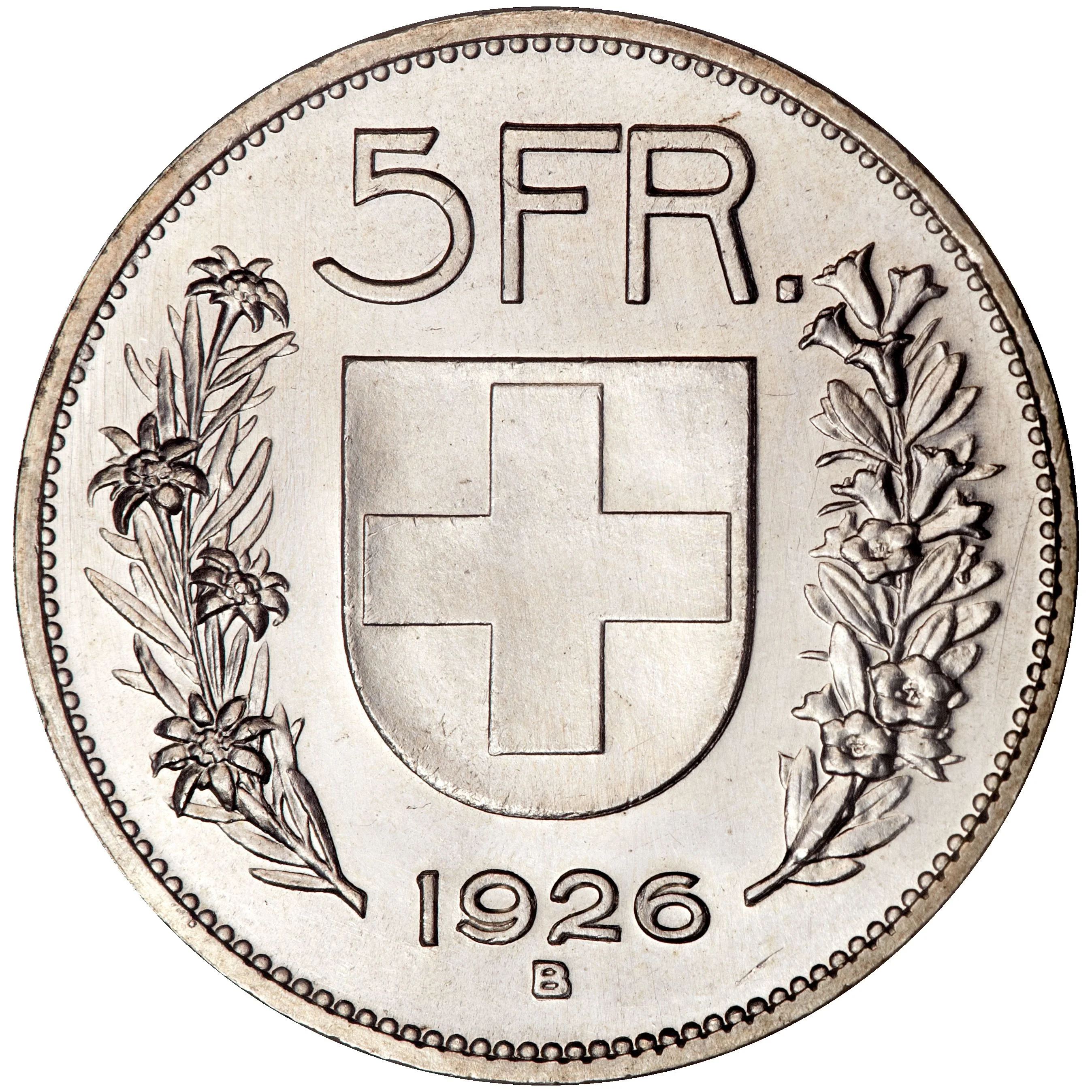
Description:
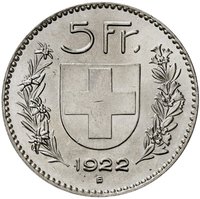
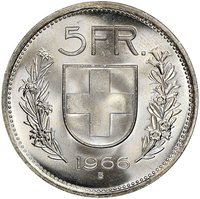
Swiss coat of arms on a square shield, flanked by two flowering edelweiss springs.
Inscription:
5 FR.
1926
B
1926
B
Script: Latin
Designer: Paul Burkhard
Edge
Smooth with inscription in relief, including 13 stars
Legend:
DOMINUS 🟉🟉🟉 | PROVIDEBIT |🟉🟉🟉🟉🟉🟉🟉🟉🟉🟉
Translation:
THE LORD WILL PROVIDE
Language: Latin
Categories
| Plants> Flower |
| Symbols> Coat of Arms |
Mints
| Name | Mark |
|---|---|
| Bern | B |
Mintings
Historical background
In 1924, Switzerland was navigating a complex monetary landscape in the wake of World War I and the subsequent European turmoil. Unlike many of its neighbours, which experienced hyperinflation and currency collapse, the Swiss franc had emerged as a notable "safe haven" currency. This strength was rooted in Switzerland's political neutrality, its robust financial sector, and a historically conservative approach to public finance. However, the country was not entirely insulated; it faced significant inflationary pressures in the immediate post-war years, which peaked around 1920, and grappled with the practical challenge of defining its currency's legal foundation after leaving the gold standard in 1914.
The core monetary issue of the period was the formal re-establishment of a gold-backed currency. The Swiss Federal Law on the Monetary System was passed in December 1924, with its provisions taking full effect in 1925. This critical legislation legally defined the Swiss franc as a gold currency, pegging it at its pre-war parity of 0.290322 grams of fine gold. This move was a deliberate statement of monetary discipline and a return to the principles of the Latin Monetary Union, which was effectively defunct. The decision to return to the pre-war parity, while bolstering confidence in the franc's stability, also meant enduring a period of deflation and economic adjustment to bring domestic prices in line with the stronger currency.
Consequently, the Swiss economy in 1924 was in a transitional phase of stabilization. The return to the gold standard at the old parity contributed to a period of deflation and modest economic stagnation in the mid-1920s, as the overvalued franc made Swiss exports more expensive. Nevertheless, the successful legal reinstatement of gold convertibility solidified the franc's reputation for reliability. This established the bedrock for Switzerland's future monetary policy, prioritizing long-term stability and setting the stage for the franc's enduring role as a global refuge asset in the decades to come.
The core monetary issue of the period was the formal re-establishment of a gold-backed currency. The Swiss Federal Law on the Monetary System was passed in December 1924, with its provisions taking full effect in 1925. This critical legislation legally defined the Swiss franc as a gold currency, pegging it at its pre-war parity of 0.290322 grams of fine gold. This move was a deliberate statement of monetary discipline and a return to the principles of the Latin Monetary Union, which was effectively defunct. The decision to return to the pre-war parity, while bolstering confidence in the franc's stability, also meant enduring a period of deflation and economic adjustment to bring domestic prices in line with the stronger currency.
Consequently, the Swiss economy in 1924 was in a transitional phase of stabilization. The return to the gold standard at the old parity contributed to a period of deflation and modest economic stagnation in the mid-1920s, as the overvalued franc made Swiss exports more expensive. Nevertheless, the successful legal reinstatement of gold convertibility solidified the franc's reputation for reliability. This established the bedrock for Switzerland's future monetary policy, prioritizing long-term stability and setting the stage for the franc's enduring role as a global refuge asset in the decades to come.
🌟 Uncommon