

5 francs – Switzerland
Add to wishlist
Switzerland
Context
Years: 1922–1923
Issuer: Switzerland
Period:
(since 1848)
Currency:
(since 1850)
Demonetization: 1 February 1934
Total mintage: 13,700,000
Material
References
KM: #
Numista: #193
Value
Exchange value: 5 CHF
Bullion value: $57.49
Obverse
Description:
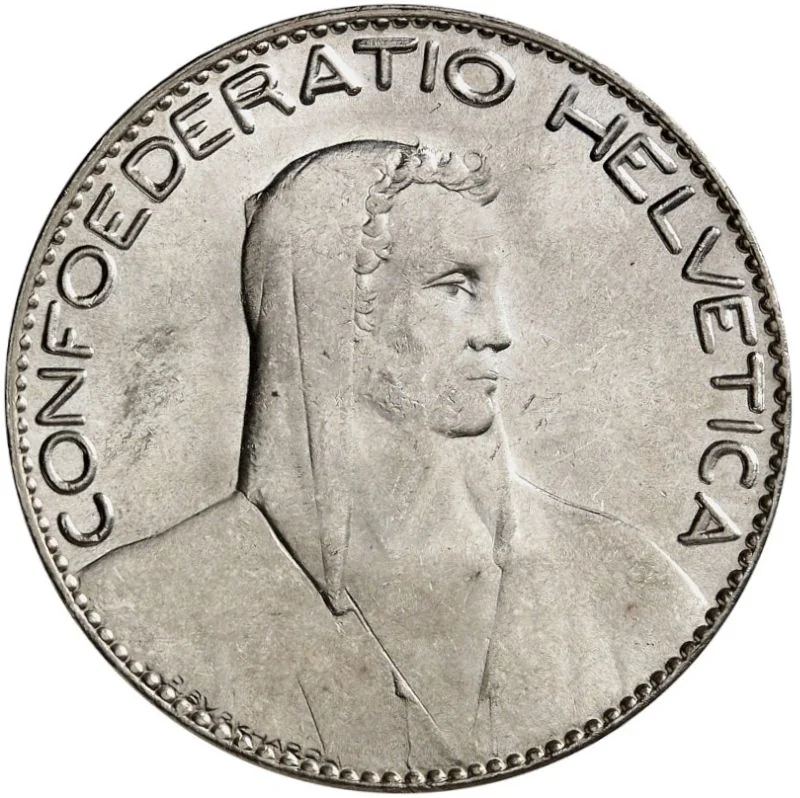
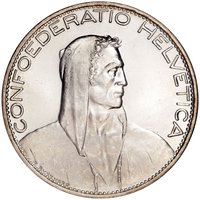
Bust of a curly-haired herdsman in a hooded shirt, facing right; commonly misidentified as William Tell.
Inscription:
CONFOEDERATIO HELVETICA
P . BVRKHARD
P . BVRKHARD
Translation:
CONFEDERATION OF SWITZERLAND
P. BURKHARD
P. BURKHARD
Script: Latin
Language: Latin
Designer: Paul Burkhard
Reverse
Description:
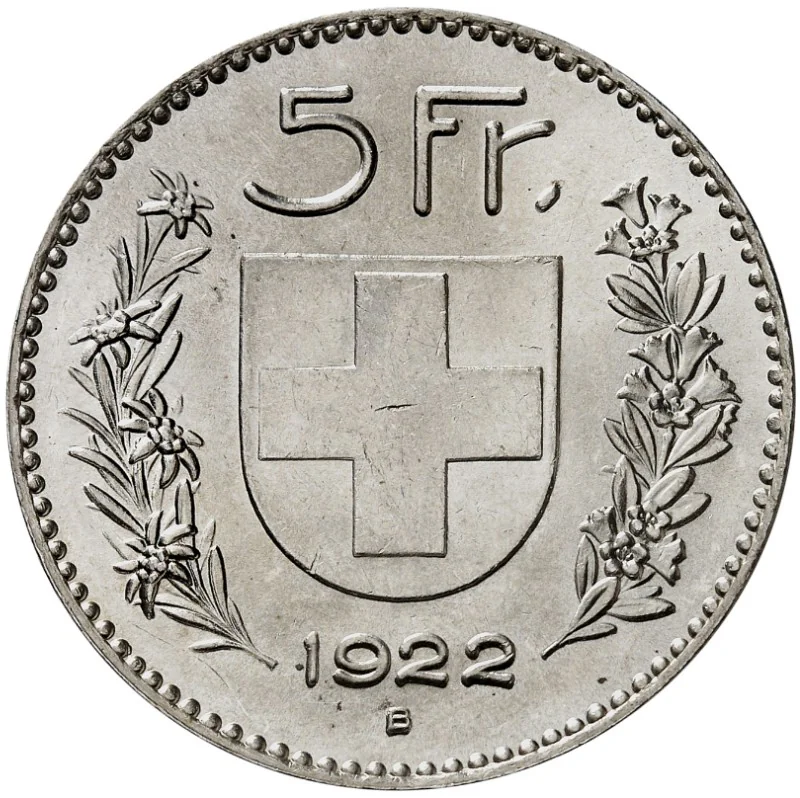
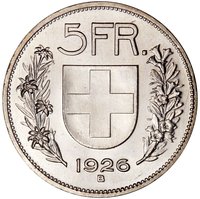
Swiss coat of arms on a square shield, with an edelweiss branch on the left and a rusty-leaved alpenrose branch on the right.
Inscription:
5 Fr.
1923
B
1923
B
Script: Latin
Designer: Paul Burkhard
Edge
Smooth with inscription in relief, including 13 stars
Legend:
DOMINUS *** | PROVIDEBIT | **********
Translation:
The Lord will provide.
Language: Latin
Categories
| Symbols> Coat of Arms |
| Symbol> Wreath |
Mints
| Name | Mark |
|---|---|
| Bern | B |
Historical background
In 1922, Switzerland’s currency situation was one of remarkable stability amidst European turmoil, a direct legacy of its unique position during the First World War. While other European nations had suspended gold convertibility and financed the war through inflation, Switzerland had maintained the gold standard, albeit with some export restrictions. This prudent policy, combined with the country's role as a safe haven for capital and its neutral, undamaged economy, meant the Swiss franc emerged from the war as a strong and trusted "hard currency." In sharp contrast to the hyperinflation beginning to ravage neighboring Germany and Austria, Switzerland experienced only moderate inflation, preserving domestic confidence in the monetary system.
The primary challenge in the early 1920s was managing this strength and the resulting capital inflows. The Swiss National Bank (SNB), established just in 1907, faced the complex task of preventing excessive appreciation of the franc, which threatened Swiss exporters. To stabilize the exchange rate and control speculative "hot money," the SNB actively intervened in foreign exchange markets and maintained low-interest rates, even as other central banks were raising theirs. This period solidified the franc's international reputation as a refuge asset, but it also created tensions between the goals of internal price stability and external exchange rate management.
By 1922, Switzerland was formally moving to reinstate a full classical gold standard, which it would achieve in 1925. The legal foundation for this was being prepared, emphasizing a return to strict monetary discipline. Thus, the currency situation was characterized by a deliberate transition from the managed stability of the war and post-war years toward a fully convertible gold-backed franc. This path stood in stark opposition to the monetary chaos unfolding across much of the continent, firmly establishing the Swiss franc's trajectory as a pillar of conservatism for the coming decades.
The primary challenge in the early 1920s was managing this strength and the resulting capital inflows. The Swiss National Bank (SNB), established just in 1907, faced the complex task of preventing excessive appreciation of the franc, which threatened Swiss exporters. To stabilize the exchange rate and control speculative "hot money," the SNB actively intervened in foreign exchange markets and maintained low-interest rates, even as other central banks were raising theirs. This period solidified the franc's international reputation as a refuge asset, but it also created tensions between the goals of internal price stability and external exchange rate management.
By 1922, Switzerland was formally moving to reinstate a full classical gold standard, which it would achieve in 1925. The legal foundation for this was being prepared, emphasizing a return to strict monetary discipline. Thus, the currency situation was characterized by a deliberate transition from the managed stability of the war and post-war years toward a fully convertible gold-backed franc. This path stood in stark opposition to the monetary chaos unfolding across much of the continent, firmly establishing the Swiss franc's trajectory as a pillar of conservatism for the coming decades.

🌱 Fairly Common