

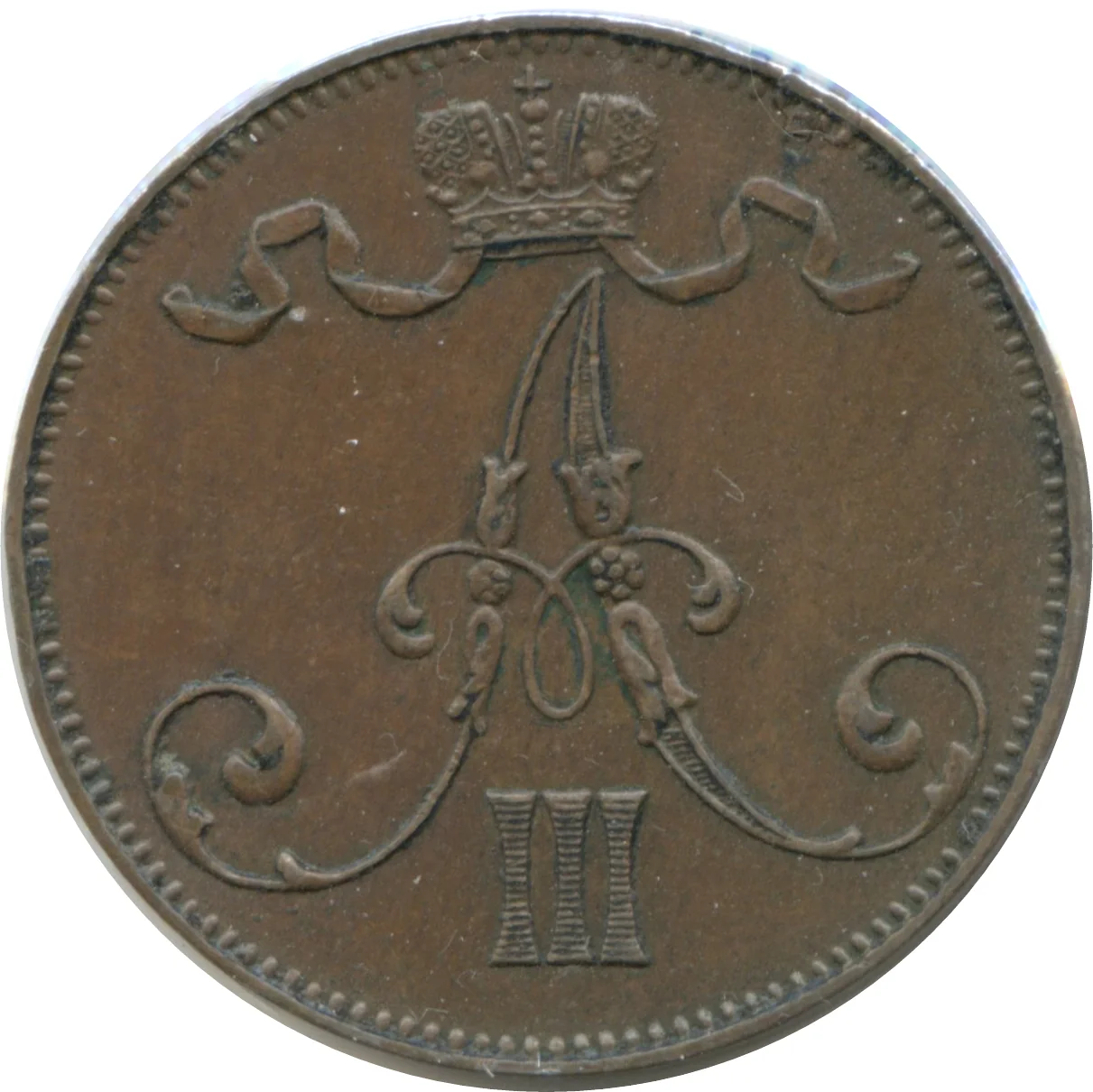
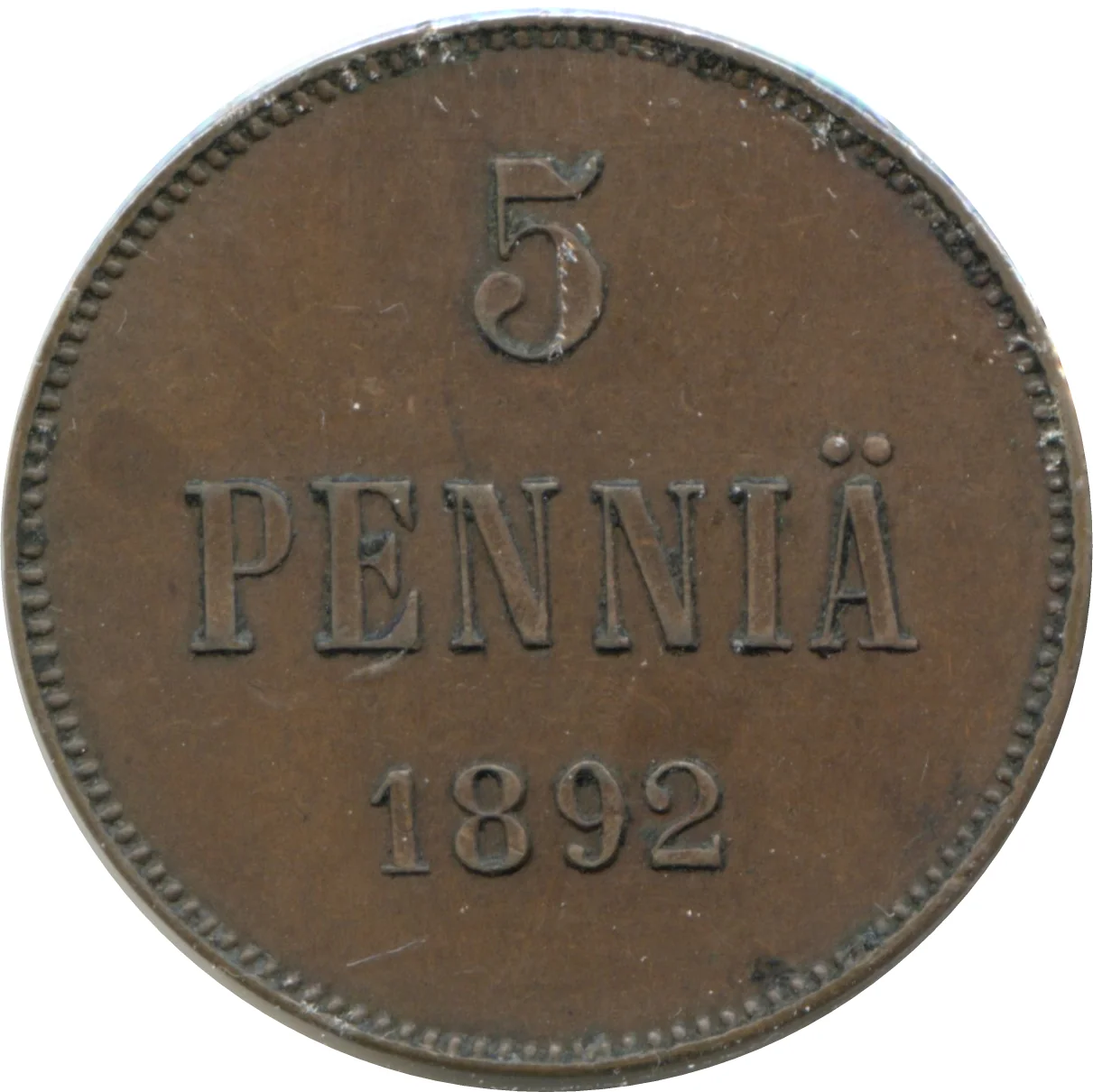
5 pennia – Finland
Add to wishlist
Finland
Context
Years: 1888–1892
Issuer: Finland
Ruler: Alexander III
Currency:
(1860—1963)
Demonetized: Yes
Total mintage: 2,000,000
Material
References
KM: #
Numista: #19851
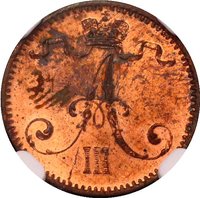
Obverse
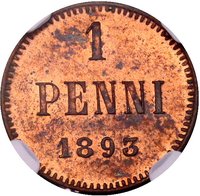
Reverse
Edge
Plain
Mints
| Name | Mark |
|---|---|
| Mint of Finland | — |
Mintings
| Year | Mint Mark | Mintage | Quality | Collection |
|---|---|---|---|---|
| 1888 | — | 600,000 | ||
| 1889 | — | 1,070,000 | ||
| 1892 | — | 330,000 |
Historical background
In 1888, Finland, as an autonomous Grand Duchy within the Russian Empire, operated under a distinct and relatively stable monetary system. The official currency was the Finnish markka (markkaa), which had been introduced in 1860 to replace the Russian ruble and assert Finland's financial autonomy. The markka was pegged to silver, adhering to the silver standard, which provided it with a fixed value in the international monetary system of the time. This stability was administered by the Bank of Finland (Suomen Pankki), founded in 1811, which held the exclusive right to issue banknotes and coins.
However, the global economic landscape was shifting. The late 19th century saw many nations, including key trading partners, moving from a silver to a gold standard. This created practical difficulties for Finland, as the value of its silver-based currency fluctuated against gold-based currencies like the Swedish krona and the German mark. These fluctuations complicated trade and finance, sparking an ongoing debate within Finnish economic and political circles. A growing consensus was forming that adopting the gold standard was necessary for modernizing the economy and ensuring long-term stability.
Consequently, 1888 was a year of deliberation and transition. The Finnish authorities were actively preparing for a major monetary reform, which would culminate just a few years later in 1891 with the official announcement of the shift to a gold-backed markka. Therefore, the currency situation in 1888 was characterized by a functioning and trusted silver-based system, but one under review and on the cusp of a significant change to align with international norms and secure the Grand Duchy's economic future.
However, the global economic landscape was shifting. The late 19th century saw many nations, including key trading partners, moving from a silver to a gold standard. This created practical difficulties for Finland, as the value of its silver-based currency fluctuated against gold-based currencies like the Swedish krona and the German mark. These fluctuations complicated trade and finance, sparking an ongoing debate within Finnish economic and political circles. A growing consensus was forming that adopting the gold standard was necessary for modernizing the economy and ensuring long-term stability.
Consequently, 1888 was a year of deliberation and transition. The Finnish authorities were actively preparing for a major monetary reform, which would culminate just a few years later in 1891 with the official announcement of the shift to a gold-backed markka. Therefore, the currency situation in 1888 was characterized by a functioning and trusted silver-based system, but one under review and on the cusp of a significant change to align with international norms and secure the Grand Duchy's economic future.
🌱 Common