

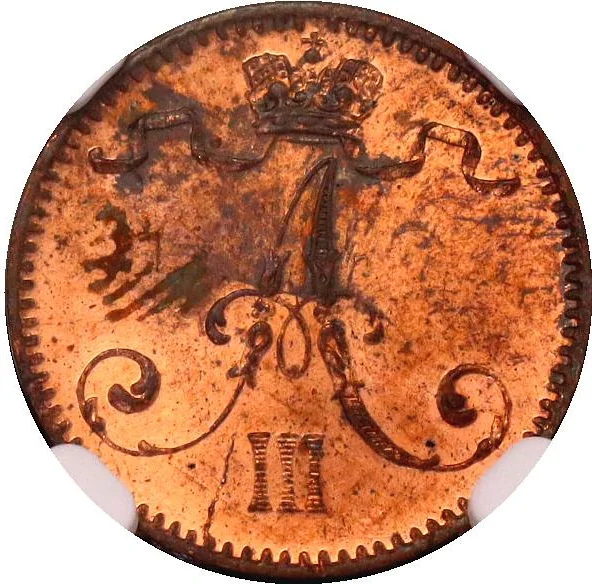
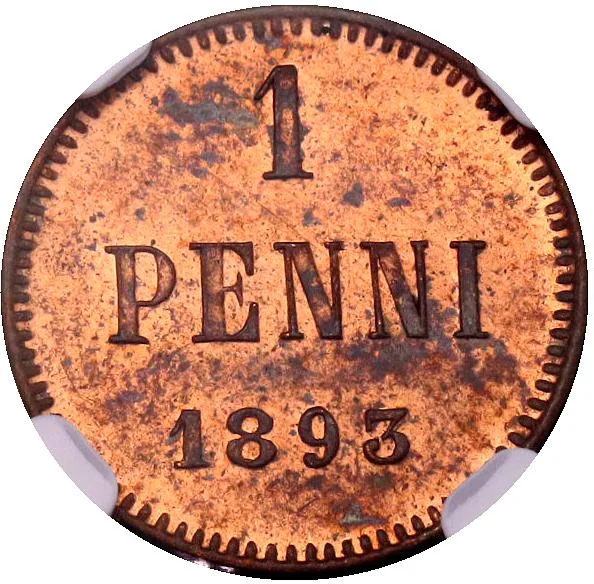
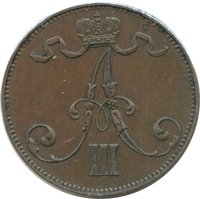
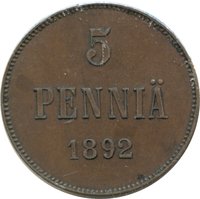
1 penni – Finland
Add to wishlist
Finland
Context
Years: 1881–1894
Issuer: Finland
Ruler: Alexander III
Currency:
(1860—1963)
Demonetized: Yes
Total mintage: 13,912,000
Material
References
KM: #
Numista: #21952
Mints
| Name | Mark |
|---|---|
| Mint of Finland | — |
Mintings
| Year | Mint Mark | Mintage | Quality | Collection |
|---|---|---|---|---|
| 1881 | — | 600,000 | ||
| 1882 | — | 100,000 | ||
| 1883 | — | 3,900,000 | ||
| 1884 | — | 404,000 | ||
| 1888 | — | 2,290,000 | ||
| 1891 | — | 1,008,000 | ||
| 1892 | — | 1,510,000 | ||
| 1893 | — | 2,290,000 | ||
| 1894 | — | 1,810,000 |
Historical background
In 1881, Finland, as an autonomous Grand Duchy within the Russian Empire, operated under a distinct monetary system that reflected its unique political status. The official currency was the Finnish markka (or mark), which had been introduced in 1860 to replace the Russian ruble and solidify Finland's economic separateness. The Bank of Finland, founded in 1811, issued these notes and coins, which bore Finnish symbols and inscriptions, asserting a clear national identity despite imperial rule.
The currency was on a silver standard, with the markka's value defined by a specific quantity of silver. This placed Finland within the broader European monetary context of the time, prior to the widespread shift to the gold standard. The system was generally stable, facilitating growing trade and industrialization within the Grand Duchy. However, Finland's monetary policy was not fully independent; it was subtly influenced by Russian financial interests and the value of the ruble, creating an underlying tension between autonomy and imperial integration.
Economically, the 1880s were a period of expansion for Finland, with a booming forestry and paper industry driving exports. The stable markka supported this growth. Nevertheless, the global move toward the gold standard was looming, and within a few years, Finland would follow suit, formally adopting the gold standard in 1877-1878, which was fully operational and defining the markka's value by 1881. Thus, the currency situation in 1881 was one of consolidated national identity, metallic stability, and poised on the cusp of the modern financial era, all within the complex framework of Russian sovereignty.
The currency was on a silver standard, with the markka's value defined by a specific quantity of silver. This placed Finland within the broader European monetary context of the time, prior to the widespread shift to the gold standard. The system was generally stable, facilitating growing trade and industrialization within the Grand Duchy. However, Finland's monetary policy was not fully independent; it was subtly influenced by Russian financial interests and the value of the ruble, creating an underlying tension between autonomy and imperial integration.
Economically, the 1880s were a period of expansion for Finland, with a booming forestry and paper industry driving exports. The stable markka supported this growth. Nevertheless, the global move toward the gold standard was looming, and within a few years, Finland would follow suit, formally adopting the gold standard in 1877-1878, which was fully operational and defining the markka's value by 1881. Thus, the currency situation in 1881 was one of consolidated national identity, metallic stability, and poised on the cusp of the modern financial era, all within the complex framework of Russian sovereignty.
🌱 Common