

¼ farthing – Ceylon
Add to wishlist
Sri Lanka
Obverse
Description:
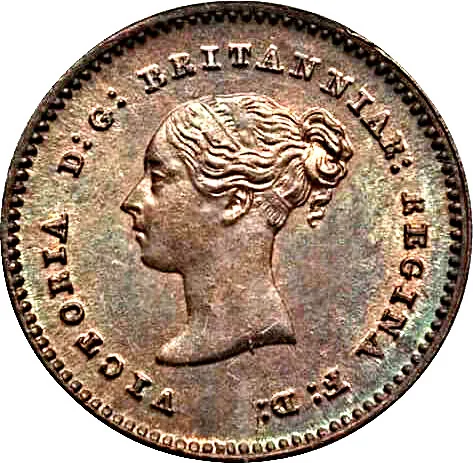
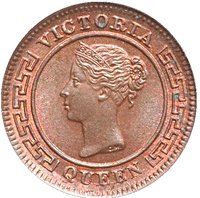
Queen Victoria's first portrait ("Young Head"), left-facing, encircled by legend.
Inscription:
VICTORIA D:G: BRITANNIAR: REGINA F:D:
Translation:
Victoria by the Grace of God, Queen of the Britains, Defender of the Faith.
Script: Latin
Language: Latin
Engraver: William Wyon
Reverse
Description:
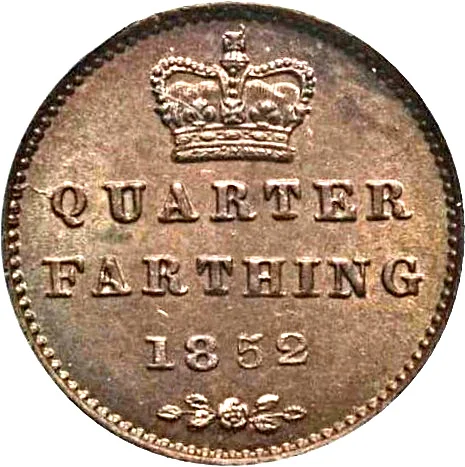
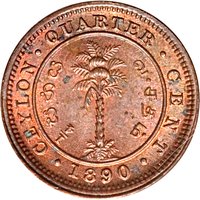
Crowned denomination between lines, date below, national flowers in exergue.
Inscription:
QUARTER
FARTHING
1852
FARTHING
1852
Script: Latin
Engraver: William Wyon
Edge
Plain
Mints
| Name | Mark |
|---|---|
| Royal Mint (Tower Hill) | — |
Mintings
| Year | Mint Mark | Mintage | Quality | Collection |
|---|---|---|---|---|
| 1839 | — | 3,840,000 | ||
| 1839 | — | — | Proof | |
| 1851 | — | 2,215,680 | ||
| 1851 | — | — | Proof | |
| 1852 | — | — | ||
| 1853 | — | — | ||
| 1853 | — | — | Proof |
Historical background
In 1839, the currency situation in Ceylon (present-day Sri Lanka) was a complex and problematic colonial monetary system, characterised by a severe shortage of specie (coin) and a confusing multiplicity of currencies. The island’s economy operated on a de facto sterling standard following the British takeover in 1815, but the official money in circulation was a chaotic mix. British gold and silver coins, Indian rupees, fanams (a local silver coin), and Dutch rix-dollars from the previous colonial era all circulated simultaneously, with their values fluctuating against one another and against the official sterling accounting unit. This multiplicity hindered trade and governance, creating uncertainty and facilitating fraud.
The core of the crisis was a chronic lack of British coinage, as silver sterling was not imported in sufficient quantities to meet the colony's needs. To fill the void, the colonial government was forced to recognise and utilise the existing heterogeneous currency, particularly the Indian silver rupee, which became the dominant medium for everyday transactions. This created an awkward duality: while government accounts were kept in pounds, shillings, and pence, most actual revenue was collected and salaries were paid in rupees, necessitating complex and often arbitrary conversion rates. The instability was exacerbated by the global depreciation of silver against gold, which further distorted the fixed conversion rates set by the authorities.
Consequently, by 1839, the system was widely recognised as dysfunctional, imposing a significant drag on economic activity and colonial administration. Pressure from merchants and government officials for reform was mounting, setting the stage for a major currency overhaul. This would culminate just a few years later, in 1844, with the closure of the Colombo Mint and the demonetisation of the old silver currencies, finally establishing a unified rupee currency tied firmly to the sterling standard.
The core of the crisis was a chronic lack of British coinage, as silver sterling was not imported in sufficient quantities to meet the colony's needs. To fill the void, the colonial government was forced to recognise and utilise the existing heterogeneous currency, particularly the Indian silver rupee, which became the dominant medium for everyday transactions. This created an awkward duality: while government accounts were kept in pounds, shillings, and pence, most actual revenue was collected and salaries were paid in rupees, necessitating complex and often arbitrary conversion rates. The instability was exacerbated by the global depreciation of silver against gold, which further distorted the fixed conversion rates set by the authorities.
Consequently, by 1839, the system was widely recognised as dysfunctional, imposing a significant drag on economic activity and colonial administration. Pressure from merchants and government officials for reform was mounting, setting the stage for a major currency overhaul. This would culminate just a few years later, in 1844, with the closure of the Colombo Mint and the demonetisation of the old silver currencies, finally establishing a unified rupee currency tied firmly to the sterling standard.
🌟 Limited