

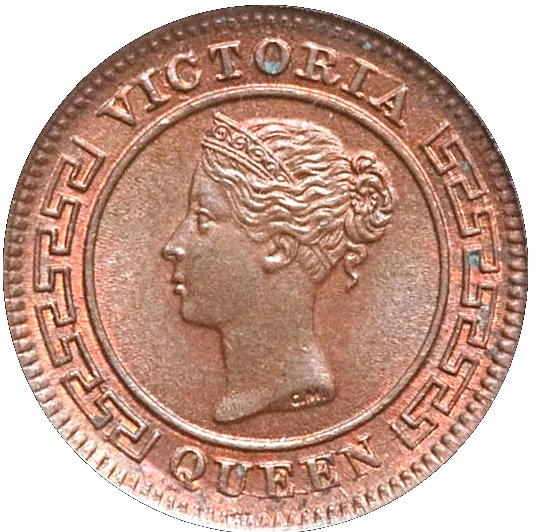
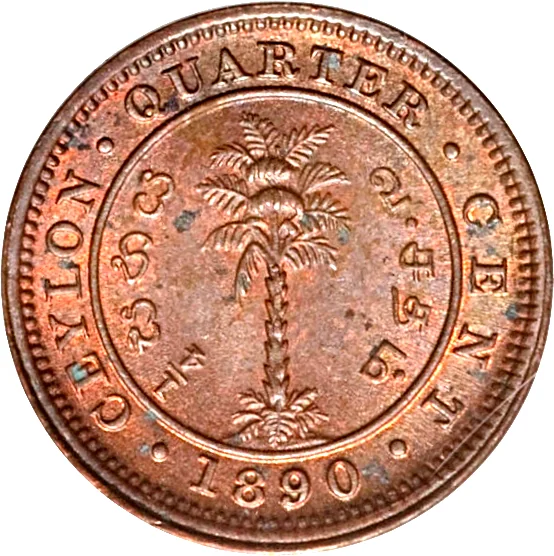
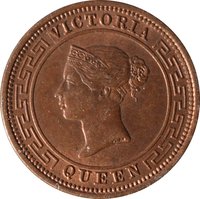
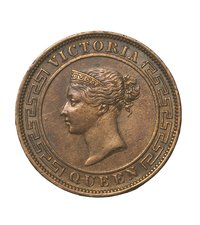
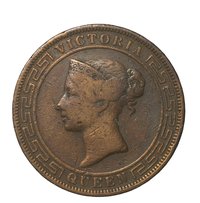
Obverse
Description:
Crowned left-facing bust.
Inscription:
VICTORIA
QUEEN
QUEEN
Script: Latin
Engraver: Leonard Charles Wyon
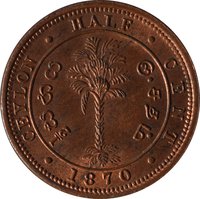
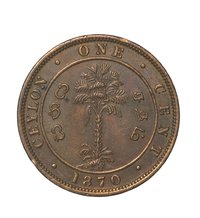
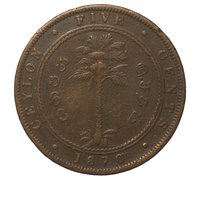
Reverse
Edge
Plain
Mints
| Name | Mark |
|---|---|
| Kolkata / Calcutta / Murshidabad | — |
Mintings
| Year | Mint Mark | Mintage | Quality | Collection |
|---|---|---|---|---|
| 1870 | — | 200,000 | ||
| 1870 | — | — | Proof | |
| 1890 | — | 200,000 | ||
| 1890 | — | — | Proof | |
| 1891 | — | — | Proof | |
| 1892 | — | — | Proof | |
| 1898 | — | — | Proof | |
| 1898 | — | 160,000 | ||
| 1901 | — | — | Proof | |
| 1901 | — | 216,000 |
Historical background
In 1870, Ceylon's currency system was in a state of complex transition, firmly embedded within the British colonial economic framework. The island operated on a sterling exchange standard, with the British pound serving as the official unit of account. However, the physical currency in daily circulation was a heterogeneous mix, predominantly featuring Indian silver rupees, along with British gold sovereigns and silver coins. This created a practical disconnect, as government accounts and large transactions were reckoned in pounds, shillings, and pence, while the rupee remained the common medium for trade and wages, leading to frequent calculations and exchange inconveniences.
The period was marked by a significant and persistent depreciation of silver against gold, which directly affected Ceylon due to its reliance on silver rupee coinage. As the rupee's value in sterling fell, it caused considerable fiscal strain for the colonial government, which had sterling-denominated obligations (like payments to the British Crown and foreign debt) but collected a large portion of its revenue in silver rupees. This exchange loss became a chronic budgetary concern, prompting debates about monetary reform. Furthermore, the shortage of small change was a perennial issue, often alleviated by the circulation of cut Spanish and Mexican dollars and various copper coins, highlighting the system's lack of uniformity.
Consequently, by 1870, there was growing pressure from the mercantile community and colonial administrators for a currency reform to simplify transactions and stabilize government finances. The situation set the stage for the major monetary change that would follow in 1871, when the government introduced a decimal system with the Ceylon rupee as the sole standard unit of account and legal tender, divided into 100 cents. The 1870 landscape, therefore, represents the final year of an increasingly untenable dual system, poised on the brink of a rationalization designed to better serve the island's export-oriented plantation economy.
The period was marked by a significant and persistent depreciation of silver against gold, which directly affected Ceylon due to its reliance on silver rupee coinage. As the rupee's value in sterling fell, it caused considerable fiscal strain for the colonial government, which had sterling-denominated obligations (like payments to the British Crown and foreign debt) but collected a large portion of its revenue in silver rupees. This exchange loss became a chronic budgetary concern, prompting debates about monetary reform. Furthermore, the shortage of small change was a perennial issue, often alleviated by the circulation of cut Spanish and Mexican dollars and various copper coins, highlighting the system's lack of uniformity.
Consequently, by 1870, there was growing pressure from the mercantile community and colonial administrators for a currency reform to simplify transactions and stabilize government finances. The situation set the stage for the major monetary change that would follow in 1871, when the government introduced a decimal system with the Ceylon rupee as the sole standard unit of account and legal tender, divided into 100 cents. The 1870 landscape, therefore, represents the final year of an increasingly untenable dual system, poised on the brink of a rationalization designed to better serve the island's export-oriented plantation economy.
Series: 1870 Ceylon circulation coins
🌱 Common