

2 Euro – Belgium
Circulating commemorative coins
Commemoration: 100th International Women's Day
Belgium

Obverse
Description:
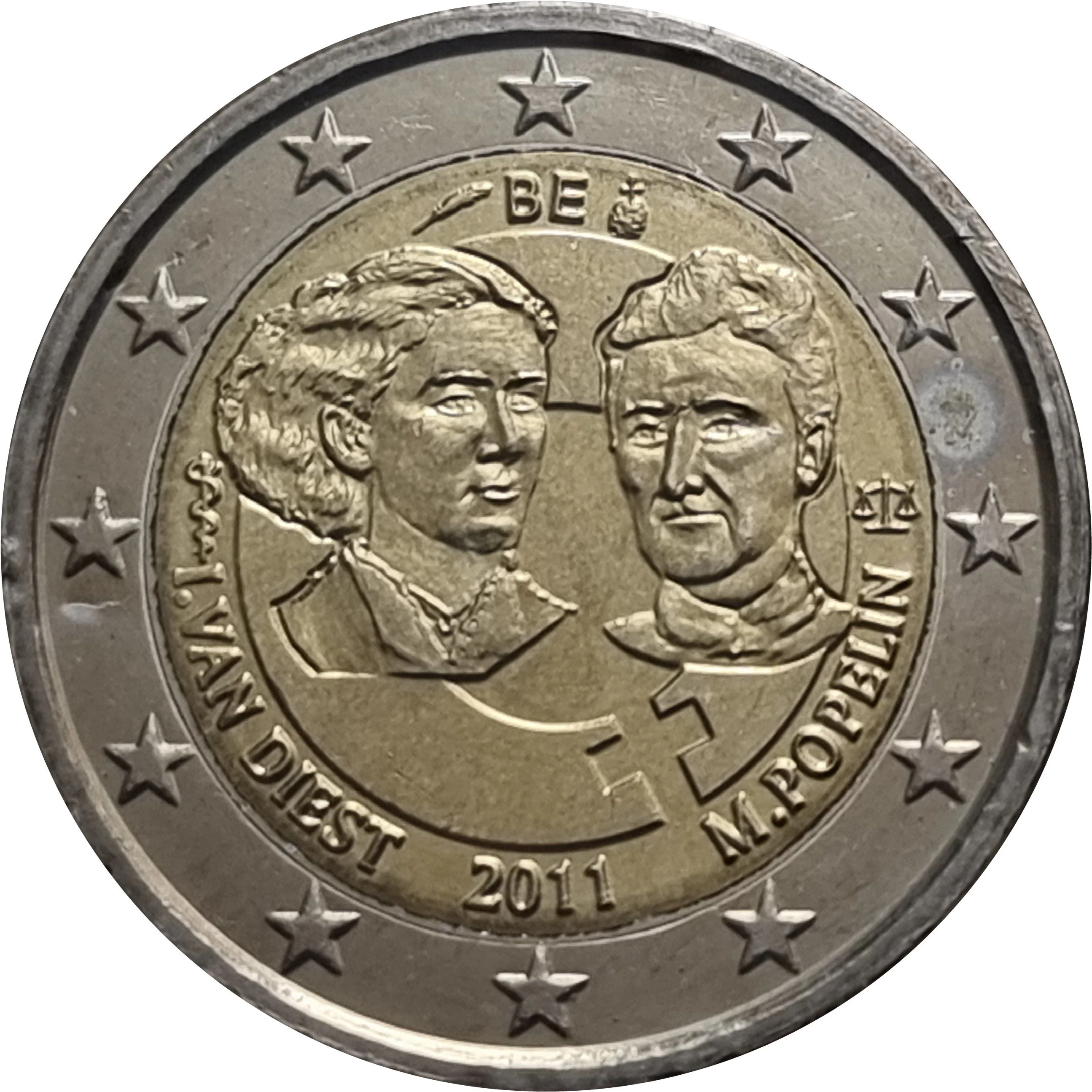
The inner part features effigies of Isala Van Diest and Marie Popelin, Belgium's first female doctor and lawyer, above their names and professional symbols. "BE" is centered above, flanked by the Mint master's mark and mintmark. The outer ring displays the 12 stars of the European Union.
Inscription:
BE
I.VAN DIEST
2011
M.POPELIN
I.VAN DIEST
2011
M.POPELIN
Translation:
I. VAN DIEST
2011
M. POPELIN
2011
M. POPELIN
Script: Latin
Engraver: Luc Luycx
Reverse
Edge
Legend:
2 ** 2 ** 2 ** 2 ** 2 ** 2 **
Mints
| Name | Mark |
|---|---|
| Royal Mint of Belgium | — |
Mintings
| Year | Mint Mark | Mintage | Quality | Collection |
|---|---|---|---|---|
| 2011 | — | 5,000,000 | ||
| 2011 | — | 6,000 | BU | |
| 2011 | — | 7,500 | Proof |
Historical background
In 2011, Belgium's currency situation was defined by its membership in the Eurozone, having adopted the euro as its official currency in 2002. The country was therefore fully integrated into the monetary policy framework of the European Central Bank (ECB), which set interest rates and managed the euro's value. This provided Belgium with stability and eliminated exchange rate risks within the single currency area, but it also meant the national government had no independent monetary tools to address its specific economic challenges.
The primary financial context for Belgium in 2011 was not a currency crisis per se, but a severe sovereign debt crisis within the Eurozone, coupled with a prolonged domestic political stalemate. Following the global financial crisis, Belgium's high public debt (around 100% of GDP) came under scrutiny from international markets. This pressure was dramatically amplified by the country's record-breaking 541 days without a formal government, which created deep uncertainty about its ability to implement fiscal consolidation and reforms.
Consequently, while the euro itself remained stable in Belgium, the country faced rising borrowing costs as bond yields spiked in late 2011, reflecting investor fears of contagion from the wider Eurozone debt crisis. The situation culminated in November 2011 when the credit rating agency Standard & Poor's downgraded Belgium's sovereign rating. This period underscored the dual vulnerability of being in the Eurozone: shielded from currency shocks but exposed to market pressure on sovereign debt without the full autonomy to devalue a national currency.
The primary financial context for Belgium in 2011 was not a currency crisis per se, but a severe sovereign debt crisis within the Eurozone, coupled with a prolonged domestic political stalemate. Following the global financial crisis, Belgium's high public debt (around 100% of GDP) came under scrutiny from international markets. This pressure was dramatically amplified by the country's record-breaking 541 days without a formal government, which created deep uncertainty about its ability to implement fiscal consolidation and reforms.
Consequently, while the euro itself remained stable in Belgium, the country faced rising borrowing costs as bond yields spiked in late 2011, reflecting investor fears of contagion from the wider Eurozone debt crisis. The situation culminated in November 2011 when the credit rating agency Standard & Poor's downgraded Belgium's sovereign rating. This period underscored the dual vulnerability of being in the Eurozone: shielded from currency shocks but exposed to market pressure on sovereign debt without the full autonomy to devalue a national currency.
Series: Belgium 2 euro commemoratives
🌱 Very Common