

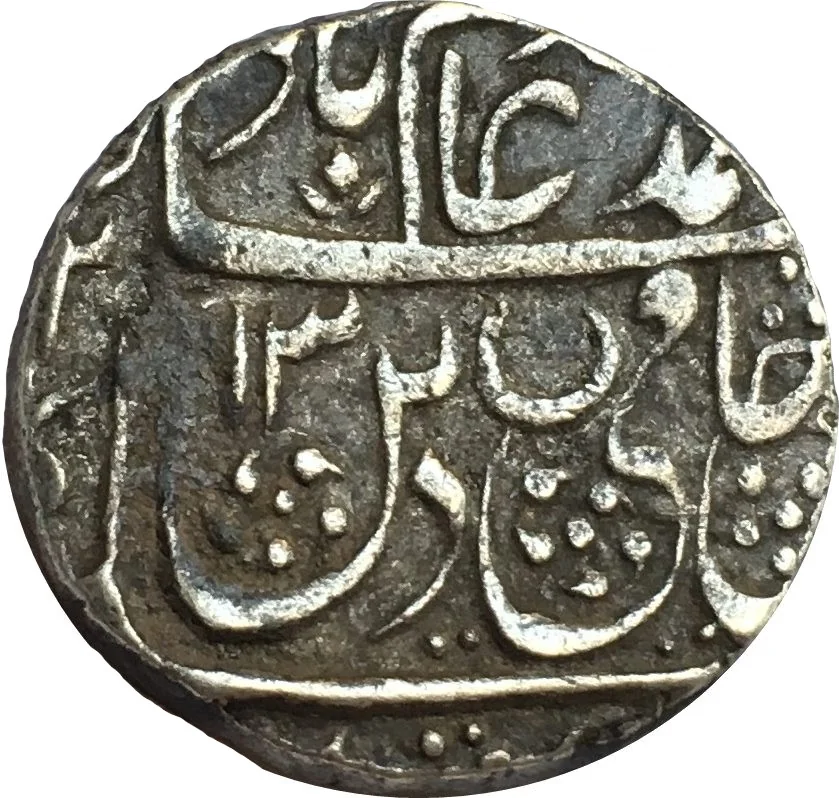
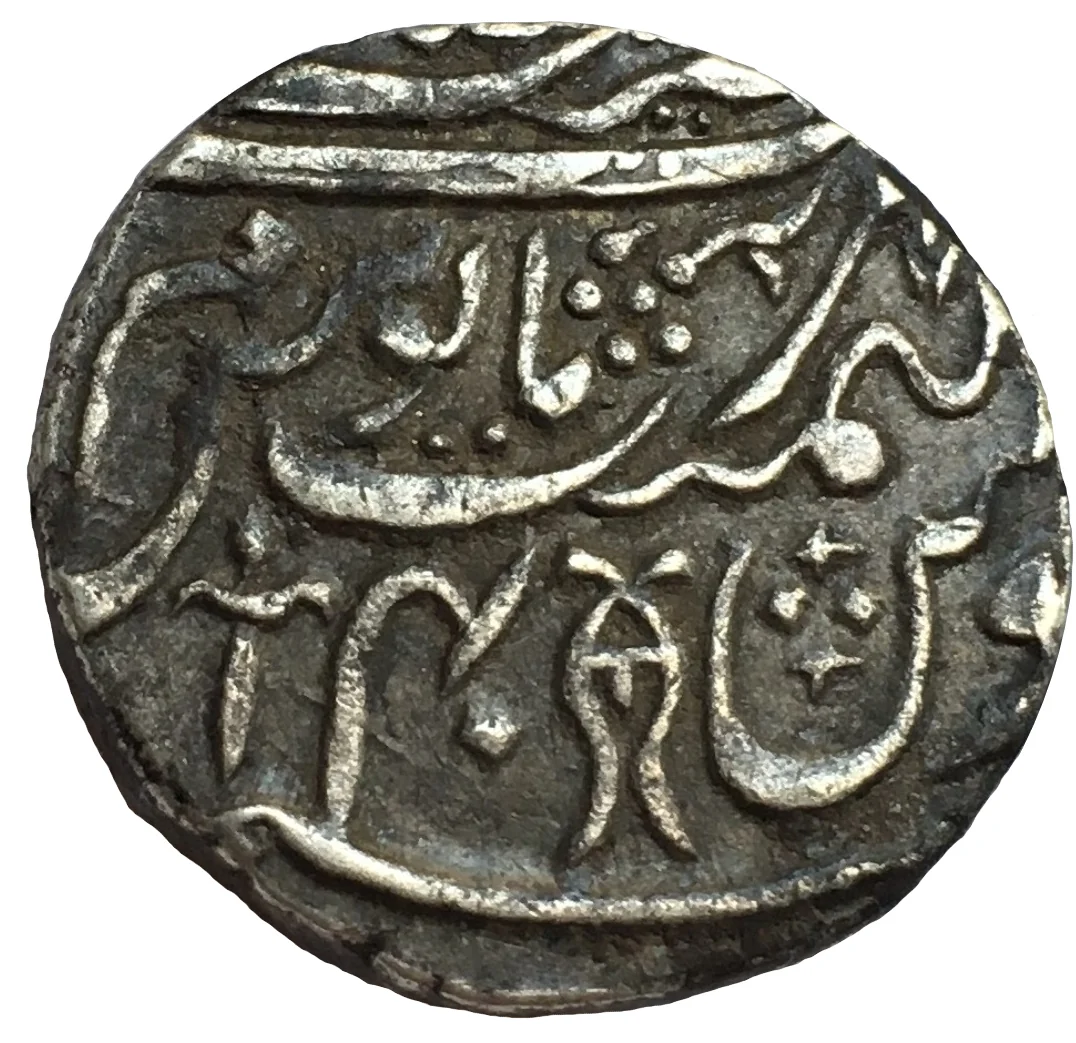
1 rupee – Awadh
Add to wishlist
India
Context
Years: 1800–1802
Country: India
Issuer: Awadh
Ruler: Shah Alam II
Currency:
(1605—1857)
Demonetized: Yes
Material
References
KM: #
Numista: #108320
Value
Bullion value: $28.14
Obverse
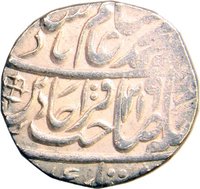
Description:
Inscription, date.
Inscription:
Shah Alam II
Reverse
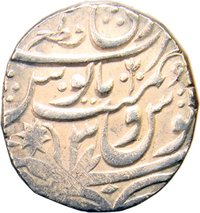
Description:
Persian "Mim": word, bud, fish.
Edge
Mintings
| Year | Mint Mark | Mintage | Quality | Collection |
|---|---|---|---|---|
| 1800 | — | — | ||
| 1801 | — | — | ||
| 1802 | — | — |
Historical background
In the late 18th and early 19th centuries, the currency situation in Awadh was characterized by significant complexity and debasement. The Nawabs of Awadh, while nominally subordinate to the Mughal Emperor in Delhi, exercised considerable autonomy, including the right to mint their own coins. The primary circulating currencies were the Awadh rupee and the Mohur (gold coin), but the region was also flooded with a multitude of other coins from neighbouring powers like the Marathas, the declining Mughal Empire, and the increasingly influential British East India Company, leading to a chaotic monetary environment.
This period saw a steady financial decline, exacerbated by the heavy tributes (subsidy) extracted from the Nawabs by the Company after the Treaty of Allahabad (1765). To meet these demands and fund courtly extravagance, successive Nawabs, particularly Asaf-ud-Daula (1775-1797), resorted to systematic currency debasement. The silver content of the Awadh rupee was repeatedly reduced, and minting rights were often farmed out to revenue officials, who further profited by issuing inferior coins. This eroded public trust in the currency, disrupted trade, and caused price inflation, harming the local economy.
By 1800, under Nawab Saadat Ali Khan II, the monetary system was in a precarious state. While attempts at reform were made, the fundamental pressure of the British subsidy and political interference continued. The Company’s own silver rupees, notably the Sicca Rupee, were gaining prominence as a more reliable standard, foreshadowing the eventual takeover of Awadh's financial and political sovereignty. Thus, the currency crisis was both a symptom and a cause of Awadh’s weakening sovereignty, mirroring its path to annexation in 1856.
This period saw a steady financial decline, exacerbated by the heavy tributes (subsidy) extracted from the Nawabs by the Company after the Treaty of Allahabad (1765). To meet these demands and fund courtly extravagance, successive Nawabs, particularly Asaf-ud-Daula (1775-1797), resorted to systematic currency debasement. The silver content of the Awadh rupee was repeatedly reduced, and minting rights were often farmed out to revenue officials, who further profited by issuing inferior coins. This eroded public trust in the currency, disrupted trade, and caused price inflation, harming the local economy.
By 1800, under Nawab Saadat Ali Khan II, the monetary system was in a precarious state. While attempts at reform were made, the fundamental pressure of the British subsidy and political interference continued. The Company’s own silver rupees, notably the Sicca Rupee, were gaining prominence as a more reliable standard, foreshadowing the eventual takeover of Awadh's financial and political sovereignty. Thus, the currency crisis was both a symptom and a cause of Awadh’s weakening sovereignty, mirroring its path to annexation in 1856.
✨ Legendary