

1 rupee – Awadh
Add to wishlist
India
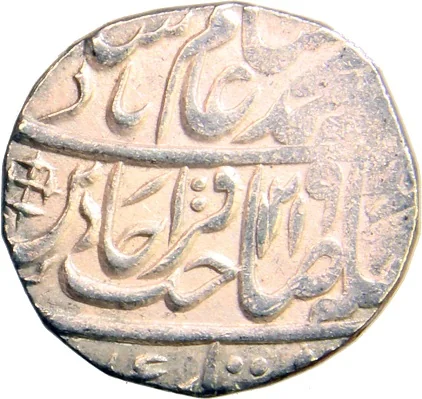
Obverse
Description:
Inscription, date, and Solomon’s cross mint mark above line.
Inscription:
AH 1219
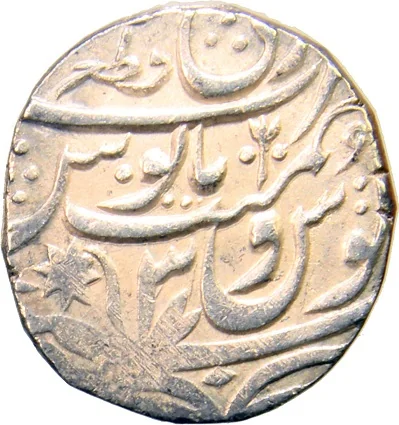
Reverse
Description:
Fish, starflower, Persian "Wa."
Inscription:
RY 37
Edge
Plain
Mints
| Name | Mark |
|---|---|
| Bareli | — |
Mintings
| Year | Mint Mark | Mintage | Quality | Collection |
|---|---|---|---|---|
| 1802 | — | — | ||
| 1803 | — | — | ||
| 1804 | — | — | ||
| 1805 | — | — | ||
| 1806 | — | — |
Historical background
In 1802, the currency situation in Awadh was characterized by significant instability and complexity, a direct result of both internal mismanagement and the growing political and financial influence of the British East India Company. The Nawab, Saadat Ali Khan II, ruled a state that was financially strained due to the enormous annual subsidy paid to the Company under the 1801 Treaty of Lucknow. This drain on the treasury led to chronic revenue shortfalls, which the Nawab attempted to address through the debasement of the coinage. The standard silver rupee, the foundation of the economy, saw its purity and weight frequently altered, leading to a proliferation of varied and suspect coins in circulation.
The monetary landscape was a confusing patchwork. Alongside the official Awadh rupee, older Mughal-era coins, regional issues from neighboring states, and Company rupees all circulated simultaneously, with fluctuating exchange rates. This multiplicity created a thriving business for money-changers (sarrafs) but caused severe hardship for peasants, soldiers, and merchants, who faced uncertainty in the real value of their payments and savings. The lack of a uniform, trusted currency stifled trade and commerce, as transactions required complex negotiations over the intrinsic metallic value of each coin rather than a simple acceptance of its face value.
This chaotic financial environment was a key instrument of British political control. The Company, through its Resident, increasingly intervened in Awadh's fiscal affairs, using the currency crisis as evidence of the Nawab's incapacity. The instability provided a pretext for further demands and supervision, steadily eroding sovereignty. Thus, by 1802, the currency situation was not merely an economic issue but a symptom of Awadh's deepening dependency, with monetary disorder accelerating the kingdom's descent into the status of a financially crippled protectorate.
The monetary landscape was a confusing patchwork. Alongside the official Awadh rupee, older Mughal-era coins, regional issues from neighboring states, and Company rupees all circulated simultaneously, with fluctuating exchange rates. This multiplicity created a thriving business for money-changers (sarrafs) but caused severe hardship for peasants, soldiers, and merchants, who faced uncertainty in the real value of their payments and savings. The lack of a uniform, trusted currency stifled trade and commerce, as transactions required complex negotiations over the intrinsic metallic value of each coin rather than a simple acceptance of its face value.
This chaotic financial environment was a key instrument of British political control. The Company, through its Resident, increasingly intervened in Awadh's fiscal affairs, using the currency crisis as evidence of the Nawab's incapacity. The instability provided a pretext for further demands and supervision, steadily eroding sovereignty. Thus, by 1802, the currency situation was not merely an economic issue but a symptom of Awadh's deepening dependency, with monetary disorder accelerating the kingdom's descent into the status of a financially crippled protectorate.
💎 Extremely Rare