

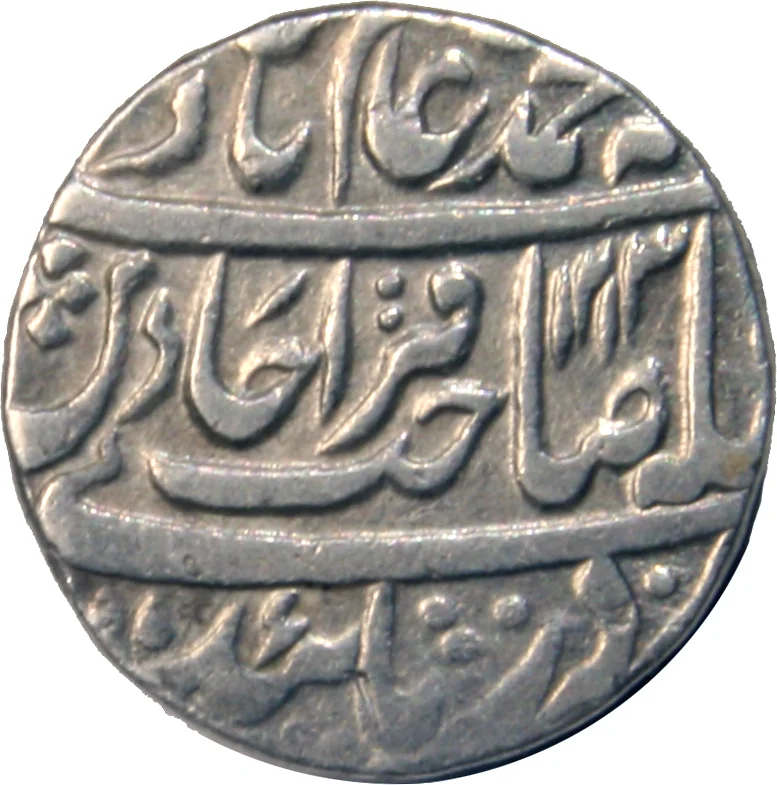
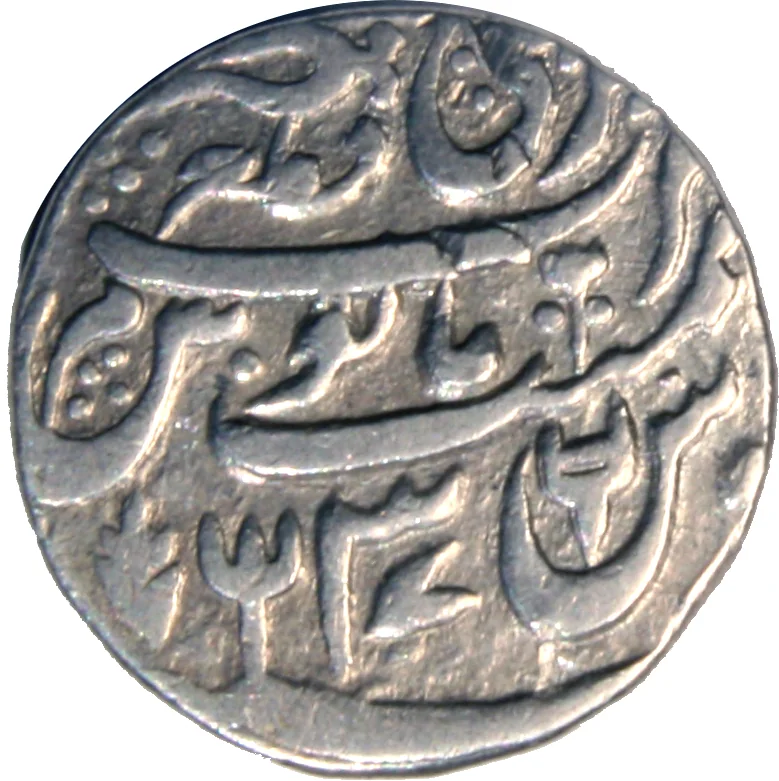
1 rupee – Awadh
Add to wishlist
India
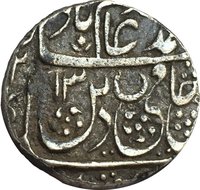
Obverse
Description:
AH, Ruler's Name
Inscription:
Shah Alam II
۱۲۱۳
۱۲۱۳
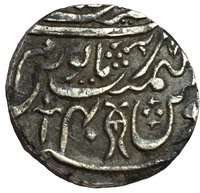
Reverse
Description:
RY dates feature Fish, Trident, Dagger, and sometimes Flower mint marks.
Inscription:
۳۷
Script: Urdu
Edge
Plain
Mints
| Name | Mark |
|---|---|
| Bareli | — |
Mintings
| Year | Mint Mark | Mintage | Quality | Collection |
|---|---|---|---|---|
| 1799 | — | — | ||
| 1800 | — | — | ||
| 1801 | — | — |
Historical background
In 1799, the currency situation in Awadh was a complex and deteriorating system, reflecting the broader political and economic decline of the nawabi under the rule of Wazir Ali Shah and his successor, Saadat Ali Khan II (who was installed by the British in January 1798). The princely state, though still nominally independent, was deeply entangled in the Subsidiary Alliance system, which drained its treasury to pay for a British-led garrison. This financial strain directly impacted the currency, leading to chronic shortages of specie (coin) and a proliferation of debased and counterfeit coins circulating alongside Mughal-era rupees.
The monetary system was not unified, operating on a dual basis of both sicca (newly minted) and sanat (older) rupees, with varying valuations. The Nawab's mint in Lucknow struggled with credibility, as successive rulers, desperate for revenue, often engaged in practices like tankhwah (assigning revenue from specific lands to creditors or officials), which further disrupted the flow of bullion to the mint. Consequently, the value of the local rupee fluctuated and typically traded at a discount compared to the more trusted Bengal Presidency rupee, complicating all trade and revenue administration.
This monetary instability was both a symptom and a cause of Awadh's weakening sovereignty. The British East India Company, increasingly the paramount power, began to insist on payments in their own stable currency, further undermining the local system. By 1799, the currency chaos was contributing to economic stagnation, eroding public trust in the Nawab's government, and creating a financial environment ripe for further British intervention to "restore order," which would ultimately pave the way for formal annexation in 1856.
The monetary system was not unified, operating on a dual basis of both sicca (newly minted) and sanat (older) rupees, with varying valuations. The Nawab's mint in Lucknow struggled with credibility, as successive rulers, desperate for revenue, often engaged in practices like tankhwah (assigning revenue from specific lands to creditors or officials), which further disrupted the flow of bullion to the mint. Consequently, the value of the local rupee fluctuated and typically traded at a discount compared to the more trusted Bengal Presidency rupee, complicating all trade and revenue administration.
This monetary instability was both a symptom and a cause of Awadh's weakening sovereignty. The British East India Company, increasingly the paramount power, began to insist on payments in their own stable currency, further undermining the local system. By 1799, the currency chaos was contributing to economic stagnation, eroding public trust in the Nawab's government, and creating a financial environment ripe for further British intervention to "restore order," which would ultimately pave the way for formal annexation in 1856.
✨ Legendary