

5 euro – Latvia
Add to wishlist
Latvia
Context
Material
Diameter: 38.61 mm
Weight: 31.47 g
Silver Weight:: 29.11 g
Shape: Round
Composition: 92.5% Silver
Standard: Silver ounce
Magnetic: No
Alignment: Medal alignment
flip
References
KM: #
Numista: #108302
Value
Exchange value: 5 EUR
Bullion value: $73.80
Inflation-adjusted value: 7.31 EUR
Obverse
Description:
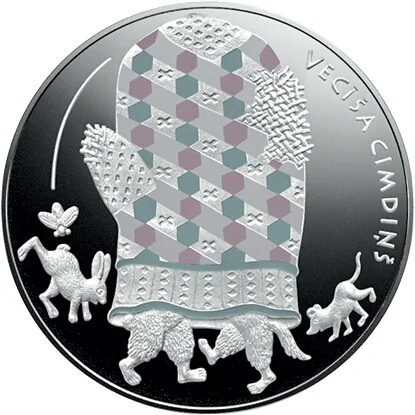
A central mitten, patterned with a bear and wolf's lower halves, is flanked by a fly and hare on the left and a mouse on the right. The inscription VECĪŠA CIMDIŅŠ curves to the right of the mitten.
Inscription:
VECĪŠA CIMDIŅŠ
Translation:
Vecā cimdiņš
Script: Latin
Language: Latvian
Engraver: Jānis Strupulis
Designer: Arvīds Priedīte
Reverse
Description:
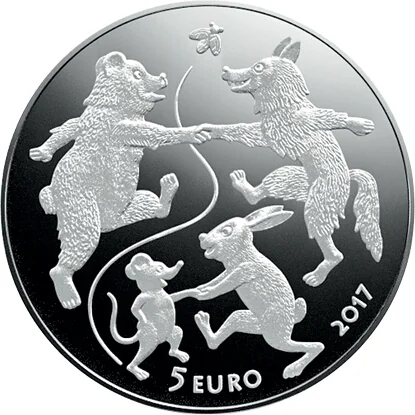
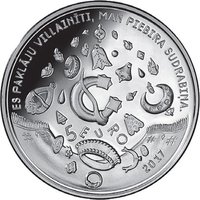
The reverse depicts a bear, wolf, mouse, and hare dancing joyfully, with a fluttering fly between them. Below are the inscriptions "5 EURO" and "2017".
Inscription:
5 EURO 2017
Script: Latin
Engraver: Jānis Strupulis
Designer: Arvīds Priedīte
Edge
Legend:
LATVIJAS BANKA ♦ LATVIJAS REPUBLIKA ♦
Mints
| Name | Mark |
|---|---|
| Lithuanian Mint | — |
Mintings
| Year | Mint Mark | Mintage | Quality | Collection |
|---|---|---|---|---|
| 2017 | — | 10,000 | Proof |
Historical background
In 2017, Latvia was in its fourth year as a member of the Eurozone, having adopted the euro on January 1, 2014. This transition from the national currency, the lats, was largely viewed as successful and had solidified the country's economic and political integration with core European institutions. By 2017, the euro was firmly established in daily use, with public support for the currency remaining relatively stable and the initial period of price-level adjustments largely complete. The macroeconomic environment was one of steady, moderate growth, with low inflation and a stable financial sector.
The primary currency-related discussions in Latvia during 2017 were not about the euro itself, but about broader financial governance and security within the monetary union. As a member of the Eurozone, Latvia's monetary policy was set by the European Central Bank (ECB), which continued its expansive quantitative easing program to stimulate the euro area economy. Domestically, attention focused on maintaining fiscal discipline to meet Eurozone stability criteria and on addressing longstanding issues within the banking sector. This was particularly salient following the 2016 liquidation of ABLV Bank, which underscored concerns about financial supervision and the sector's exposure to non-resident deposits, primarily from the former Soviet Union.
Furthermore, 2017 was a year of looking forward within the Eurozone framework. There was active Latvian participation in discussions on deepening the Economic and Monetary Union (EMU), including proposals for a European banking union and further fiscal integration. Domestically, the government's focus was on leveraging the stability of the single currency to attract investment and converge with average EU income levels, while ensuring that the national economy remained competitive within the euro area. Thus, the currency situation was characterized by operational normality, with policy debates centered on enhancing the architecture and security of the Eurozone system to which Latvia was now irrevocably tied.
The primary currency-related discussions in Latvia during 2017 were not about the euro itself, but about broader financial governance and security within the monetary union. As a member of the Eurozone, Latvia's monetary policy was set by the European Central Bank (ECB), which continued its expansive quantitative easing program to stimulate the euro area economy. Domestically, attention focused on maintaining fiscal discipline to meet Eurozone stability criteria and on addressing longstanding issues within the banking sector. This was particularly salient following the 2016 liquidation of ABLV Bank, which underscored concerns about financial supervision and the sector's exposure to non-resident deposits, primarily from the former Soviet Union.
Furthermore, 2017 was a year of looking forward within the Eurozone framework. There was active Latvian participation in discussions on deepening the Economic and Monetary Union (EMU), including proposals for a European banking union and further fiscal integration. Domestically, the government's focus was on leveraging the stability of the single currency to attract investment and converge with average EU income levels, while ensuring that the national economy remained competitive within the euro area. Thus, the currency situation was characterized by operational normality, with policy debates centered on enhancing the architecture and security of the Eurozone system to which Latvia was now irrevocably tied.
💎 Very Rare