

1 shu – Japan
Add to wishlist
Japan
Material
Weight: 1.87 g
Silver Weight:: 1.81 g
Thickness: 1.5 mm
Shape: Irregular rectangular
Composition: 96.8% Silver
Magnetic: No
Techniques: Hammered, Countermarked
Alignment: Medal alignment
flip
References
Numista: #10811
Value
Bullion value: $4.63
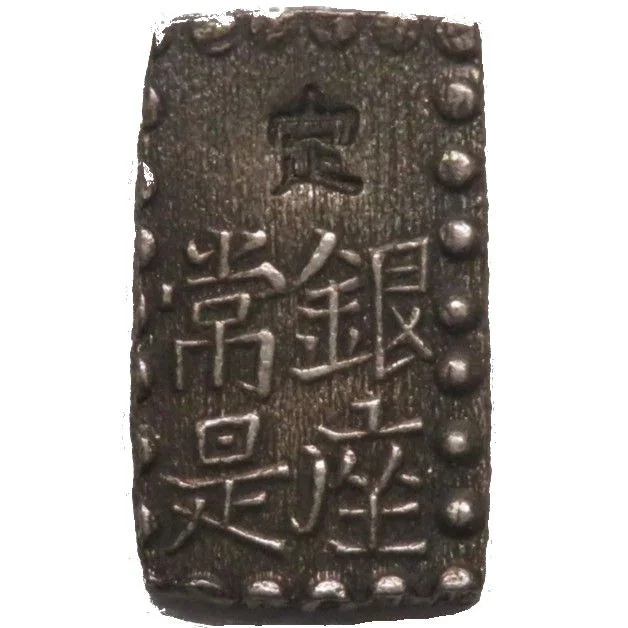
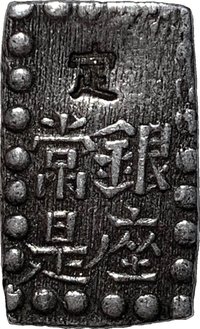
Obverse
Description:
定 incuse stamp over 4 characters in pearl border
Inscription:
定
常銀
是座
常銀
是座
Translation:
Fixed Standard Silver;
This is the seat.
This is the seat.
Scripts: Chinese (traditional, regular script)
Language: Classical Chinese
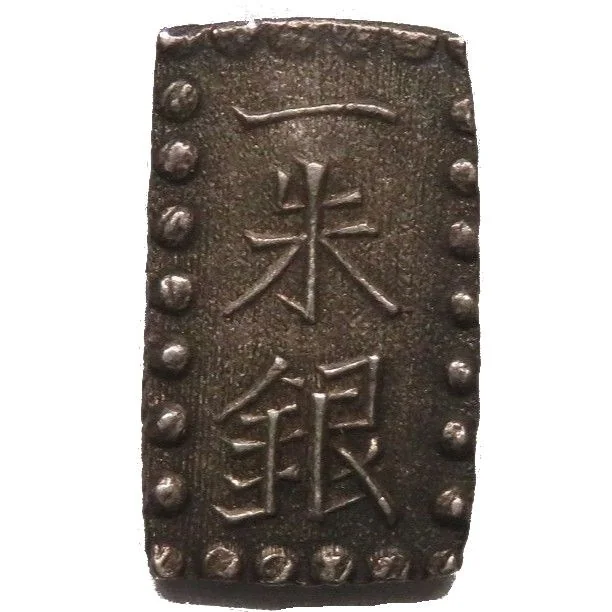
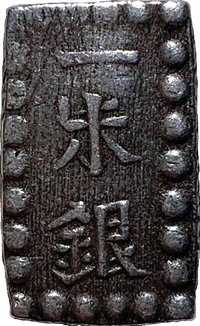
Reverse
Description:
Denomination: 3 vertical characters in pearl border.
Inscription:
一
朱
銀
朱
銀
Translation:
One Zhu Silver
Scripts: Chinese (traditional, regular script)
Language: Chinese
Edge
Vertical reeding on short sidesSlanted reeding on long sides
Mints
| Name | Mark |
|---|---|
| Ginza, Edo | — |
Mintings
| Year | Mint Mark | Mintage | Quality | Collection |
|---|---|---|---|---|
| — | — | — | ||
| — | — | — | Proof |
Historical background
In 1853, Japan's currency system was a complex and fragmented relic of the Tokugawa shogunate's decentralized feudal structure. The primary units were gold koban and ryō, silver chōgin (oval-shaped ingots) and monme, and copper zeni coins, each circulating with distinct, non-decimal exchange rates that fluctuated by region. Crucially, the shogunate in Edo (Tokyo), over 200 semi-autonomous domains (han), and even wealthy merchants all issued their own paper scrip, known as hansatsu and shogunatsu. This created a chaotic monetary landscape where a note from one domain might be worthless or heavily discounted in another, severely hindering national trade and economic cohesion.
This instability was exacerbated by long-standing fiscal problems. Decades of debasement—reducing the precious metal content in coins—to fund government expenses had eroded trust in the currency and triggered inflation. The system was also strained by a growing imbalance of trade, as Japan imported significant silver for Chinese silk and other goods while maintaining a largely isolationist policy under sakoku. By 1853, the currency was fragile, lacking uniform standards and struggling to support the domestic economy even before the arrival of foreign pressure.
Thus, when Commodore Matthew Perry's "Black Ships" arrived in 1853, they confronted a monetary system ill-prepared for the coming shock. The unequal treaties forced on Japan from 1854, particularly the Convention of Kanagawa in 1854 and the Harris Treaty of 1858, would soon expose this weakness. These agreements demanded open ports, fixed low tariffs, and, critically, the right for foreigners to exchange gold and silver at a fixed rate. This clause, ignorant of Japan's different gold-to-silver ratio, triggered a massive and rapid outflow of gold, plunging the already precarious currency into crisis and hastening the collapse of the Tokugawa regime.
This instability was exacerbated by long-standing fiscal problems. Decades of debasement—reducing the precious metal content in coins—to fund government expenses had eroded trust in the currency and triggered inflation. The system was also strained by a growing imbalance of trade, as Japan imported significant silver for Chinese silk and other goods while maintaining a largely isolationist policy under sakoku. By 1853, the currency was fragile, lacking uniform standards and struggling to support the domestic economy even before the arrival of foreign pressure.
Thus, when Commodore Matthew Perry's "Black Ships" arrived in 1853, they confronted a monetary system ill-prepared for the coming shock. The unequal treaties forced on Japan from 1854, particularly the Convention of Kanagawa in 1854 and the Harris Treaty of 1858, would soon expose this weakness. These agreements demanded open ports, fixed low tariffs, and, critically, the right for foreigners to exchange gold and silver at a fixed rate. This clause, ignorant of Japan's different gold-to-silver ratio, triggered a massive and rapid outflow of gold, plunging the already precarious currency into crisis and hastening the collapse of the Tokugawa regime.
🌱 Common