


200 Dollars – Australia
Australia
Context

Material

References
KM: #Click to copy to clipboard277
Numista: #108096
Value
Exchange value: 200 AUD = $142.41
Bullion value: $10368.86
Inflation-adjusted value: 447.99 AUD
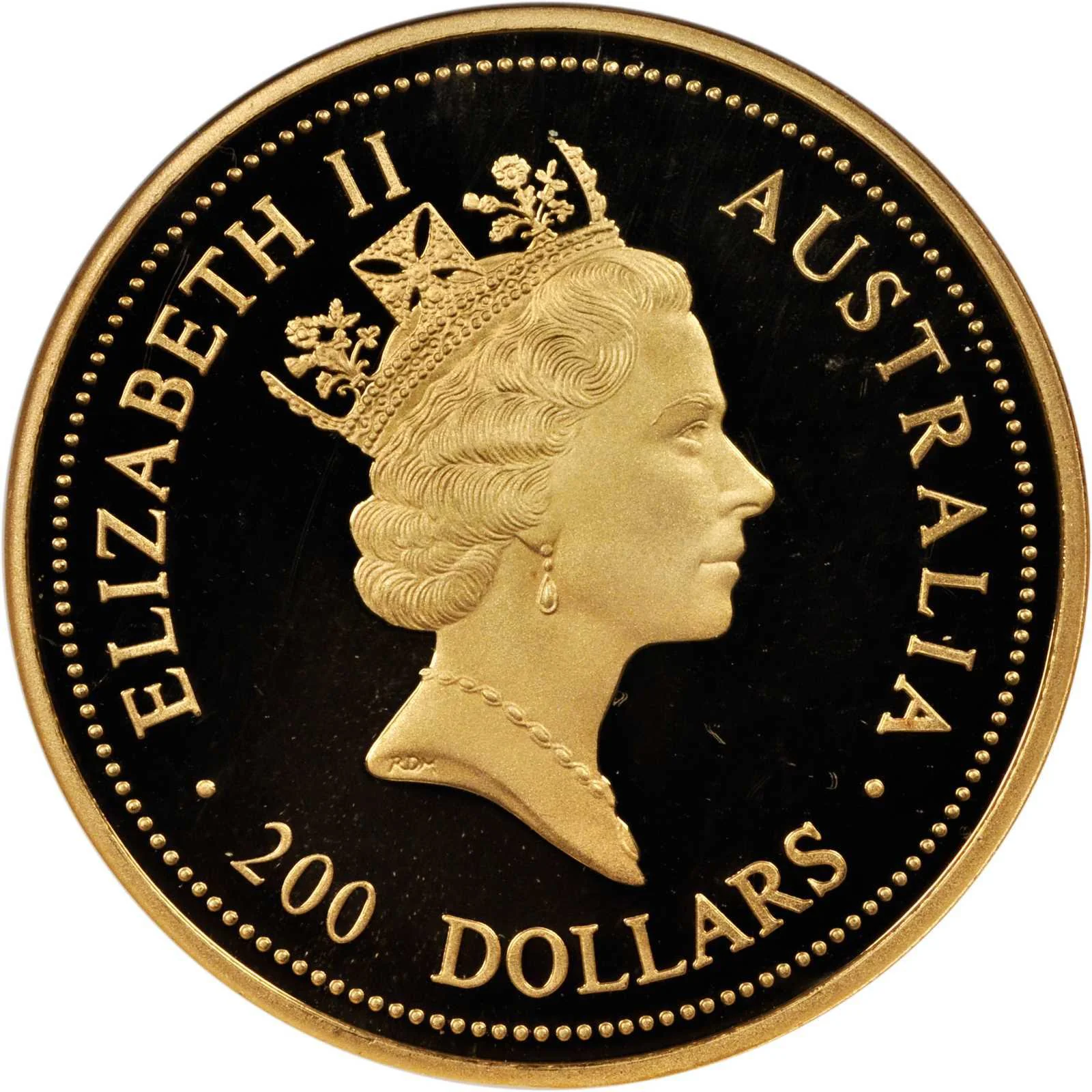
Obverse
Description:
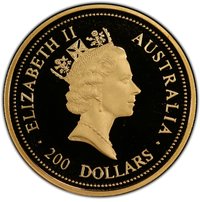
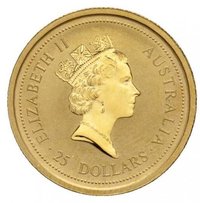
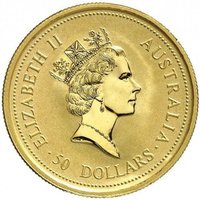
Queen Elizabeth III facing right in the King George IV State Diadem.
Inscription:
ELIZABETH II
AUSTRALIA
200 DOLLARS
RDM
AUSTRALIA
200 DOLLARS
RDM
Script: Latin
Designer: Raphael David Maklouf
Reverse
Description:
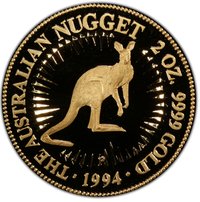
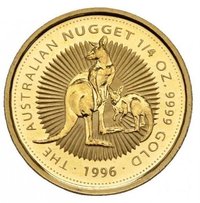
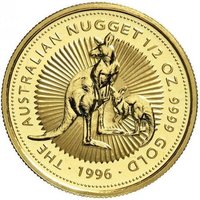
A kangaroo with her joey.
Inscription:
THE AUSTRALIAN NUGGET 2 OZ. 9999 GOLD
· 1995 ·
· 1995 ·
Script: Latin
Designer: Louise Pinder
Edge
Reeded
Mints
| Name | Mark |
|---|---|
| Perth Mint | — |
Mintings
| Year | Mint Mark | Mintage | Quality | Collection |
|---|---|---|---|---|
| 1995 | — | 100 | Proof |
Historical background
In 1995, the Australian dollar (AUD) was navigating a period of significant transition and volatility, shaped by both domestic economic reforms and global financial currents. The decade had begun with the dollar's value being officially floated on the foreign exchange market in 1983, and by the mid-90s, it was fully subject to the pressures of international capital flows, commodity prices, and interest rate differentials. The Reserve Bank of Australia (RBA) had shifted its primary focus to an explicit inflation-targeting framework, announced in 1993, which meant monetary policy was increasingly geared towards maintaining price stability rather than directly managing the currency's exchange rate.
The year itself was characterised by a generally weak Australian dollar, which traded within a range of roughly US 70 to 75 cents for much of the period. This relative softness was driven by several factors: a widening current account deficit, comparatively high domestic interest rates which nonetheless lagged behind those in the United States, and a prevailing "commodity currency" sensitivity to global economic cycles. Furthermore, the AUD was still shaking off the effects of the early 1990s recession, and while economic recovery was underway, investor confidence remained cautious. The currency's weakness was a double-edged sword, boosting the competitiveness of export sectors like mining and agriculture but also raising the cost of imports and overseas debt.
Politically and economically, the period was defined by the ongoing implementation of microeconomic reforms under the Keating Government, including further deregulation of the labour and financial markets. These reforms aimed to enhance Australia's international competitiveness in the long term. In this context, the RBA intervened in the foreign exchange market only sparingly, consistent with its post-float philosophy, preferring to allow the dollar to find its market level while using interest rate adjustments to pursue its inflation targets. Thus, the currency situation of 1995 reflects a modern, market-determined AUD, learning to absorb shocks and respond to a complex mix of domestic policy settings and volatile global investor sentiment.
The year itself was characterised by a generally weak Australian dollar, which traded within a range of roughly US 70 to 75 cents for much of the period. This relative softness was driven by several factors: a widening current account deficit, comparatively high domestic interest rates which nonetheless lagged behind those in the United States, and a prevailing "commodity currency" sensitivity to global economic cycles. Furthermore, the AUD was still shaking off the effects of the early 1990s recession, and while economic recovery was underway, investor confidence remained cautious. The currency's weakness was a double-edged sword, boosting the competitiveness of export sectors like mining and agriculture but also raising the cost of imports and overseas debt.
Politically and economically, the period was defined by the ongoing implementation of microeconomic reforms under the Keating Government, including further deregulation of the labour and financial markets. These reforms aimed to enhance Australia's international competitiveness in the long term. In this context, the RBA intervened in the foreign exchange market only sparingly, consistent with its post-float philosophy, preferring to allow the dollar to find its market level while using interest rate adjustments to pursue its inflation targets. Thus, the currency situation of 1995 reflects a modern, market-determined AUD, learning to absorb shocks and respond to a complex mix of domestic policy settings and volatile global investor sentiment.
Series: Australian Nugget



✨ Legendary