

10 schilling – Austria
Add to wishlist
Austria
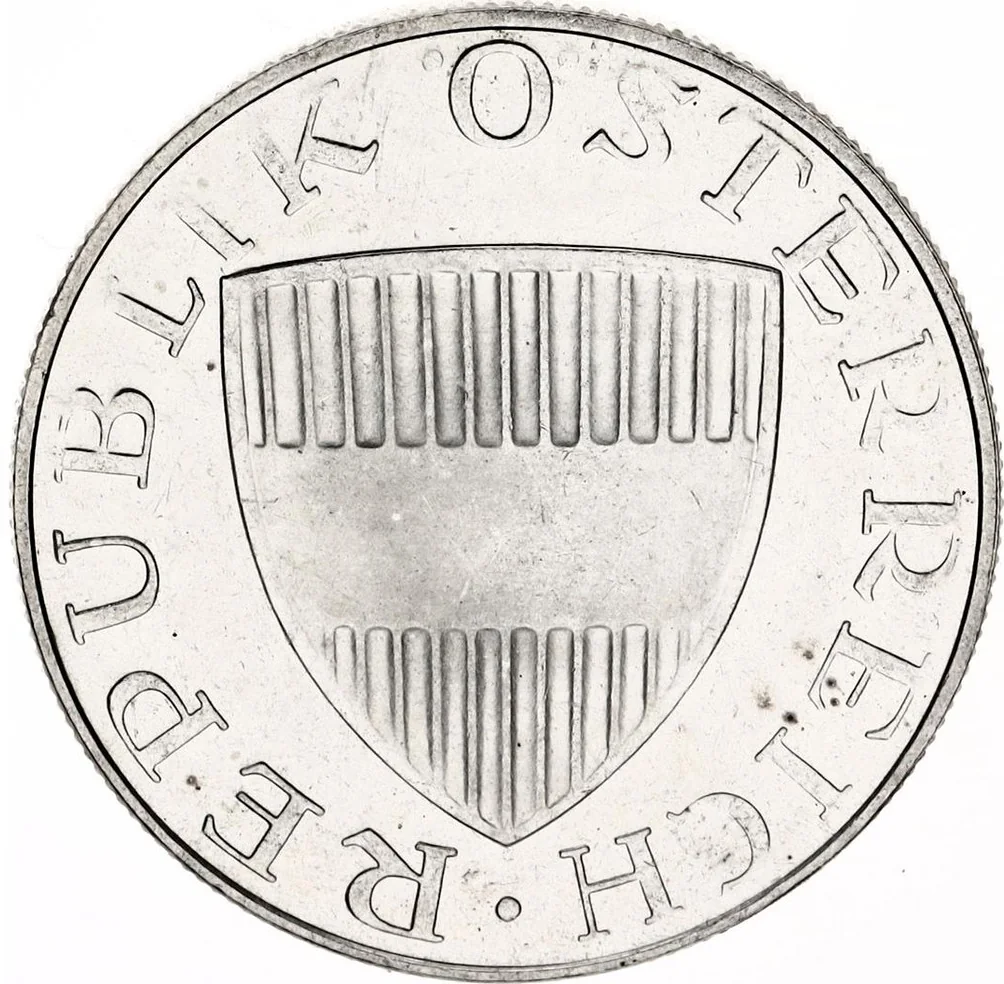
Obverse
Description:
Austrian red-white shield.
Inscription:
REPUBLIK ÖSTERREICH ·
Translation:
REPUBLIC OF AUSTRIA ·
Script: Latin
Language: German
Engraver: Ferdinand Welz
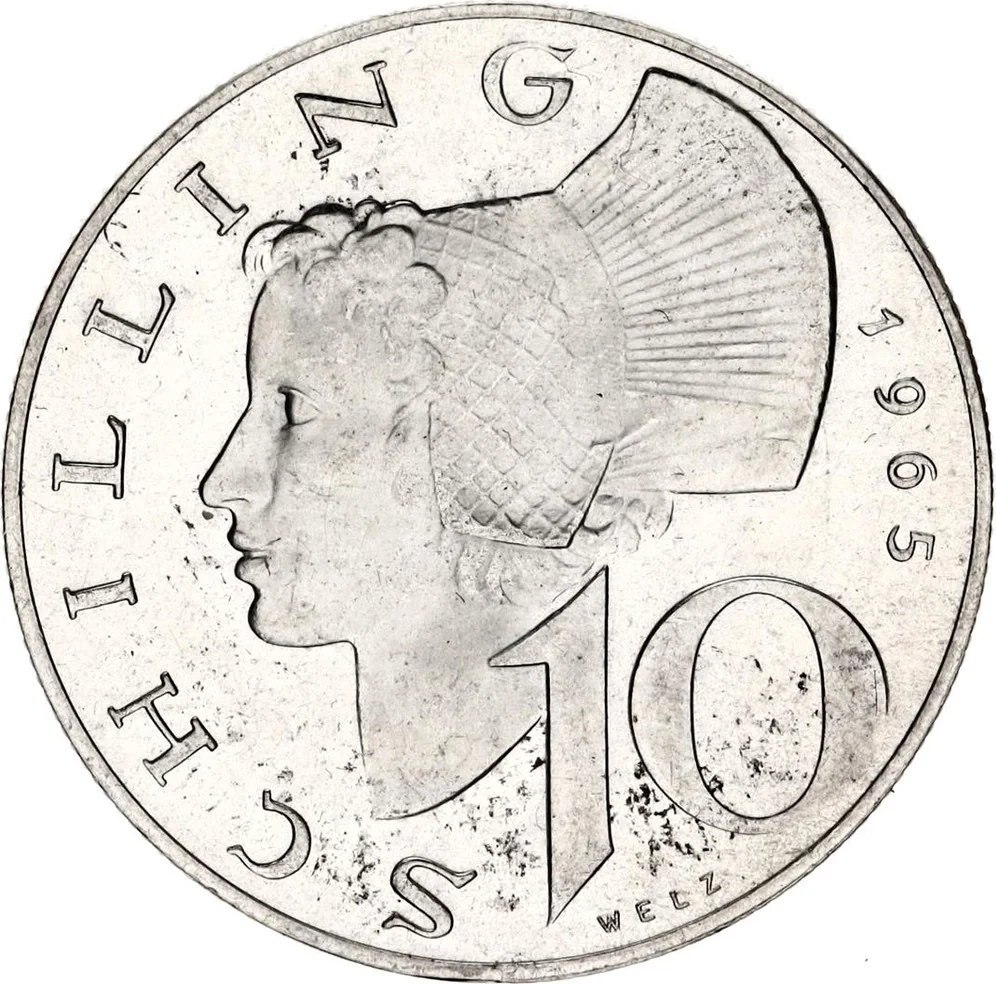
Reverse
Description:
Woman in traditional Lower Austrian hat.
Inscription:
SCHILLING 1972
10
WELZ
10
WELZ
Script: Latin
Engraver: Ferdinand Welz
Edge
Milled
Mints
| Name | Mark |
|---|---|
| Münze Österreich | — |
Mintings
| Year | Mint Mark | Mintage | Quality | Collection |
|---|---|---|---|---|
| 1957 | — | 15,635,500 | ||
| 1957 | — | — | Proof | |
| 1958 | — | 27,280,000 | ||
| 1958 | — | — | Proof | |
| 1959 | — | 4,739,500 | ||
| 1959 | — | — | Proof | |
| 1964 | — | 27,000 | Proof | |
| 1964 | — | 187,000 | ||
| 1965 | — | — | Proof | |
| 1965 | — | 1,721,000 | ||
| 1966 | — | 3,430,500 | ||
| 1966 | — | — | Proof | |
| 1967 | — | 1,393,500 | ||
| 1967 | — | — | Proof | |
| 1968 | — | 1,525,000 | ||
| 1968 | — | 15,000 | Proof | |
| 1969 | — | 1,317,500 | ||
| 1969 | — | 20,000 | Proof | |
| 1970 | — | 4,493,900 | ||
| 1970 | — | 89,100 | Proof | |
| 1971 | — | 7,320,500 | ||
| 1971 | — | 80,000 | Proof | |
| 1972 | — | 14,210,500 | ||
| 1972 | — | 75,000 | Proof | |
| 1973 | — | 14,559,000 | ||
| 1973 | — | 80,000 | Proof |
Historical background
In 1957, Austria's currency situation was defined by stability and successful integration into the European post-war economic order, a stark contrast to the hyperinflation and turmoil of earlier decades. The foundation for this was the Austrian Schilling, which had been successfully reintroduced in 1945 and then radically reformed with the "Schilling Law" of 1947. This law created a new, hard currency by implementing a severe currency conversion that drastically reduced the money supply, wiping out wartime liquidity and establishing trust. By 1957, the Schilling was a symbol of the country's remarkable economic recovery, or "Wirtschaftswunder," underpinned by conservative fiscal policy, Marshall Plan aid, and nationalised industries.
The currency's stability was institutionally safeguarded by the Austrian National Bank (OeNB), which had been re-established as an independent central bank in 1955 following the regaining of full sovereignty with the State Treaty. In 1957, Austria was also actively participating in the European Payments Union (EPU), a system crucial for facilitating multilateral trade and convertibility among European currencies before the return to full convertibility. The Schilling was effectively pegged to the US Dollar within the Bretton Woods system of fixed exchange rates, which provided a predictable framework for the booming export-oriented economy.
Looking ahead, 1957 was a calm prelude to a significant international monetary milestone. The country's strong reserves and stable currency paved the way for Austria to be among the first European nations to formally adopt external convertibility for the Schilling in 1958, in line with the broader European move under the IMF. This step eliminated most restrictions on currency transactions for non-residents, further integrating Austria into international finance and trade, and solidifying the Schilling's reputation as one of Europe's strongest and most stable post-war currencies.
The currency's stability was institutionally safeguarded by the Austrian National Bank (OeNB), which had been re-established as an independent central bank in 1955 following the regaining of full sovereignty with the State Treaty. In 1957, Austria was also actively participating in the European Payments Union (EPU), a system crucial for facilitating multilateral trade and convertibility among European currencies before the return to full convertibility. The Schilling was effectively pegged to the US Dollar within the Bretton Woods system of fixed exchange rates, which provided a predictable framework for the booming export-oriented economy.
Looking ahead, 1957 was a calm prelude to a significant international monetary milestone. The country's strong reserves and stable currency paved the way for Austria to be among the first European nations to formally adopt external convertibility for the Schilling in 1958, in line with the broader European move under the IMF. This step eliminated most restrictions on currency transactions for non-residents, further integrating Austria into international finance and trade, and solidifying the Schilling's reputation as one of Europe's strongest and most stable post-war currencies.
🌱 Very Common