

5 schilling – Austria
Add to wishlist
Austria
Obverse
Description:
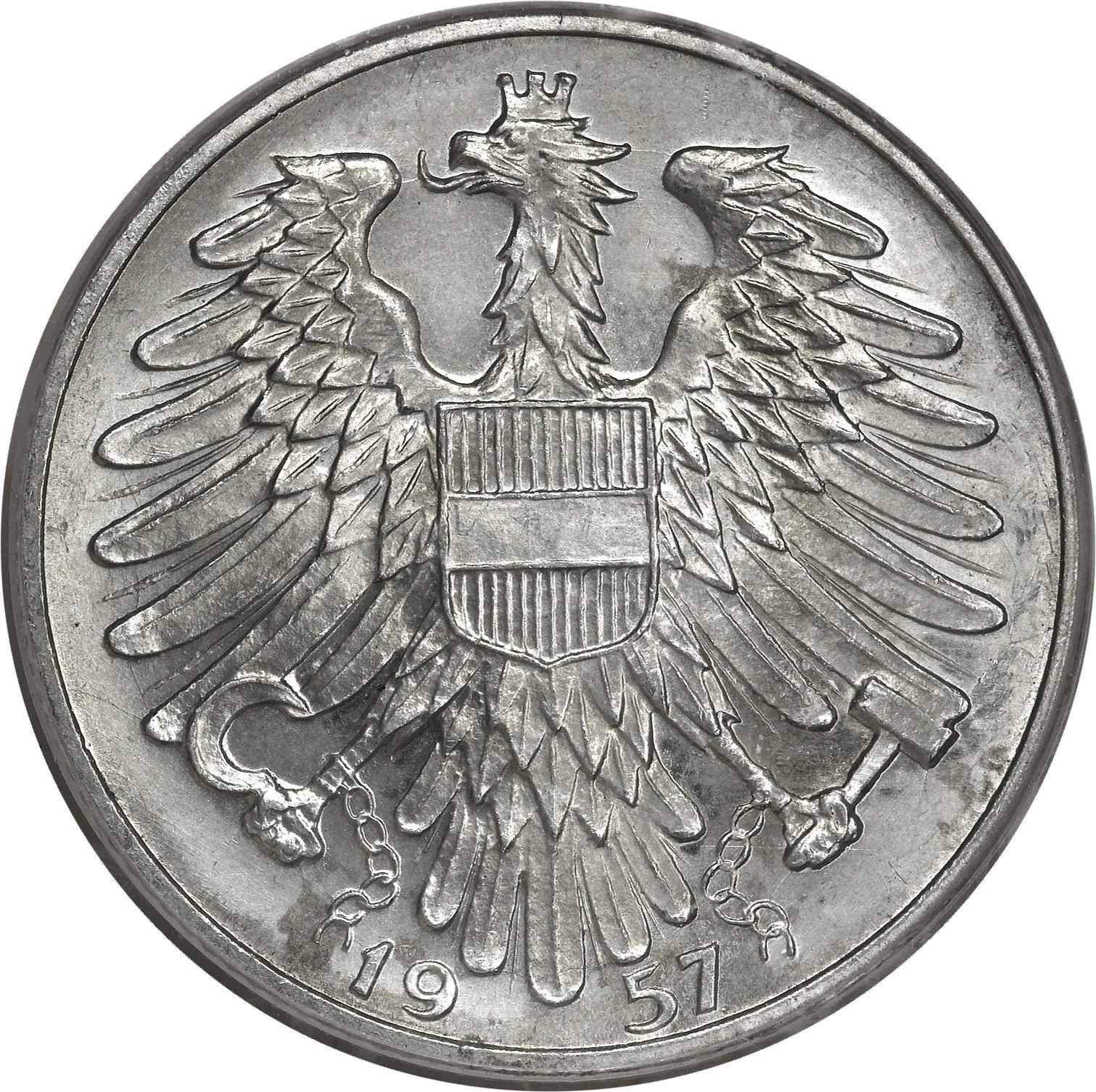
Austria's coat of arms features an eagle holding the national shield.
Inscription:
1957
Script: Latin
Reverse
Description:
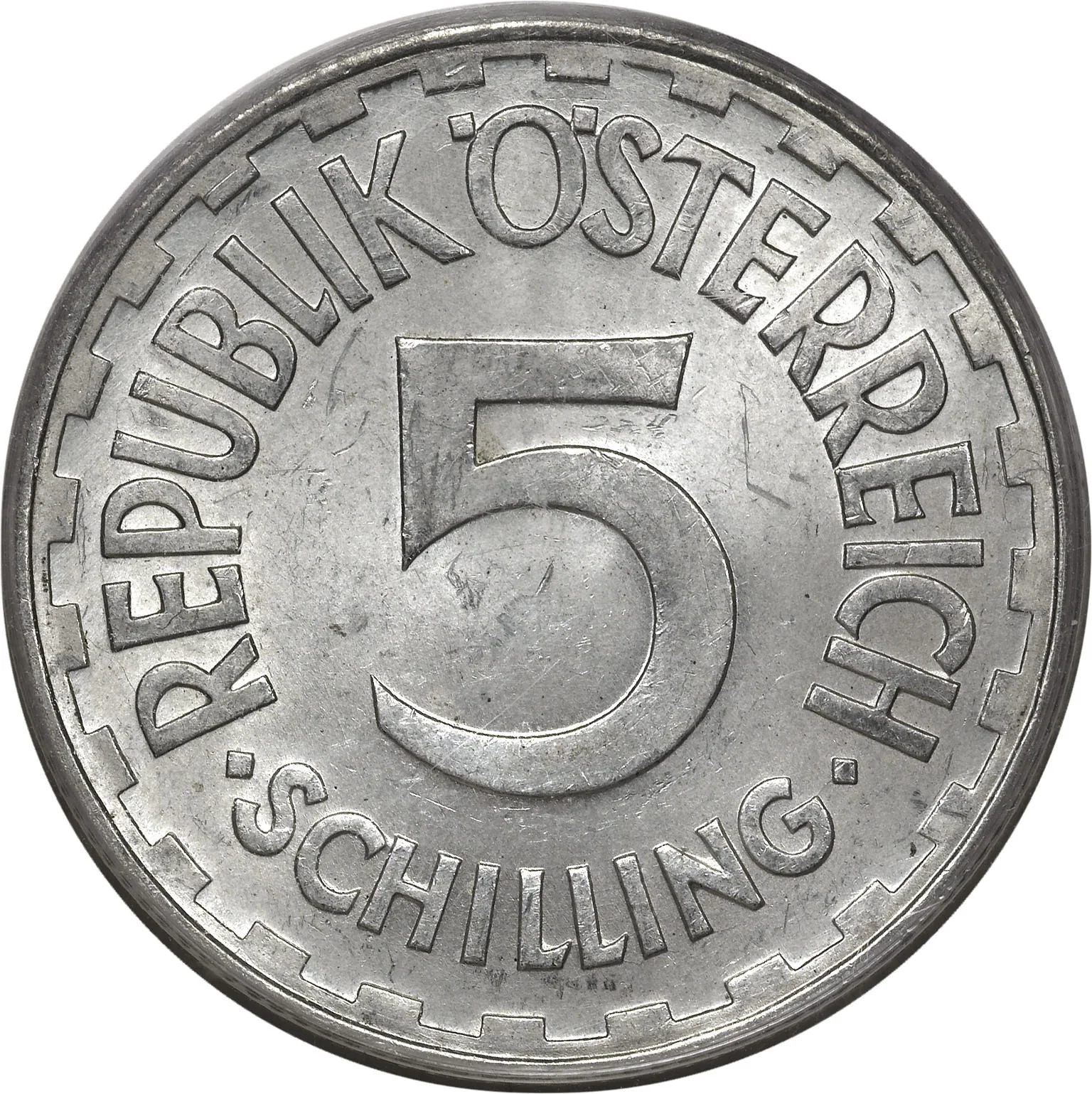
Top: country. Centre: value. Bottom: denomination.
Inscription:
REPUBLIK ÖSTERREICH
5
·SCHILLING·
5
·SCHILLING·
Translation:
REPUBLIC OF AUSTRIA
5
SCHILLING
5
SCHILLING
Script: Latin
Language: German
Engraver: Michael Powolny
Edge
Reeded
Categories
| Animal> Bird> Eagle |
| Symbols> Coat of Arms |
| Symbol> Hammer and sickle |
Mints
| Name | Mark |
|---|---|
| Münze Österreich | — |
Mintings
| Year | Mint Mark | Mintage | Quality | Collection |
|---|---|---|---|---|
| 1952 | — | 43,231,000 | ||
| 1952 | — | — | Proof | |
| 1957 | — | 240,200 | ||
| 1957 | — | — | Proof |
Historical background
In 1952, Austria was in the complex and fragile process of monetary and economic reconstruction following World War II and the end of the Allied occupation. The foundation had been laid with the 1947 Schilling Law, which introduced the new Austrian Schilling to replace the inflationary Reichsmark and the even less stable Allied military currency. This currency reform was a crucial step, but by 1952, the economy remained under severe strain. The country was still grappling with the physical destruction of war, a large displaced population, and the burdens of supplying the remaining occupation forces, all of which pressured the state budget and the new currency's stability.
The primary monetary challenge in 1952 was controlling persistent inflation and stabilizing the schilling's value. While the 1947 reform had halted hyperinflation, price increases and a thriving black market continued, fueled by a money supply that was still too large relative to available goods. A key instrument for managing this was the "Kontrollbank" system, established in the immediate post-war years. Through this mechanism, the Austrian National Bank strictly controlled the allocation of credit to essential industries, deliberately restricting the money flow to curb inflationary pressures, even at the cost of slower economic growth in the short term.
By the latter half of 1952, these stringent policies, combined with the first tangible benefits from the Marshall Plan and the gradual revival of industry and agriculture, began to yield positive results. Inflationary pressures started to subside, and confidence in the schilling grew. This period of consolidation set the essential precondition for the more dynamic economic growth and monetary stability that would follow later in the decade, particularly after the 1955 State Treaty restored full Austrian sovereignty and allowed for further economic integration with the West.
The primary monetary challenge in 1952 was controlling persistent inflation and stabilizing the schilling's value. While the 1947 reform had halted hyperinflation, price increases and a thriving black market continued, fueled by a money supply that was still too large relative to available goods. A key instrument for managing this was the "Kontrollbank" system, established in the immediate post-war years. Through this mechanism, the Austrian National Bank strictly controlled the allocation of credit to essential industries, deliberately restricting the money flow to curb inflationary pressures, even at the cost of slower economic growth in the short term.
By the latter half of 1952, these stringent policies, combined with the first tangible benefits from the Marshall Plan and the gradual revival of industry and agriculture, began to yield positive results. Inflationary pressures started to subside, and confidence in the schilling grew. This period of consolidation set the essential precondition for the more dynamic economic growth and monetary stability that would follow later in the decade, particularly after the 1955 State Treaty restored full Austrian sovereignty and allowed for further economic integration with the West.
🌱 Very Common