

50 Groschen – Austria
Austria
Context
Years: 1959–2001
Issuer: Austria 
Period:
(since 1945)
Currency:
(1945—2001)
Demonetization: 28 February 2002
Total mintage: 609,678,000
Material
References
KM: #Click to copy to clipboard2885
Numista: #655
Value
Exchange value: 0.50 ATS
Inflation-adjusted value: 4.40 ATS
Obverse
Description:
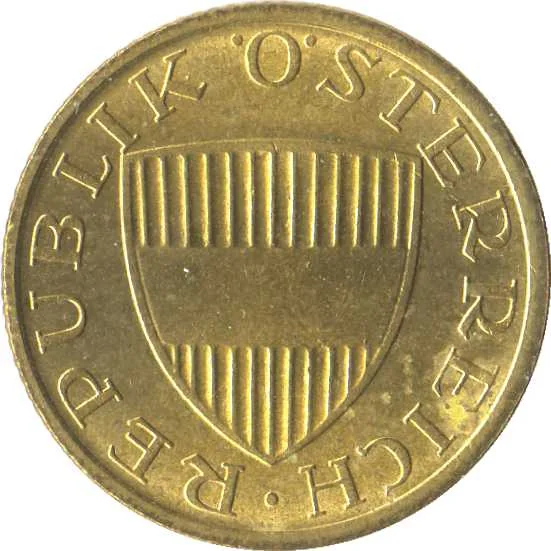
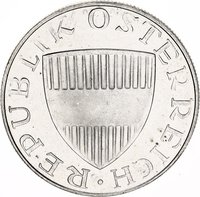
Austrian coat of arms with state title in semicircle.
Inscription:
REPUBLIK ÖSTERREICH
Translation:
REPUBLIC OF AUSTRIA
Script: Latin
Language: German
Engraver: Hans Köttenstorfer
Reverse
Description:
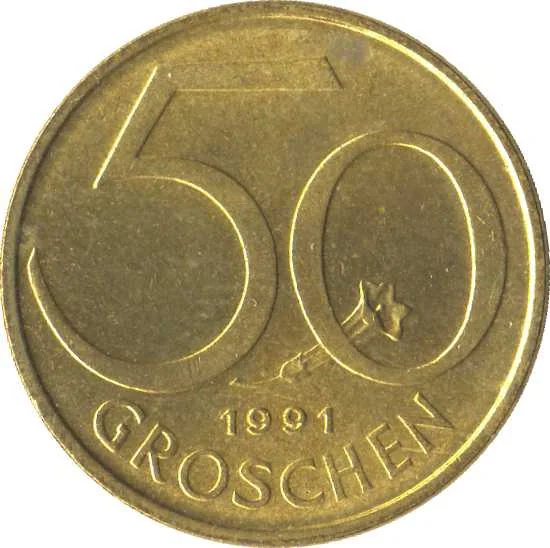
The date divides the face value, with a gentian flower (Gentiana acaulis) inside the '0'.
Inscription:
50
1991
GROSCHEN
1991
GROSCHEN
Script: Latin
Engraver: Ferdinand Welz
Edge
Reeded
Categories
| Plants> Flower |
| Symbols> Coat of Arms |
Mints
| Name | Mark |
|---|---|
| Münze Österreich | — |
Mintings
| Year | Mint Mark | Mintage | Quality | Collection |
|---|---|---|---|---|
| 1959 | — | — | Proof | |
| 1959 | — | 14,122,000 | ||
| 1960 | — | 22,404,000 | ||
| 1960 | — | — | Proof | |
| 1961 | — | 19,891,000 | ||
| 1961 | — | — | Proof | |
| 1962 | — | 10,008,000 | ||
| 1962 | — | — | Proof | |
| 1963 | — | — | Proof | |
| 1963 | — | 9,483,000 | ||
| 1964 | — | 5,331,000 | ||
| 1964 | — | — | Proof | |
| 1965 | — | 15,007,000 | ||
| 1965 | — | — | Proof | |
| 1966 | — | 7,322,000 | ||
| 1966 | — | — | Proof | |
| 1967 | — | 8,237,000 | ||
| 1967 | — | — | Proof | |
| 1968 | — | 7,741,600 | ||
| 1968 | — | 15,400 | Proof | |
| 1969 | — | 7,070,000 | ||
| 1969 | — | 26,000 | Proof | |
| 1970 | — | 29,941,000 | ||
| 1970 | — | 128,000 | Proof | |
| 1971 | — | 14,217,000 | ||
| 1971 | — | 84,000 | Proof | |
| 1972 | — | 17,367,000 | ||
| 1972 | — | 80,000 | Proof | |
| 1973 | — | 17,902,000 | ||
| 1973 | — | 90,000 | Proof | |
| 1974 | — | 15,852,000 | ||
| 1974 | — | 76,000 | Proof | |
| 1975 | — | 49,000 | Proof | |
| 1975 | — | 7,726,000 | ||
| 1976 | — | 11,150,000 | ||
| 1976 | — | 44,000 | Proof | |
| 1977 | — | 7,258,000 | ||
| 1977 | — | 44,000 | Proof | |
| 1978 | — | 12,407,000 | ||
| 1978 | — | 43,000 | Proof | |
| 1979 | — | 16,351,000 | ||
| 1979 | — | 44,000 | Proof | |
| 1980 | — | 29,884,000 | ||
| 1980 | — | 48,000 | Proof | |
| 1981 | — | 12,993,000 | ||
| 1981 | — | 49,000 | Proof | |
| 1982 | — | 9,950,000 | ||
| 1982 | — | 50,000 | Proof | |
| 1983 | — | 15,182,000 | ||
| 1983 | — | 65,000 | Proof | |
| 1984 | — | 20,742,000 | ||
| 1984 | — | 65,000 | Proof | |
| 1985 | — | 15,654,000 | ||
| 1985 | — | 45,000 | Proof | |
| 1986 | — | 17,016,000 | ||
| 1986 | — | 42,000 | Proof | |
| 1987 | — | 7,258,000 | ||
| 1987 | — | 42,000 | Proof | |
| 1988 | — | 16,267,000 | ||
| 1988 | — | 39,000 | Proof | |
| 1989 | — | 17,353,000 | ||
| 1989 | — | 38,000 | Proof | |
| 1990 | — | 29,653,000 | ||
| 1990 | — | 35,000 | Proof | |
| 1991 | — | 44,990,000 | ||
| 1991 | — | 27,000 | Proof | |
| 1992 | — | 20,000,000 | ||
| 1992 | — | 25,000 | Proof | |
| 1993 | — | 15,000,000 | ||
| 1993 | — | 28,000 | Proof | |
| 1994 | — | 10,000,000 | ||
| 1994 | — | 25,000 | Proof | |
| 1995 | — | 20,000,000 | ||
| 1995 | — | 27,000 | Proof | |
| 1996 | — | 15,000,000 | ||
| 1996 | — | 25,000 | Proof | |
| 1997 | — | 10,000,000 | ||
| 1997 | — | 25,000 | Proof | |
| 1998 | — | 25,000 | Proof | |
| 1999 | — | 50,000 | Proof | |
| 2000 | — | 4,300,000 | ||
| 2000 | — | 75,000 | Proof | |
| 2001 | — | 75,000 |
Historical background
In 1959, Austria's currency situation was defined by stability and successful integration into the European post-war economic order, a stark contrast to the hyperinflation and instability of earlier decades. The foundation for this was the Austrian Schilling, which had been successfully re-established as a stable currency with the Schilling Law of 1947. This radical currency reform had wiped out the wartime inflation, replacing the Reichsmark and creating a hard, trusted currency that became known as the "Alpendollar" for its strength. By 1959, the Schilling was operating under a fixed exchange rate system tied to the US Dollar within the framework of the Bretton Woods system, providing predictable exchange rates crucial for trade and reconstruction.
This monetary stability was a key pillar of Austria's remarkable Wirtschaftswunder (economic miracle), a period of rapid industrial growth and rising living standards. The stable Schilling encouraged both domestic investment and foreign capital inflow, particularly from the United States through the Marshall Plan. The Austrian National Bank (OeNB), regaining its full sovereignty after the end of the Allied occupation in 1955, could effectively manage this fixed parity. The currency's strength reflected the success of the nation's consensual social partnership model, where coordinated wage policies helped maintain price stability and competitiveness.
Looking ahead, 1959 was a calm precursor to a significant international monetary milestone. The enduring stability of the Schilling throughout the 1950s gave Austria the credibility to make a major step toward full convertibility. In the same year, Austria joined the European Monetary Agreement and, more importantly, declared the external convertibility of the Schilling for non-residents on December 19, 1959. This move integrated Austria more deeply into the international financial system and laid the groundwork for its future economic prosperity and European integration.
This monetary stability was a key pillar of Austria's remarkable Wirtschaftswunder (economic miracle), a period of rapid industrial growth and rising living standards. The stable Schilling encouraged both domestic investment and foreign capital inflow, particularly from the United States through the Marshall Plan. The Austrian National Bank (OeNB), regaining its full sovereignty after the end of the Allied occupation in 1955, could effectively manage this fixed parity. The currency's strength reflected the success of the nation's consensual social partnership model, where coordinated wage policies helped maintain price stability and competitiveness.
Looking ahead, 1959 was a calm precursor to a significant international monetary milestone. The enduring stability of the Schilling throughout the 1950s gave Austria the credibility to make a major step toward full convertibility. In the same year, Austria joined the European Monetary Agreement and, more importantly, declared the external convertibility of the Schilling for non-residents on December 19, 1959. This move integrated Austria more deeply into the international financial system and laid the groundwork for its future economic prosperity and European integration.
🌱 Very Common