

500 Pesos – Philippines
Philippines
Context
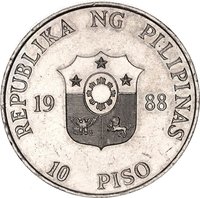
Year: 1988
Issuer: Philippines 
Period:
(since 1946)
Currency:
(since 1967)
Demonetization: 30 April 2019
Total mintage: 7,500
Material
References
KM: #Click to copy to clipboard249
Numista: #192818
Value
Exchange value: 500 PHP = $8.68
Bullion value: $74.13
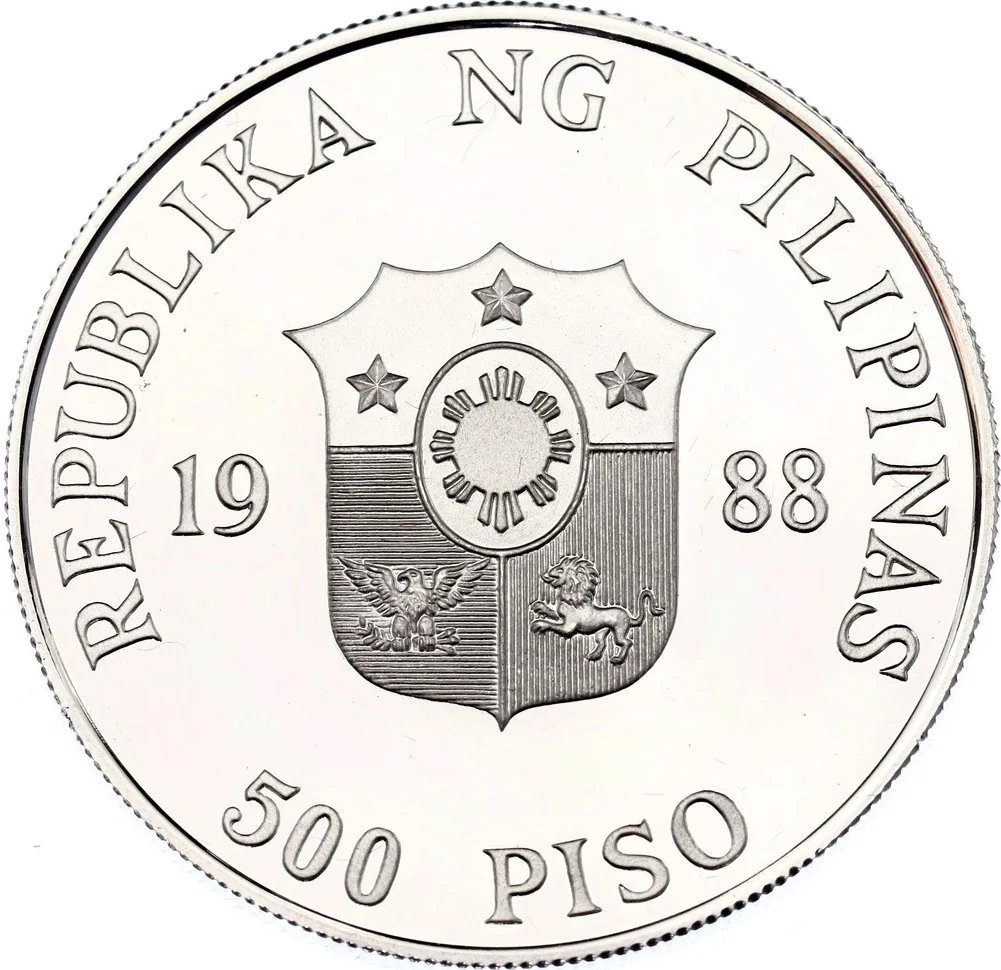
Obverse
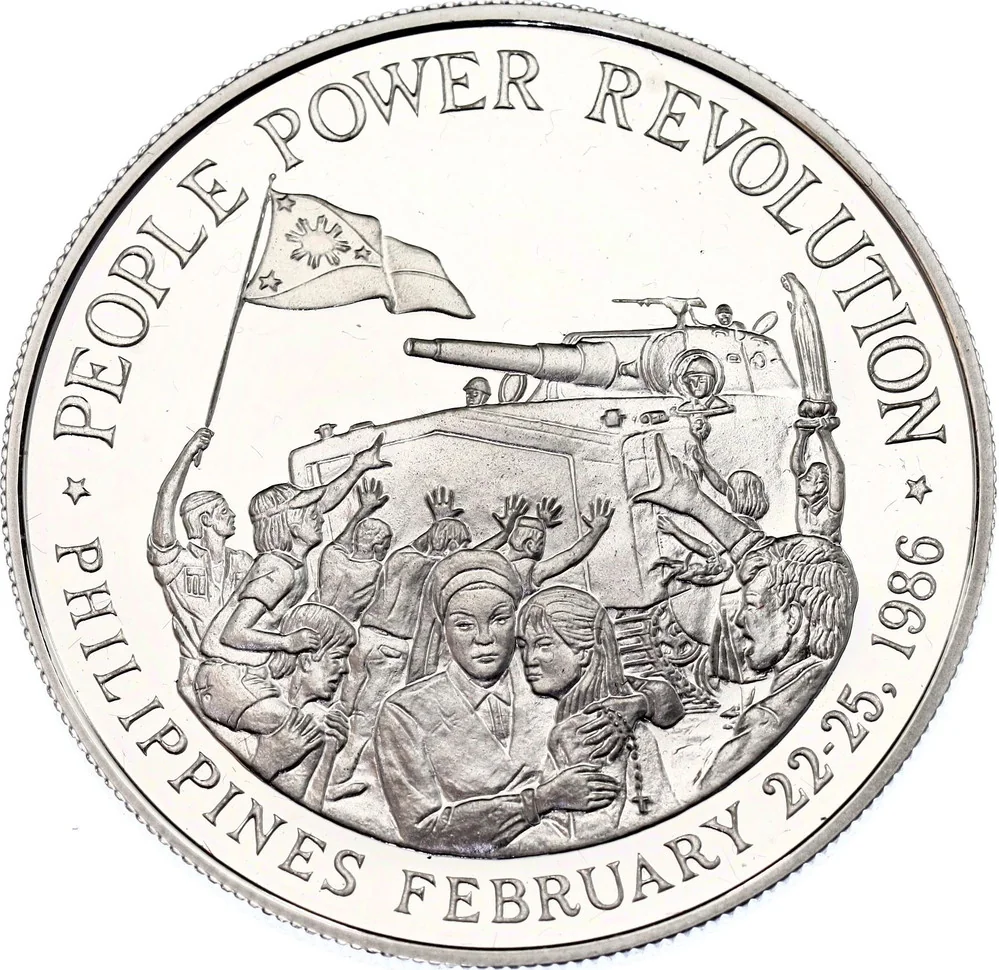
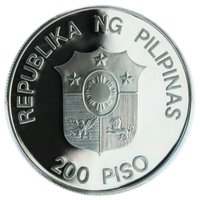
Reverse
Description:
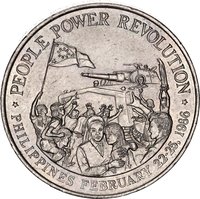
Protesters facing a tank.
Inscription:
PEOPLE POWER REVOLUTION
★ PHILIPPINES FEBRUARY 22-25, 1986 ★
★ PHILIPPINES FEBRUARY 22-25, 1986 ★
Script: Latin
Edge
Reeded
Categories
| Event> Revolution |
| Symbols> Coat of Arms |
Mints
| Name | Mark |
|---|---|
| Royal Mint | — |
Mintings
| Year | Mint Mark | Mintage | Quality | Collection |
|---|---|---|---|---|
| 1988 | — | 7,500 | Proof |
Historical background
In 1988, the Philippines was navigating a critical period of economic stabilization and reform under the presidency of Corazon Aquino. The country was emerging from the deep economic crisis and political turmoil of the Marcos era, which had culminated in severe foreign debt, capital flight, and a sharp devaluation of the peso. The currency, the Philippine Peso (PHP), was operating under a managed float system, heavily influenced by the central bank, Bangko Sentral ng Pilipinas (BSP). Its value was relatively stable but fragile, trading in a band around ₱20 to ₱21 per US dollar, a rate maintained through direct intervention and tight monetary policy to rebuild international reserves and curb inflation.
This stability was hard-won, following the aggressive reforms of Finance Secretary Jaime Ongpin and the BSP, which included high interest rates and fiscal austerity under the guidance of the International Monetary Fund (IMF) and World Bank. A significant achievement was the 1987 debt restructuring agreement under the Brady Plan framework, which alleviated pressure on the balance of payments and provided a foundation for currency confidence. However, the economy remained vulnerable. Underlying weaknesses included a large trade deficit, persistent inflationary pressures, and a reliance on remittances from overseas Filipino workers, which were becoming an increasingly vital source of foreign exchange.
Overall, the currency situation in 1988 reflected a nation in cautious recovery. The peso was not freely convertible, and exchange controls, though being gradually liberalized, were still in place. The government's priority was to maintain stability to attract foreign investment and support the new democratic institutions, rather than pursue rapid growth. Thus, while the exchange rate itself appeared steady, it was a symbol of an economy still convalescing, heavily dependent on external support and disciplined central bank management to prevent a relapse into the volatility of the early 1980s.
This stability was hard-won, following the aggressive reforms of Finance Secretary Jaime Ongpin and the BSP, which included high interest rates and fiscal austerity under the guidance of the International Monetary Fund (IMF) and World Bank. A significant achievement was the 1987 debt restructuring agreement under the Brady Plan framework, which alleviated pressure on the balance of payments and provided a foundation for currency confidence. However, the economy remained vulnerable. Underlying weaknesses included a large trade deficit, persistent inflationary pressures, and a reliance on remittances from overseas Filipino workers, which were becoming an increasingly vital source of foreign exchange.
Overall, the currency situation in 1988 reflected a nation in cautious recovery. The peso was not freely convertible, and exchange controls, though being gradually liberalized, were still in place. The government's priority was to maintain stability to attract foreign investment and support the new democratic institutions, rather than pursue rapid growth. Thus, while the exchange rate itself appeared steady, it was a symbol of an economy still convalescing, heavily dependent on external support and disciplined central bank management to prevent a relapse into the volatility of the early 1980s.

💎 Extremely Rare