

10 Pfennigs – German Democratic Republic
Germany
Context
Years: 1963–1990
Country: Germany 
Issuer: German Democratic Republic 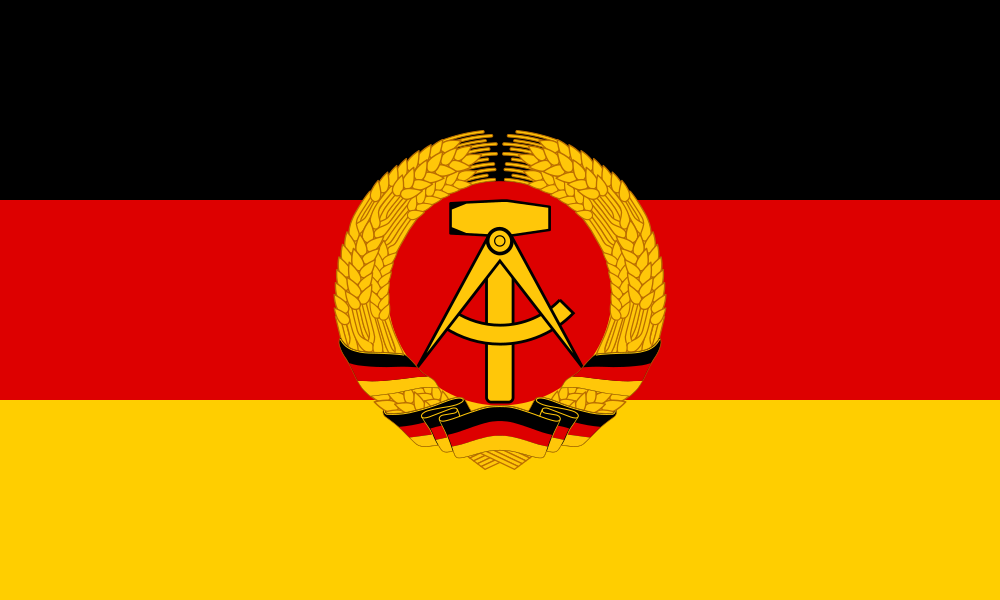
Period:
(1949—1990)
Currency:
(1948—1990)
Demonetization: 1 July 1990
Total mintage: 765,139,652
Material
References
KM: #Click to copy to clipboard10
Numista: #1925
Value
Exchange value: 0.10 DDM
Inflation-adjusted value: 0.53 DDM
Obverse
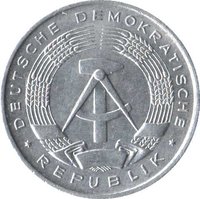
Description:
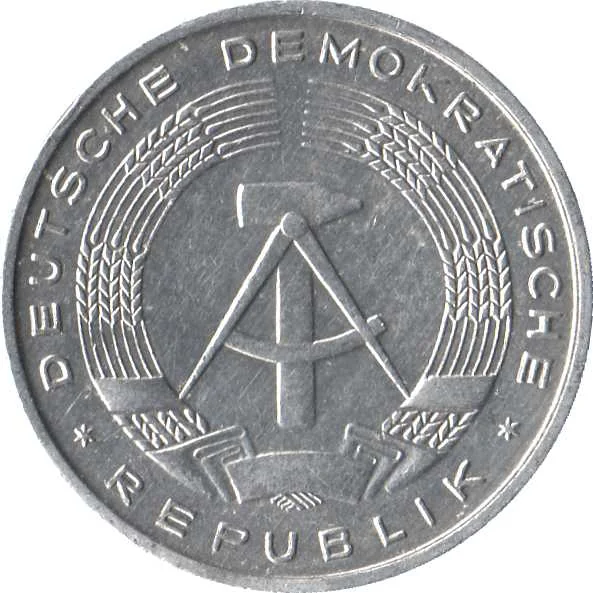
State emblem: a hammer and compass encircled by rye, with a ribbon in black, red, and yellow.
Inscription:
DEUTSCHE DEMOKRATISCHE
REPUBLIK
REPUBLIK
Translation:
German Democratic Republic
Script: Latin
Language: German
Engraver: Rudi Högner
Reverse
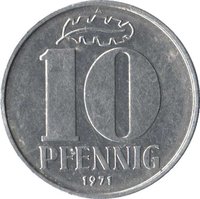
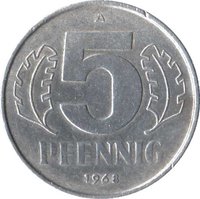
Description:
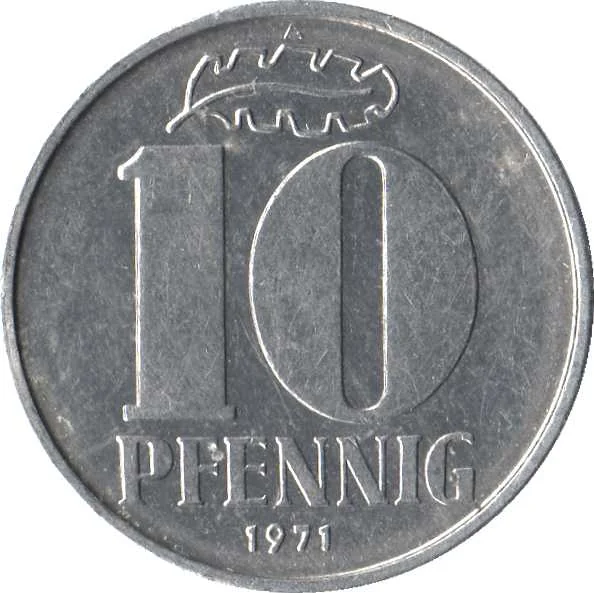
Oak leaf and mintmark above, date below.
Inscription:
A
10
PFENNIG
1971
10
PFENNIG
1971
Script: Latin
Engraver: Rudi Högner
Edge
Plain
Mints
| Name | Mark |
|---|---|
| Berlin | A |
Mintings
| Year | Mint Mark | Mintage | Quality | Collection |
|---|---|---|---|---|
| 1963 | A | 21,063,474 | ||
| 1965 | A | 55,312,635 | ||
| 1967 | A | 96,994,702 | ||
| 1968 | A | 207,460,678 | ||
| 1970 | A | 13,386,600 | ||
| 1971 | A | 66,618,228 | ||
| 1972 | A | 5,701,781 | ||
| 1973 | A | 11,257,088 | ||
| 1978 | A | 40,000,000 | ||
| 1979 | A | 54,665,050 | ||
| 1979 | A | — | Proof | |
| 1980 | A | 20,664,000 | ||
| 1980 | A | — | Proof | |
| 1981 | A | 40,704,150 | ||
| 1981 | A | 40 | Proof | |
| 1982 | A | 40,212,000 | ||
| 1982 | A | 2,500 | Proof | |
| 1983 | A | 40,699,000 | ||
| 1983 | A | 2,550 | Proof | |
| 1984 | A | 12,000 | In sets | |
| 1984 | A | 3,015 | Proof | |
| 1985 | A | 1,010,000 | ||
| 1985 | A | 2,816 | Proof | |
| 1986 | A | 1,000,000 | ||
| 1986 | A | 2,800 | Proof | |
| 1987 | A | 2,345 | Proof | |
| 1987 | A | 20,000 | In sets | |
| 1988 | A | 10,704,000 | ||
| 1988 | A | 2,300 | Proof | |
| 1989 | A | 2,300 | Proof | |
| 1989 | A | 37,620,000 | ||
| 1990 | A | 13,600 | In sets |
Historical background
In 1963, the currency situation in the German Democratic Republic (GDR) was defined by the strict separation of its monetary system from that of West Germany and the persistent challenges of a centrally planned economy. The official currency was the East German Mark (Mark der DDR), which was non-convertible and isolated from international markets. Its value was artificially set by the state and bore no relation to its real purchasing power or to the value of the West German Deutsche Mark (DM). A critical feature of the system was the existence of a vast black market and special stores (such as Intershop, established in 1962) where coveted Western goods could only be purchased with hard currencies like the DM, creating a de facto two-tier economy that undermined the state's own currency.
This duality highlighted the fundamental weakness of the GDR's economy and the growing discontent among its population. While the state promoted the Ostmark as a symbol of socialist sovereignty, its citizens placed far greater trust in the hard currency of the capitalist rival, the Deutsche Mark. Receiving packages or remittances in DM from West German relatives became a crucial source of access to quality goods, creating a significant social divide between those with and without access to Western currency. The government, facing chronic shortages of consumer goods and production inefficiencies, tacitly tolerated this system as a necessary pressure valve and a source of foreign exchange, even as it contradicted socialist ideology.
Consequently, the monetary policy of 1963 was less about economic reform and more about control and political management. The state maintained a complex system of exchange rates for different transactions (e.g., for foreign tourists or for mandatory currency exchanges by visitors from the West), all designed to extract hard currency. There was no move toward convertibility or market-based valuation. The currency situation thus remained frozen, reflecting the broader political stalemate of the Cold War division of Germany, where the Ostmark served as an instrument of state authority and economic isolation rather than a tool for genuine prosperity or integration.
This duality highlighted the fundamental weakness of the GDR's economy and the growing discontent among its population. While the state promoted the Ostmark as a symbol of socialist sovereignty, its citizens placed far greater trust in the hard currency of the capitalist rival, the Deutsche Mark. Receiving packages or remittances in DM from West German relatives became a crucial source of access to quality goods, creating a significant social divide between those with and without access to Western currency. The government, facing chronic shortages of consumer goods and production inefficiencies, tacitly tolerated this system as a necessary pressure valve and a source of foreign exchange, even as it contradicted socialist ideology.
Consequently, the monetary policy of 1963 was less about economic reform and more about control and political management. The state maintained a complex system of exchange rates for different transactions (e.g., for foreign tourists or for mandatory currency exchanges by visitors from the West), all designed to extract hard currency. There was no move toward convertibility or market-based valuation. The currency situation thus remained frozen, reflecting the broader political stalemate of the Cold War division of Germany, where the Ostmark served as an instrument of state authority and economic isolation rather than a tool for genuine prosperity or integration.
🌱 Very Common