

5 Pfennigs – German Democratic Republic
Germany
Context
Years: 1968–1990
Country: Germany 
Issuer: German Democratic Republic 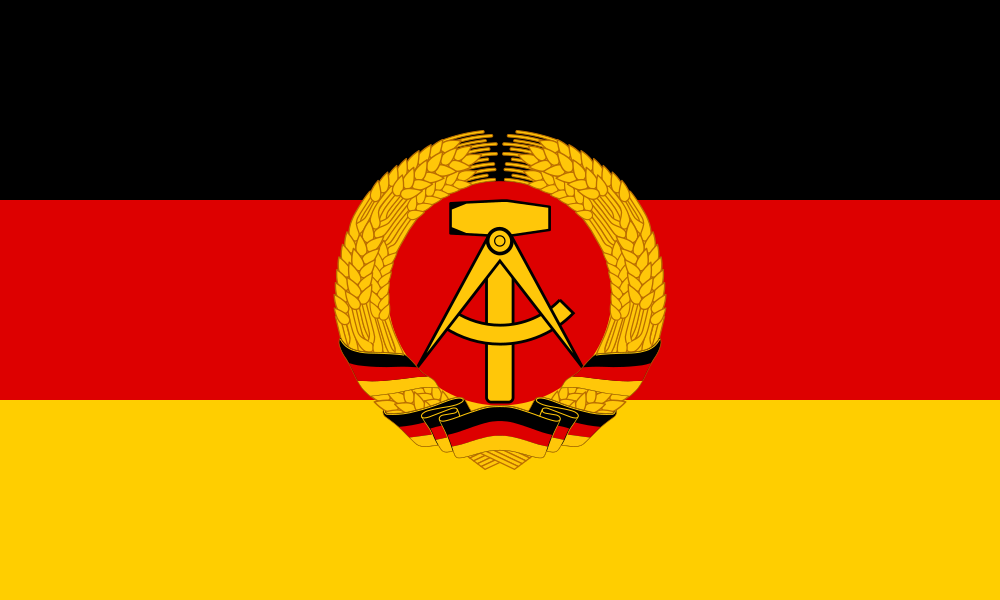
Period:
(1949—1990)
Currency:
(1948—1990)
Demonetization: 1 July 1991
Total mintage: 784,957,164
Material
References
KM: #Click to copy to clipboard9
Numista: #1926
Value
Exchange value: 0.05 DDM
Inflation-adjusted value: 0.23 DDM
Obverse
Description:
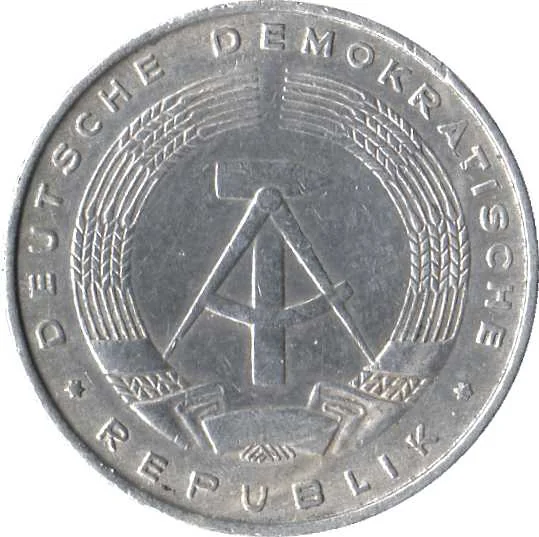
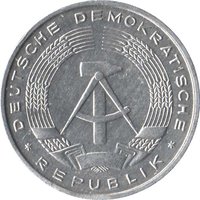
GDR emblem: a hammer and compass within a wreath of ears, encircled by a black-red-yellow ribbon.
Inscription:
DEUTSCHE DEMOKRATISCHE
REPUBLIK
REPUBLIK
Translation:
German Democratic Republic
Script: Latin
Language: German
Engraver: Rudi Högner
Reverse
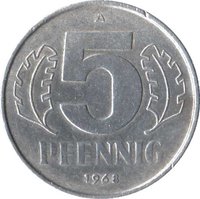
Description:
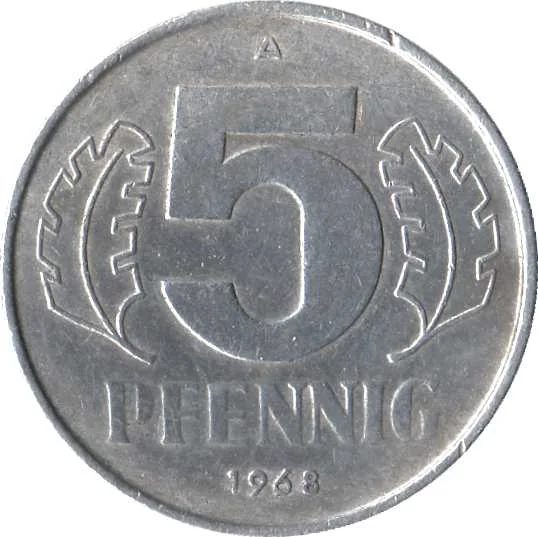
Face value, two oak leaves, date below, mintmark above.
Inscription:
A
5
PFENNIG
1968
5
PFENNIG
1968
Script: Latin
Engraver: Rudi Högner
Edge
Plain
Mints
| Name | Mark |
|---|---|
| Berlin | A |
Mintings
| Year | Mint Mark | Mintage | Quality | Collection |
|---|---|---|---|---|
| 1968 | A | 282,303,197 | ||
| 1972 | A | 51,461,800 | ||
| 1975 | A | 84,709,850 | ||
| 1976 | A | 2 | ||
| 1978 | A | 43,257,450 | ||
| 1979 | A | 46,194,200 | ||
| 1979 | A | — | Proof | |
| 1980 | A | 31,977,000 | ||
| 1980 | A | — | Proof | |
| 1981 | A | 40 | Proof | |
| 1981 | A | 33,101,999 | ||
| 1982 | A | 916,000 | ||
| 1982 | A | 2,500 | Proof | |
| 1983 | A | 100,890,000 | ||
| 1983 | A | 2,550 | Proof | |
| 1984 | A | 6,000 | ||
| 1984 | A | 3,015 | Proof | |
| 1985 | A | 1,000,000 | ||
| 1985 | A | 2,816 | Proof | |
| 1986 | A | 2,800 | Proof | |
| 1986 | A | 1,000,000 | ||
| 1987 | A | 2,345 | Proof | |
| 1987 | A | 20,000 | ||
| 1988 | A | 35,929,000 | ||
| 1988 | A | 2,300 | Proof | |
| 1989 | A | 21,540,000 | ||
| 1989 | A | 2,300 | Proof | |
| 1990 | A | 50,630,000 |
Historical background
In 1968, the currency situation in the German Democratic Republic (GDR) was defined by the rigid separation of two distinct monetary zones: the internally used GDR Mark (Mark der DDR) and the externally powerful Deutsche Mark (DM) of West Germany. The GDR Mark was a non-convertible "soft currency," its value and stability artificially maintained by the state and central planning. It could not be exchanged for Western currencies on international markets, and its purchasing power was largely confined within the borders of the GDR and the Eastern Bloc, reflecting the country's controlled, shortage economy.
This system created a profound duality, as the West German Deutsche Mark operated as a highly desirable parallel currency within East Germany itself. Acquired through Western remittances, intershop stores, and the black market, the DM provided access to a shadow economy of high-quality Western goods and services unavailable for GDR Marks. This undermined the state's ideological and economic control, as the DM became a tangible symbol of West Germany's prosperity and a constant reminder of the GDR's relative economic weakness and consumer goods shortages.
The government, under Walter Ulbricht, responded with strict regulations to protect its currency monopoly. The possession and unauthorized exchange of Western currencies were criminal offenses. However, the policy of "Abgrenzung" (demarcation) and the construction of the Berlin Wall in 1961 had failed to stop the DM's influence. By 1968, the state had begun to tacitly tolerate certain channels for DM, such as the official "Genex" gift catalog service, which allowed Western relatives to send goods in return for DM, acknowledging the currency's irreplaceable role in securing hard currency and placating the population. Thus, the currency situation remained a tense compromise between oppressive control and pragmatic, if reluctant, accommodation.
This system created a profound duality, as the West German Deutsche Mark operated as a highly desirable parallel currency within East Germany itself. Acquired through Western remittances, intershop stores, and the black market, the DM provided access to a shadow economy of high-quality Western goods and services unavailable for GDR Marks. This undermined the state's ideological and economic control, as the DM became a tangible symbol of West Germany's prosperity and a constant reminder of the GDR's relative economic weakness and consumer goods shortages.
The government, under Walter Ulbricht, responded with strict regulations to protect its currency monopoly. The possession and unauthorized exchange of Western currencies were criminal offenses. However, the policy of "Abgrenzung" (demarcation) and the construction of the Berlin Wall in 1961 had failed to stop the DM's influence. By 1968, the state had begun to tacitly tolerate certain channels for DM, such as the official "Genex" gift catalog service, which allowed Western relatives to send goods in return for DM, acknowledging the currency's irreplaceable role in securing hard currency and placating the population. Thus, the currency situation remained a tense compromise between oppressive control and pragmatic, if reluctant, accommodation.
🌱 Very Common