

5 Francs – Switzerland
Switzerland
Context
Years: 1850–1886
Issuer: Switzerland 
Period:
(since 1848)
Currency:
(since 1850)
Demonetization: 1 February 1934
Total mintage: 2,126,005
Material
References
KM: #Click to copy to clipboard11
Numista: #191
Value
Exchange value: 5 CHF = $6.46
Bullion value: $64.40
Obverse
Description:
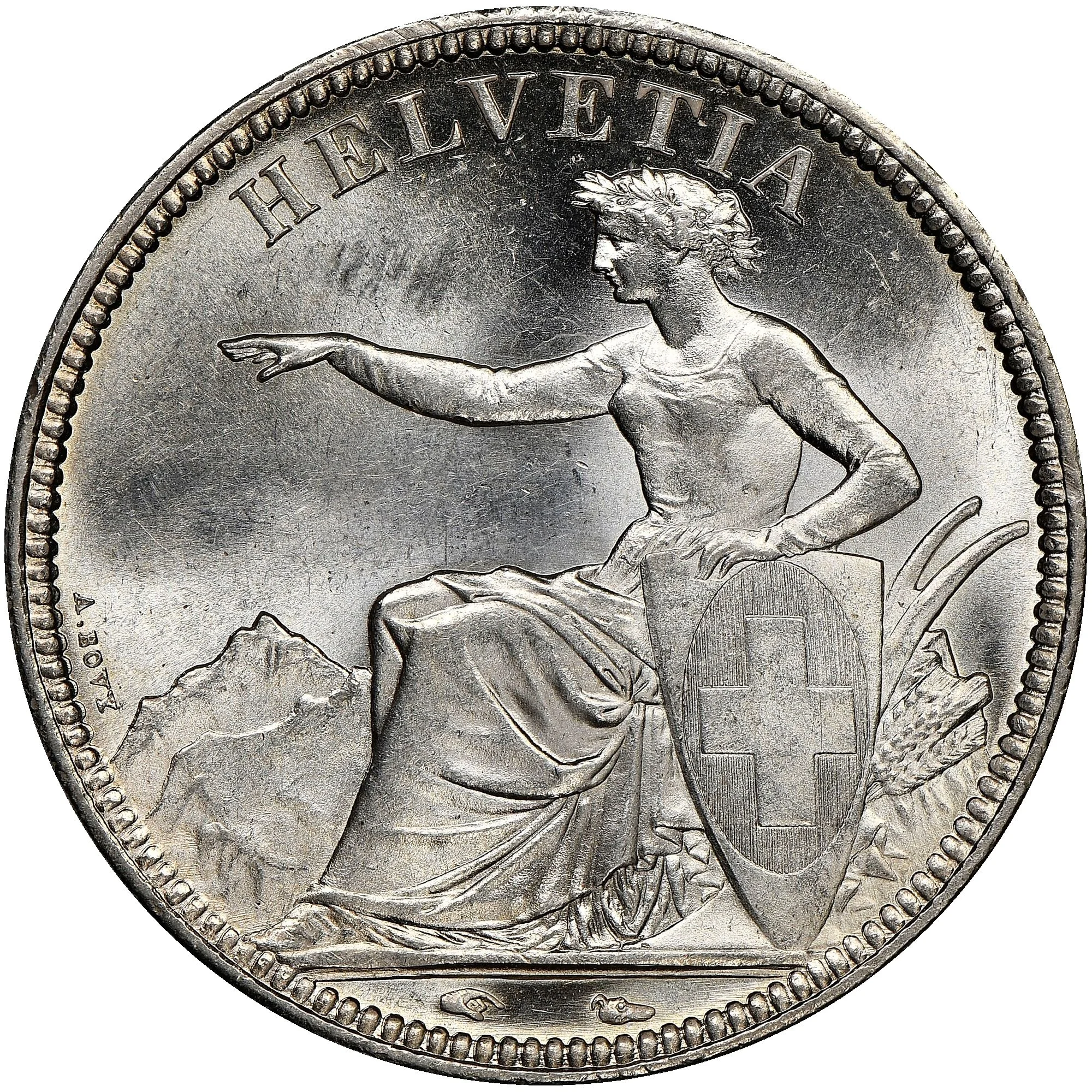
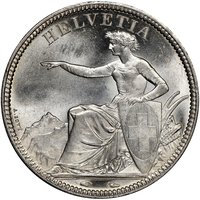
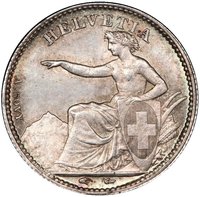
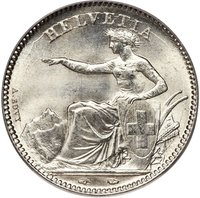
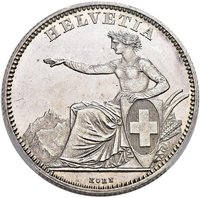
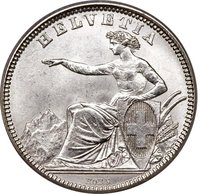
Helvetia seated left, wearing laurel wreath and toga, raising her right arm and holding Switzerland's shield. Plow and wheat to her right, mountains in background.
Inscription:
HELVETIA
A . BOVY
A . BOVY
Translation:
HELVETIA
A. BOVY
A. BOVY
Script: Latin
Engraver: Antoine Bovy
Designer: Friedrich Fisch
Reverse
Description:
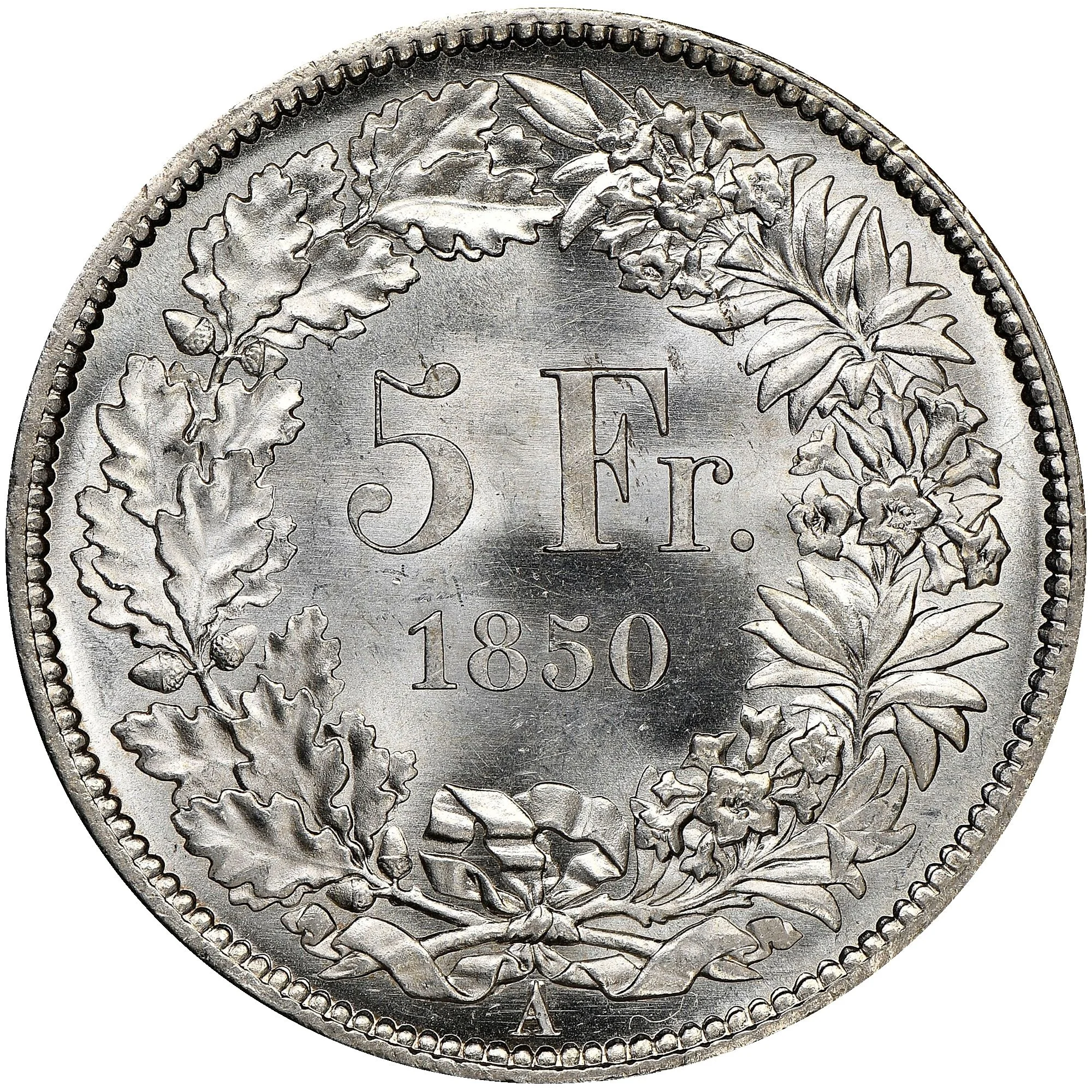
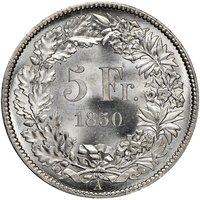
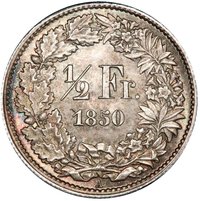
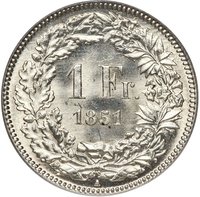
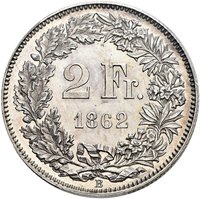
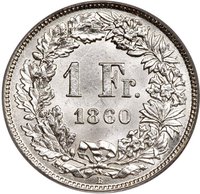
Oak and alpine rose wreath tied with ribbon below.
Inscription:
5 Fr.
1850
B
1850
B
Script: Latin
Engraver: Antoine Bovy
Designer: Friedrich Fisch
Edge
Reeded.
Mints
| Name | Mark |
|---|---|
| Monnaie de Paris | A |
| Bern | B |
| Royal Mint of Belgium | B. |
Mintings
Historical background
In 1850, Switzerland was a monetary patchwork, a direct reflection of its fragmented political structure prior to the modern federal state. Over 75 different entities—including individual cantons, cities, and even private banks—issued their own coins, while a vast array of foreign currencies (particularly French francs, Italian lire, and South German gulden) circulated freely. This chaotic system crippled domestic trade and commerce, as exchange rates fluctuated locally and transactions required constant conversion, creating uncertainty and inefficiency for a nation undergoing early industrialization.
The new Swiss Federal Constitution of 1848, which established a stronger central government, explicitly gave the Confederation the sole right to mint coins. The Federal Coinage Act of 1850 was the direct response, aiming to unify the monetary system and assert federal authority. Switzerland deliberately chose to join the Latin Monetary Union in spirit, adopting the franc as its unit, with the same weight and gold/silver content as the French franc. This established a stable, decimal-based currency (1 franc = 100 centimes) that was internationally compatible.
Thus, the first federal coins, the 1-franc and ½-franc pieces, entered circulation in 1850. They marked a pivotal first step toward national economic integration. However, unification was a process, not an overnight event; old and foreign coins remained in use for years as the new federal currency slowly permeated the economy. This successful reform laid the essential foundation for Switzerland's future financial stability and paved the way for its later banking prominence.
The new Swiss Federal Constitution of 1848, which established a stronger central government, explicitly gave the Confederation the sole right to mint coins. The Federal Coinage Act of 1850 was the direct response, aiming to unify the monetary system and assert federal authority. Switzerland deliberately chose to join the Latin Monetary Union in spirit, adopting the franc as its unit, with the same weight and gold/silver content as the French franc. This established a stable, decimal-based currency (1 franc = 100 centimes) that was internationally compatible.
Thus, the first federal coins, the 1-franc and ½-franc pieces, entered circulation in 1850. They marked a pivotal first step toward national economic integration. However, unification was a process, not an overnight event; old and foreign coins remained in use for years as the new federal currency slowly permeated the economy. This successful reform laid the essential foundation for Switzerland's future financial stability and paved the way for its later banking prominence.
Series: Helvetia seated series
🌟 Uncommon