

10 Groschen – Austria
Austria

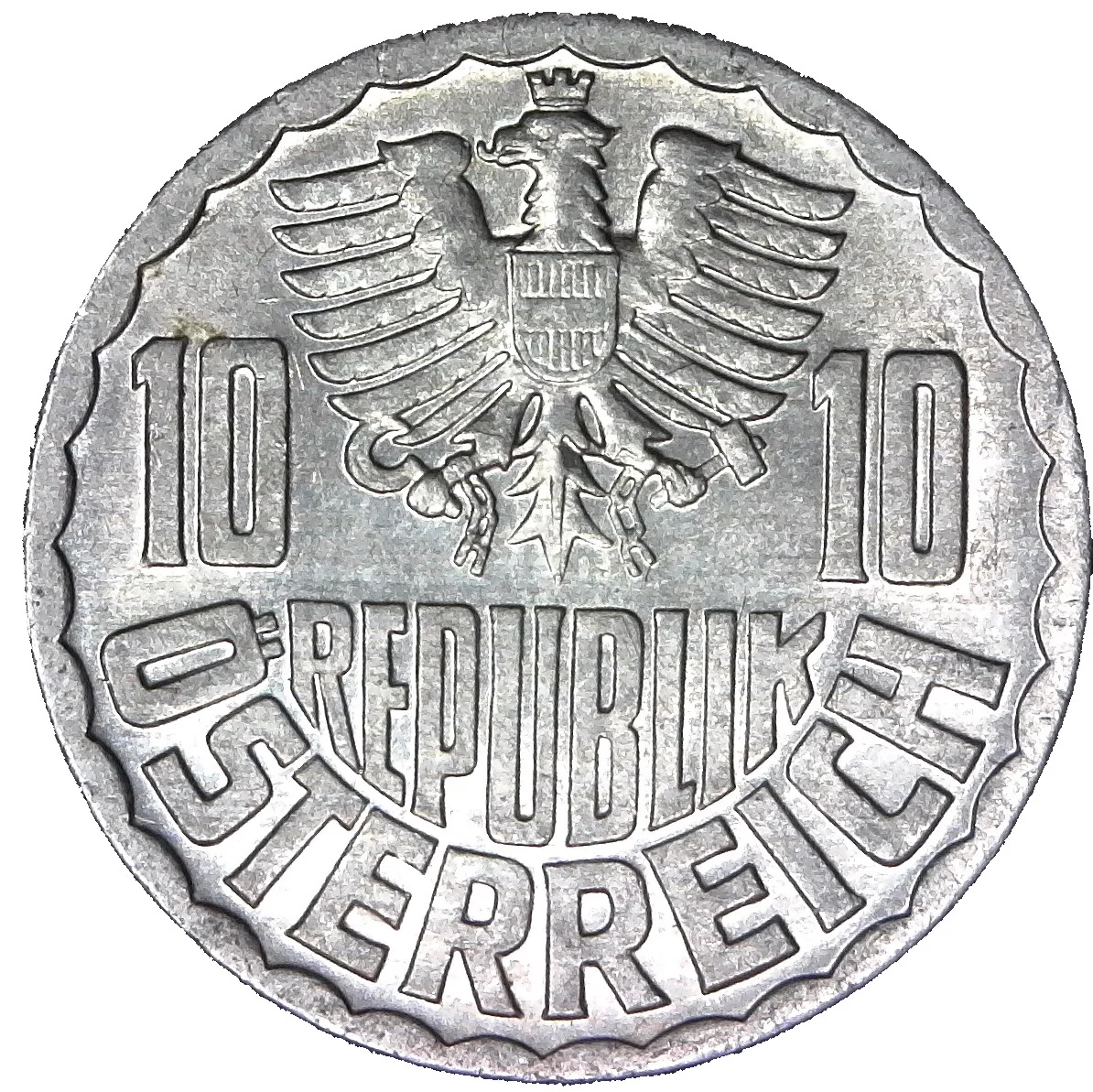
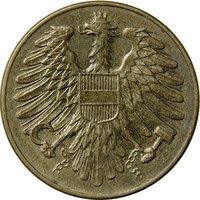
Obverse
Description:
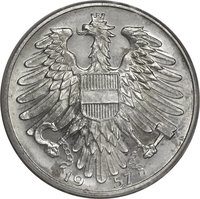
Austria's coat of arms (an eagle with broken chains and a shield) with the country name and denomination on the scalloped rim.
Inscription:
10 10
REPUBLIK
ÖSTERREICH
REPUBLIK
ÖSTERREICH
Translation:
REPUBLIC
AUSTRIA
AUSTRIA
Script: Latin
Language: German
Engraver: Hans Köttenstorfer
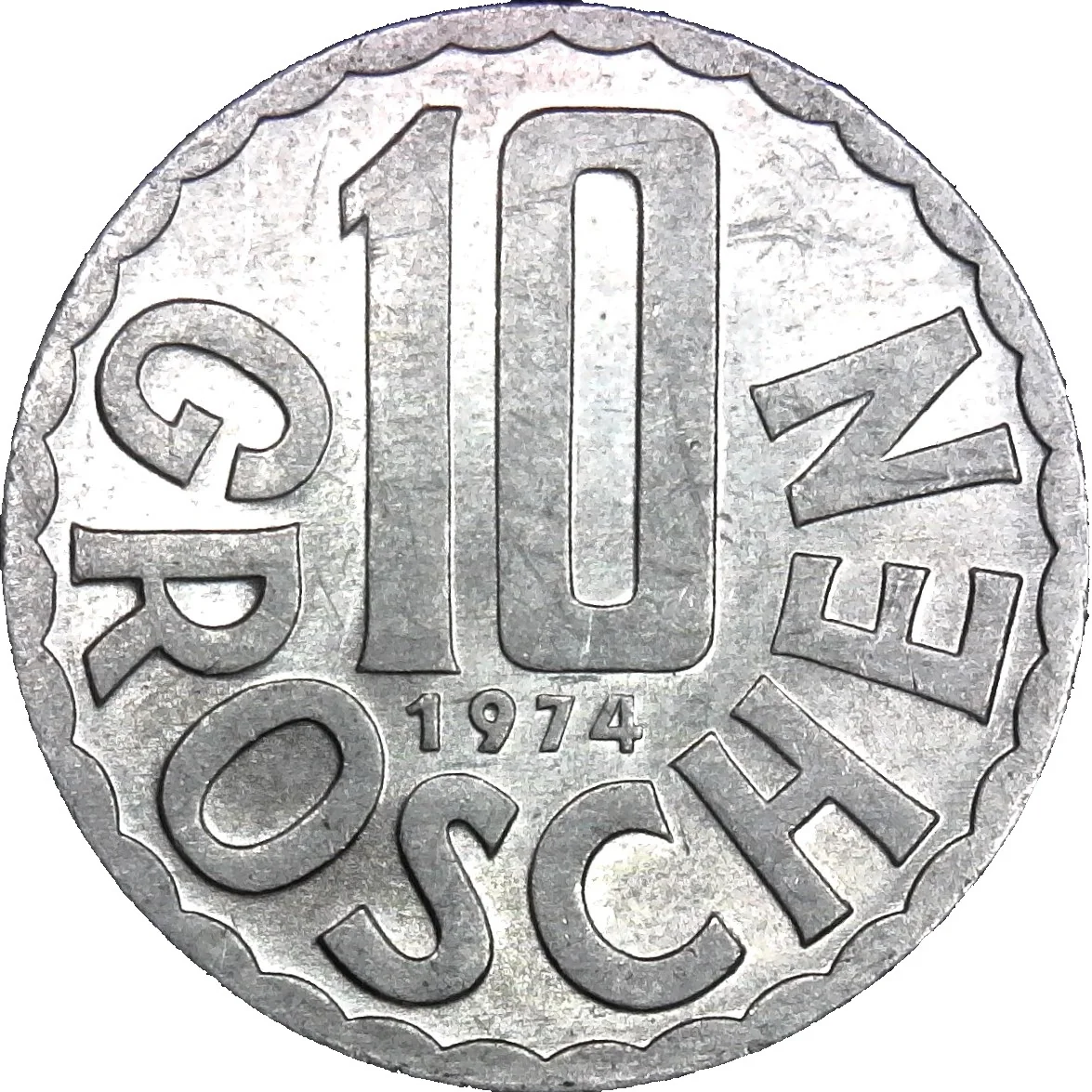
Reverse
Description:
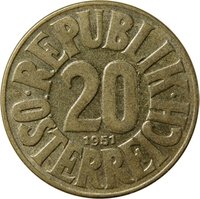
Face value above year in scalloped rim.
Inscription:
10
1974
GROSCHEN
1974
GROSCHEN
Script: Latin
Engraver: Hans Köttenstorfer
Edge
Plain
Categories
| Animal> Bird> Eagle |
| Symbols> Coat of Arms |
| Symbol> Hammer and sickle |
Mints
| Name | Mark |
|---|---|
| Münze Österreich | — |
Mintings
| Year | Mint Mark | Mintage | Quality | Collection |
|---|---|---|---|---|
| 1951 | — | 9,573,000 | ||
| 1951 | — | — | Proof | |
| 1952 | — | — | Proof | |
| 1952 | — | 45,911,400 | ||
| 1953 | — | 22,577,600 | ||
| 1953 | — | — | Proof | |
| 1955 | — | — | Proof | |
| 1955 | — | 51,707,000 | ||
| 1957 | — | 33,509,000 | ||
| 1957 | — | — | Proof | |
| 1959 | — | 80,719,000 | ||
| 1959 | — | — | Proof | |
| 1961 | — | 11,283,000 | ||
| 1962 | — | 24,635,000 | ||
| 1962 | — | — | Proof | |
| 1963 | — | 38,062,000 | ||
| 1963 | — | — | Proof | |
| 1964 | — | — | Proof | |
| 1964 | — | 34,928,000 | ||
| 1965 | — | 40,615,000 | ||
| 1965 | — | — | Proof | |
| 1966 | — | 24,991,000 | ||
| 1966 | — | — | Proof | |
| 1967 | — | 32,552,999 | ||
| 1967 | — | — | Proof | |
| 1968 | — | 42,395,800 | ||
| 1968 | — | 16,000 | Proof | |
| 1969 | — | 19,953,000 | ||
| 1969 | — | 27,000 | Proof | |
| 1970 | — | 36,997,500 | ||
| 1970 | — | 102,000 | Proof | |
| 1971 | — | 57,450,000 | ||
| 1971 | — | 82,000 | Proof | |
| 1972 | — | 75,661,000 | ||
| 1972 | — | 81,000 | Proof | |
| 1973 | — | 60,244,000 | ||
| 1973 | — | 97,000 | Proof | |
| 1974 | — | 55,924,000 | ||
| 1974 | — | 78,000 | Proof | |
| 1975 | — | 60,576,000 | ||
| 1975 | — | 49,000 | Proof | |
| 1976 | — | 39,357,000 | ||
| 1976 | — | 44,000 | Proof | |
| 1977 | — | 53,610,000 | ||
| 1977 | — | 44,000 | Proof | |
| 1978 | — | 57,857,000 | ||
| 1978 | — | 43,000 | Proof | |
| 1979 | — | 44,000 | Proof | |
| 1979 | — | 103,686,000 | ||
| 1980 | — | 79,848,000 | ||
| 1980 | — | 48,000 | Proof | |
| 1981 | — | 92,268,000 | ||
| 1981 | — | 49,000 | Proof | |
| 1982 | — | 99,950,000 | ||
| 1982 | — | 50,000 | Proof | |
| 1983 | — | 93,768,000 | ||
| 1983 | — | 65,000 | Proof | |
| 1984 | — | 86,603,000 | ||
| 1984 | — | 65,000 | Proof | |
| 1985 | — | 86,304,000 | ||
| 1985 | — | 45,000 | Proof | |
| 1986 | — | 108,912,000 | ||
| 1986 | — | 42,000 | Proof | |
| 1987 | — | 114,058,000 | ||
| 1987 | — | 42,000 | Proof | |
| 1988 | — | 114,461,000 | ||
| 1988 | — | 39,000 | Proof | |
| 1989 | — | 127,784,000 | ||
| 1989 | — | 38,000 | Proof | |
| 1990 | — | 182,050,000 | ||
| 1990 | — | 35,000 | Proof | |
| 1991 | — | 145,000,000 | ||
| 1991 | — | 27,000 | Proof | |
| 1992 | — | 125,000,000 | ||
| 1992 | — | 25,000 | Proof | |
| 1993 | — | 120,000,000 | ||
| 1993 | — | 28,000 | Proof | |
| 1994 | — | 110,000,000 | ||
| 1994 | — | 25,000 | Proof | |
| 1995 | — | 80,000,000 | ||
| 1995 | — | 27,000 | Proof | |
| 1996 | — | 100,000,000 | ||
| 1996 | — | 25,000 | Proof | |
| 1997 | — | 80,000,000 | ||
| 1997 | — | 25,000 | Proof | |
| 1998 | — | 32,000,000 | ||
| 1998 | — | 25,000 | Proof | |
| 1999 | — | 50,000 | ||
| 2000 | — | 75,000 | ||
| 2001 | — | 75,000 |
Historical background
In 1951, Austria was in the early stages of its remarkable post-war recovery, but its currency situation remained precarious and tightly controlled. The official currency was the Austrian Schilling, reintroduced in 1945 to replace the Reichsmark. However, the economy was still characterized by severe shortages, a large black market, and a complex system of price controls and rationing. The National Bank, re-established in 1945, lacked full sovereignty as monetary policy was heavily influenced by the Allied Occupation Council, reflecting the country's divided status under American, British, French, and Soviet administration.
The key monetary challenge was a significant imbalance between the volume of money in circulation and the available goods, leading to persistent inflationary pressures. This was exacerbated by the costs of reconstruction and the need to support refugees and displaced persons. To manage this, authorities maintained strict foreign exchange controls and a multi-tiered exchange rate system. Different rates applied to essential imports, other goods, and tourism, creating distortions. The black market rate for the Schilling was substantially weaker than the official rates, highlighting the gap between controlled prices and economic reality.
This constrained environment set the stage for critical reforms. The year 1951 itself saw important steps toward stabilization, including budgetary tightening and the beginning of a shift toward more uniform exchange rates, processes strongly encouraged by the nascent Marshall Plan aid. These efforts would culminate in the landmark "Schilling Law" of November 1952, which established a stable, convertible Schilling, defined its gold parity, and granted full independence to the Austrian National Bank. Therefore, the currency situation in 1951 is best understood as the tense and transitional prelude to this decisive stabilization, which laid the foundation for Austria's subsequent "economic miracle."
The key monetary challenge was a significant imbalance between the volume of money in circulation and the available goods, leading to persistent inflationary pressures. This was exacerbated by the costs of reconstruction and the need to support refugees and displaced persons. To manage this, authorities maintained strict foreign exchange controls and a multi-tiered exchange rate system. Different rates applied to essential imports, other goods, and tourism, creating distortions. The black market rate for the Schilling was substantially weaker than the official rates, highlighting the gap between controlled prices and economic reality.
This constrained environment set the stage for critical reforms. The year 1951 itself saw important steps toward stabilization, including budgetary tightening and the beginning of a shift toward more uniform exchange rates, processes strongly encouraged by the nascent Marshall Plan aid. These efforts would culminate in the landmark "Schilling Law" of November 1952, which established a stable, convertible Schilling, defined its gold parity, and granted full independence to the Austrian National Bank. Therefore, the currency situation in 1951 is best understood as the tense and transitional prelude to this decisive stabilization, which laid the foundation for Austria's subsequent "economic miracle."
🌱 Very Common