

50 francs – Belgium
Add to wishlist
Circulating commemorative coins
Commemoration: Brussels Exposition and Railway Centennial
Belgium
Context
Year: 1935
Issuer: Belgium
Ruler: Leopold III
Currency:
(1832—2001)
Demonetization: 2 June 1939
Total mintage: 140,435
Material
References
KM: #
Numista: #18914
Value
Exchange value: 50 BEF
Bullion value: $37.93
Obverse
Description:
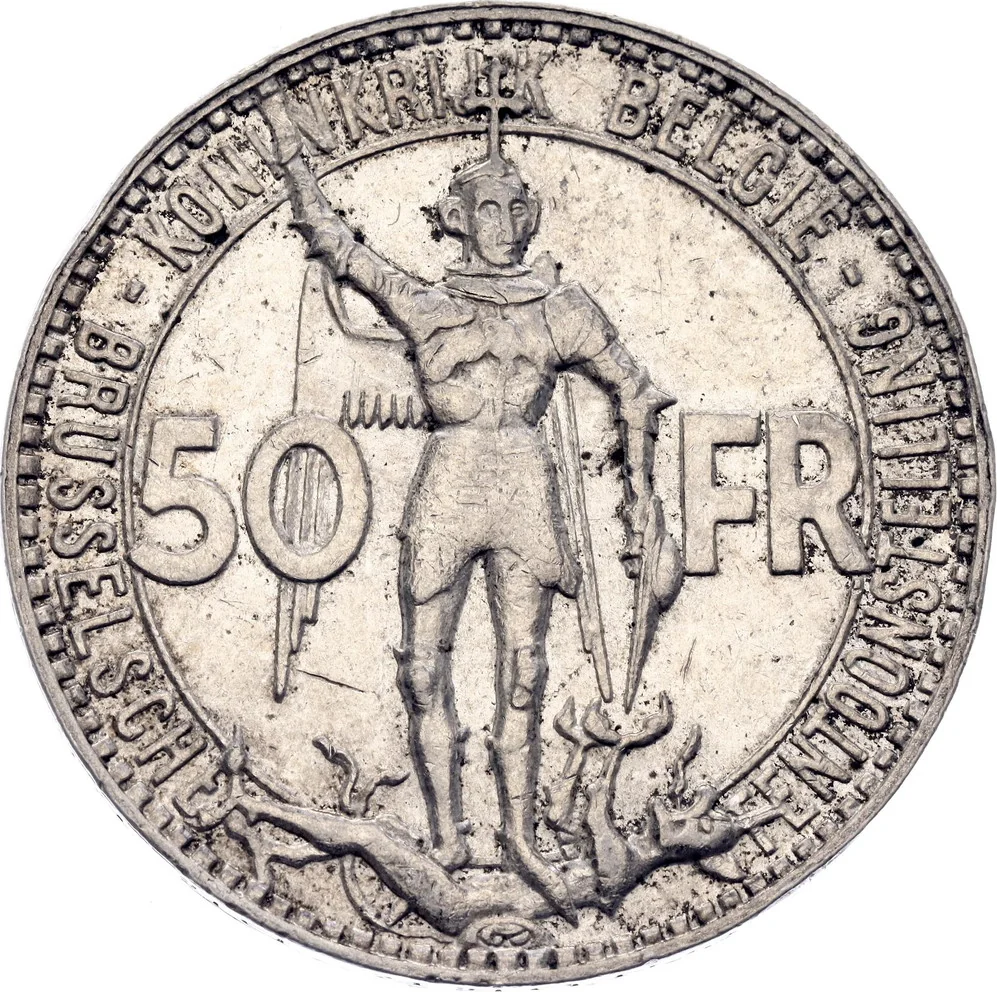
Saint Michael standing winged on a dragon, dividing value. Dutch text encircles it.
Inscription:
- KONINKRIJK BELGIE -
BRUSSELSCHE TENTOONSTELLING
50 FR
BRUSSELSCHE TENTOONSTELLING
50 FR
Translation:
Kingdom of Belgium
Brussels Exhibition
50 Francs
Brussels Exhibition
50 Francs
Script: Latin
Engraver: Paul Wissaert
Reverse
Description:
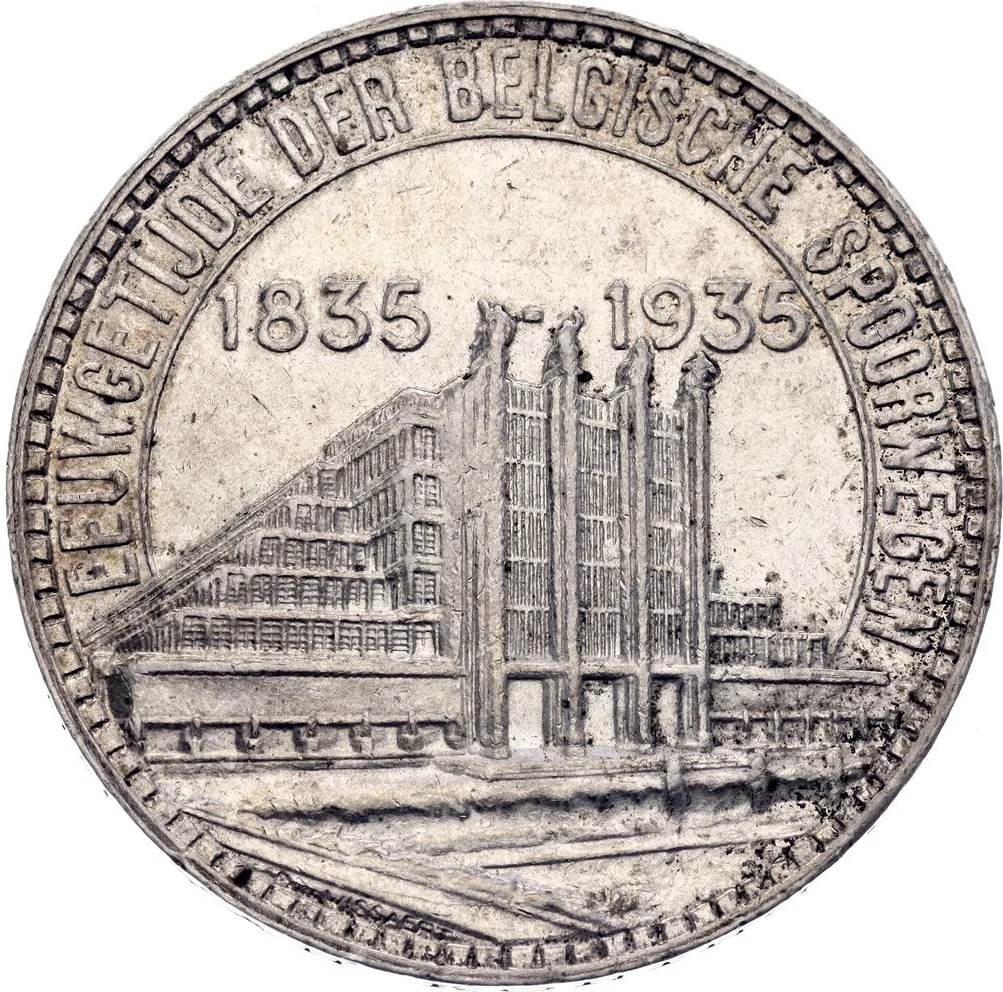
Brussels Expo building with years above. Dutch text arcs around the half circle.
Inscription:
EEUWGETIJDE DER BELGISCHE SPOORWEGEN
1835 - 1935
1835 - 1935
Translation:
Centenary of the Belgian Railways
1835 - 1935
1835 - 1935
Script: Latin
Language: Dutch
Engraver: Paul Wissaert
Edge
Plain with incused lettering
Legend:
ONDER DE REGEERING VAN KONING LEOPOLD III
Translation:
Under the Reign of King Leopold III
Language: Dutch
Categories
| Person> Religious figure |
| Object> Cold weapons |
| Mythology> Fantastic animal |
| Object> Armour |
Mints
| Name | Mark |
|---|---|
| Royal Mint of Belgium | — |
Mintings
| Year | Mint Mark | Mintage | Quality | Collection |
|---|---|---|---|---|
| 1935 | — | 140,435 |
Historical background
In 1935, Belgium was grappling with the severe economic consequences of the Great Depression, which had exposed the fragility of its financial system and currency. The Belgian franc, which had been painstakingly stabilized and pegged to gold in 1926 after a period of hyperinflation, came under intense speculative pressure. A significant overvaluation, combined with the deflationary policies of the "Gold Bloc" (a group of European nations, including Belgium, committed to maintaining the gold standard), crippled Belgian exports and deepened industrial recession, leading to widespread bankruptcies and high unemployment.
The crisis culminated in the spring of 1935, forcing a fundamental policy shift. Under the new government of Prime Minister Paul van Zeeland, and with crucial advice from monetary expert Maurice Frère, Belgium was forced to abandon the gold standard in March 1935. This decisive move involved a devaluation of the franc by 28%, a measure designed to restore competitiveness, stimulate exports, and break the cycle of deflation. The devaluation was accompanied by a comprehensive reform package, including the creation of the Bank of Belgium (to replace the old National Bank) and the Office of Rediscount and Guarantee, aimed at recapitalizing banks and restoring confidence in the financial sector.
The 1935 devaluation proved to be a turning point for the Belgian economy. It successfully ended the deflationary spiral and marked the beginning of a slow but tangible recovery, distinguishing Belgium from other Gold Bloc countries that resisted devaluation for longer. The episode underscored the limitations of the international gold standard during economic crises and established a new framework for Belgian monetary policy, prioritizing domestic economic stability over a rigid peg to gold. This pragmatic approach would shape Belgium's financial governance in the decades to follow.
The crisis culminated in the spring of 1935, forcing a fundamental policy shift. Under the new government of Prime Minister Paul van Zeeland, and with crucial advice from monetary expert Maurice Frère, Belgium was forced to abandon the gold standard in March 1935. This decisive move involved a devaluation of the franc by 28%, a measure designed to restore competitiveness, stimulate exports, and break the cycle of deflation. The devaluation was accompanied by a comprehensive reform package, including the creation of the Bank of Belgium (to replace the old National Bank) and the Office of Rediscount and Guarantee, aimed at recapitalizing banks and restoring confidence in the financial sector.
The 1935 devaluation proved to be a turning point for the Belgian economy. It successfully ended the deflationary spiral and marked the beginning of a slow but tangible recovery, distinguishing Belgium from other Gold Bloc countries that resisted devaluation for longer. The episode underscored the limitations of the international gold standard during economic crises and established a new framework for Belgian monetary policy, prioritizing domestic economic stability over a rigid peg to gold. This pragmatic approach would shape Belgium's financial governance in the decades to follow.
⭐ Somewhat Rare