

50 francs – Belgium
Add to wishlist
Circulating commemorative coins
Commemoration: European Soccer Championship
Belgium
Context
Material
References
KM: #
Numista: #6397
Value
Exchange value: 50 BEF
Inflation-adjusted value: 88.34 BEF
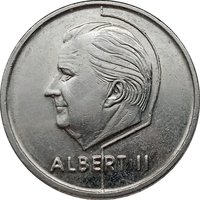
Obverse
Description:
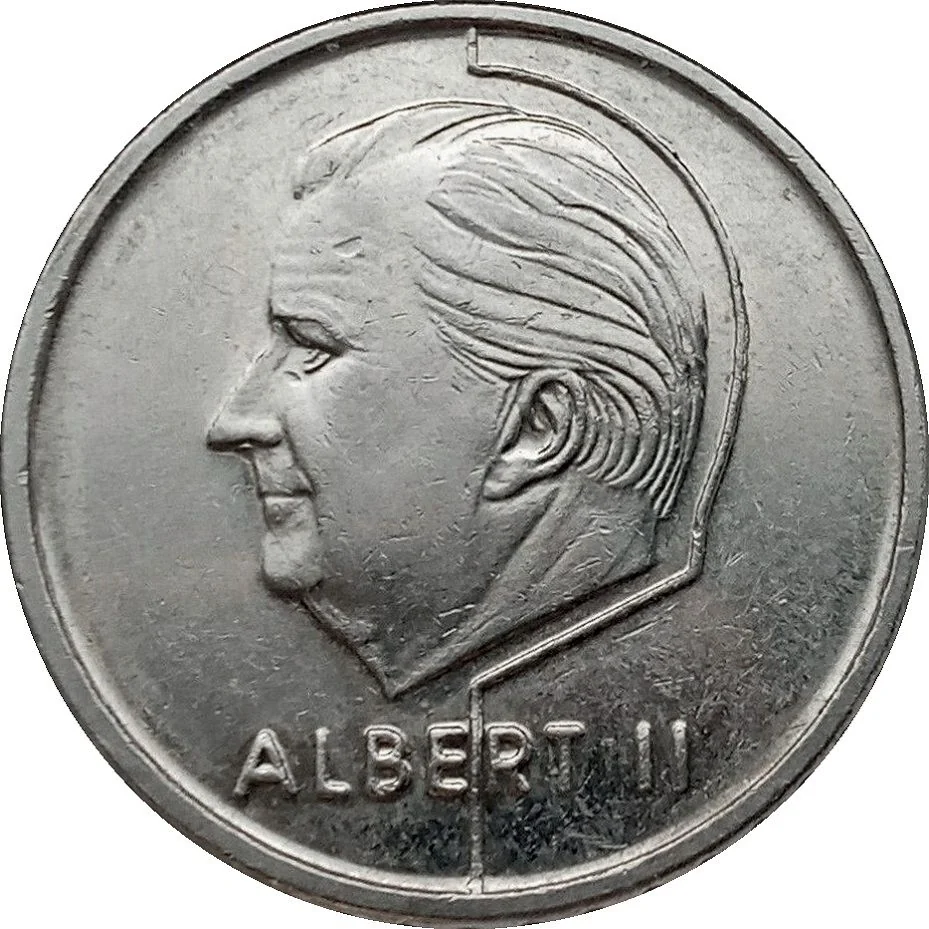
Albert II in left profile, name below, with silhouette outline.
Inscription:
ALBERT II
Script: Latin
Engraver: Jan Alfons Keustermans
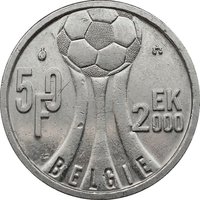
Reverse
Description:
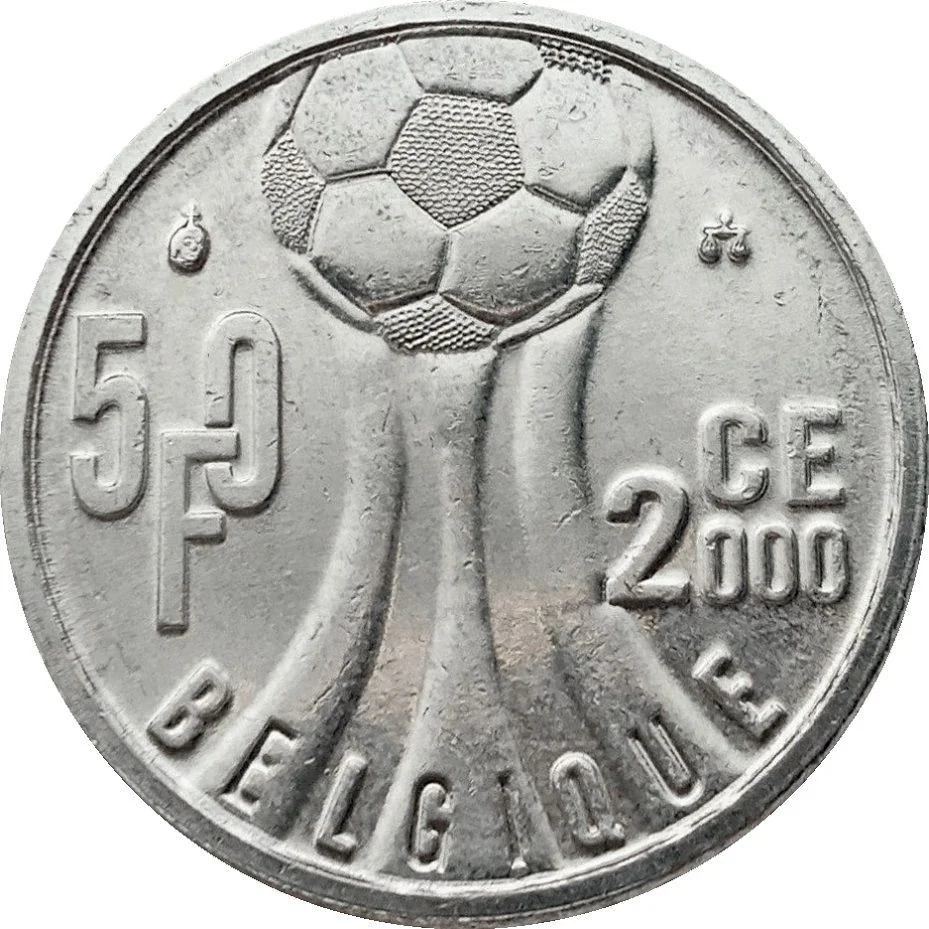
Football on pedestal. Left: value and mint mark. Right: year, privy mark, lettering. French legend below.
Inscription:
50
F
CE
2000
BELGIQUE
F
CE
2000
BELGIQUE
Translation:
50
F
CE
2000
BELGIQUE
F
CE
2000
BELGIQUE
Script: Latin
Language: French
Engraver: Jan Alfons Keustermans
Edge
Reeded
Mints
| Name | Mark |
|---|---|
| Royal Mint of Belgium | — |
Mintings
| Year | Mint Mark | Mintage | Quality | Collection |
|---|---|---|---|---|
| 2000 | — | 20,000 | In sets | |
| 2000 | — | 500,000 |
Historical background
By the year 2000, Belgium was in the final, established phase of operating within the Eurozone's precursor system, the European Exchange Rate Mechanism (ERM II). The Belgian franc (BEF) had been pegged to other European currencies, most importantly the Deutsche Mark, for many years as part of a deliberate policy to import monetary stability and combat the country's historically high inflation. This alignment was formalized with Belgium's participation in the launch of the euro on 1 January 1999, when the franc became a fixed, non-decimal subunit of the new single currency at a rate of 40.3399 BEF to 1 EUR. Throughout 2000, while euro banknotes and coins were not yet in physical circulation, the euro existed as "book money" and was used for electronic payments and financial markets, with the franc remaining the everyday physical currency.
The domestic currency situation was stable but marked by a sense of anticipation for the impending cash changeover, scheduled for 1 January 2002. The National Bank of Belgium, alongside commercial banks and retailers, was deeply engaged in extensive logistical preparations for the introduction of euro notes and coins. This involved producing and securing billions of new banknotes and coins, adapting millions of vending machines and cash registers, and launching public information campaigns to familiarize citizens with the new currency's appearance and value.
Economically, Belgium in 2000 was fully subject to the monetary policy set by the European Central Bank (ECB) in Frankfurt, having ceded national control over interest rates and money supply. The primary focus was on ensuring a smooth and efficient transition to the physical euro, minimizing disruption for businesses and consumers. The period was thus one of technical execution and public education, marking the quiet end of the Belgian franc's long history as the final step in Belgium's irreversible integration into the European Monetary Union.
The domestic currency situation was stable but marked by a sense of anticipation for the impending cash changeover, scheduled for 1 January 2002. The National Bank of Belgium, alongside commercial banks and retailers, was deeply engaged in extensive logistical preparations for the introduction of euro notes and coins. This involved producing and securing billions of new banknotes and coins, adapting millions of vending machines and cash registers, and launching public information campaigns to familiarize citizens with the new currency's appearance and value.
Economically, Belgium in 2000 was fully subject to the monetary policy set by the European Central Bank (ECB) in Frankfurt, having ceded national control over interest rates and money supply. The primary focus was on ensuring a smooth and efficient transition to the physical euro, minimizing disruption for businesses and consumers. The period was thus one of technical execution and public education, marking the quiet end of the Belgian franc's long history as the final step in Belgium's irreversible integration into the European Monetary Union.
🌱 Common