

50 toea (Statehood) – Papua New Guinea
Add to wishlist
Circulating commemorative coins
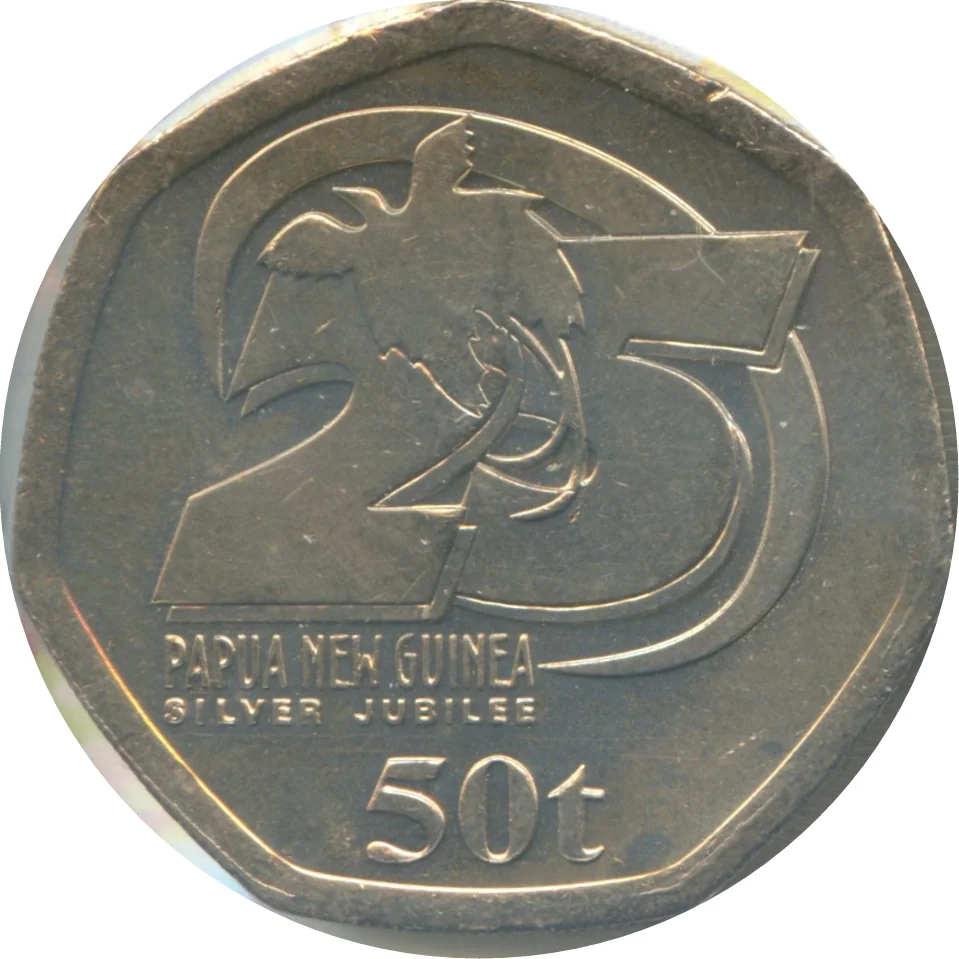
Commemoration: 25th Anniversary of Statehood
Papua New Guinea
Context
Material
Diameter: 30 mm
Weight: 13.5 g
Thickness: 2 mm
Shape: Heptagonal
Composition: Copper-nickel
Technique: Milled
Alignment: Medal alignment
flip
References
KM: #
Numista: #10758
Value
Exchange value: 0.50 PGK
Obverse
Description:
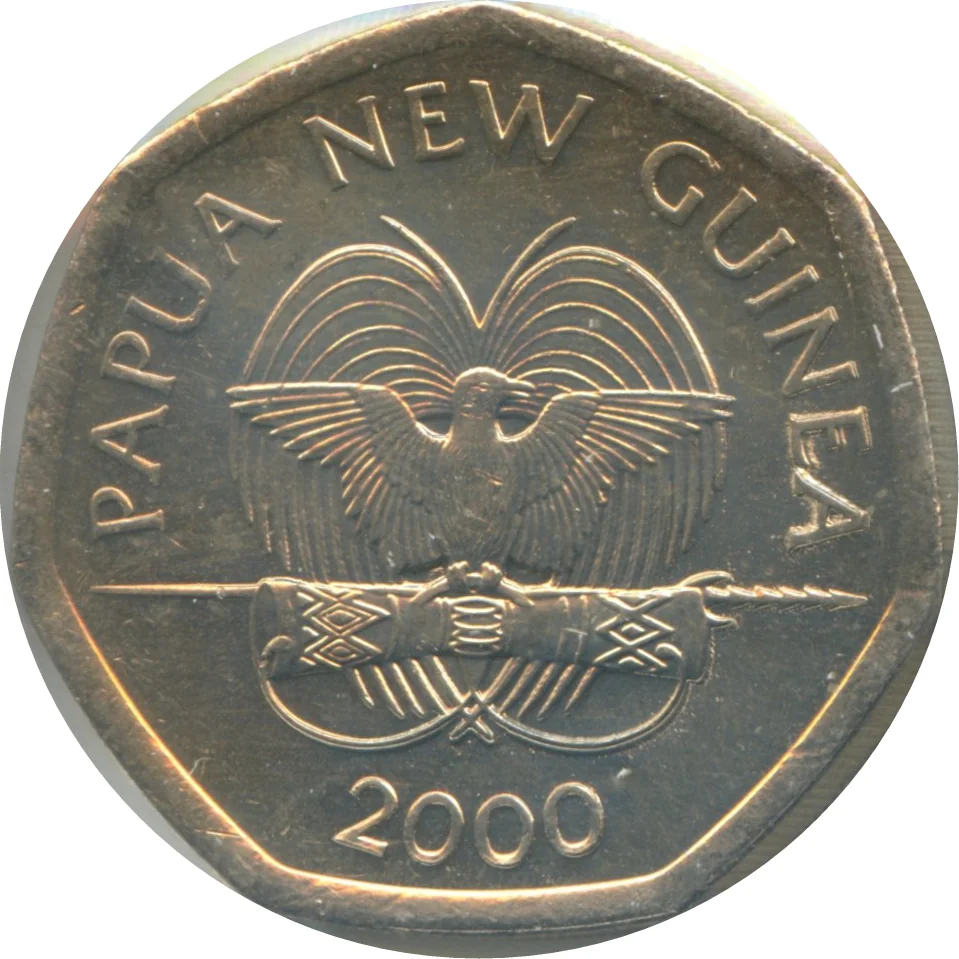
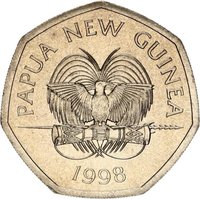
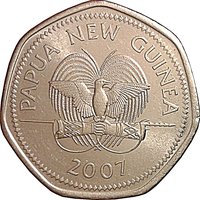
A bird-of-paradise above a spear and kundu drum.
Inscription:
PAPUA NEW GUINEA
2000
2000
Script: Latin
Reverse
Edge
Milled
Categories
| Object> Cold weapons |
| Animal> Bird |
| Art> Music |
| Event> Independence |
| Symbols> Coat of Arms |
Mints
| Name | Mark |
|---|---|
| Royal Mint | — |
Mintings
| Year | Mint Mark | Mintage | Quality | Collection |
|---|---|---|---|---|
| 2000 | — | — |
Historical background
In the year 2000, Papua New Guinea's currency, the kina (PGK), was in a state of managed instability, grappling with the severe after-effects of a prolonged economic crisis. The decade prior had been marred by a costly secessionist conflict on Bougainville, a severe drought in 1997, and a collapse in global commodity prices, which devastated the country's key export sectors of mining, oil, and agriculture. By 2000, the kina was under a de facto "crawling peg" regime, where the Bank of Papua New Guinea (BPNG) was heavily managing its descent against major currencies, primarily the US dollar and the Australian dollar, to prevent a catastrophic freefall while attempting to maintain some export competitiveness.
This managed depreciation was a response to intense foreign exchange shortages and mounting pressure on the country's reserves. A significant parallel (black) market for foreign currency had emerged, where businesses and individuals paid a substantial premium over the official rate to access much-needed US or Australian dollars, highlighting a critical lack of confidence in the kina and the strain on formal channels. The government, led by Prime Minister Sir Mekere Morauta who took office in 1999, was in the midst of implementing a stringent reform program backed by the International Monetary Fund (IMF) and World Bank, which included fiscal austerity, public service reforms, and the privatization of state assets, all aimed at stabilizing the macroeconomy and the currency.
Consequently, the currency situation in 2000 was one of cautious transition, defined by a tightly controlled official devaluation rather than a float. The Morauta government's reforms were beginning to restore some international credibility, but the kina remained weak, illiquid, and subject to strict central bank controls. The fundamental challenge was to rebuild foreign reserves, curb inflation, and attract foreign investment, all necessary to move towards a more stable and convertible currency, a process that would extend well beyond the turn of the millennium.
This managed depreciation was a response to intense foreign exchange shortages and mounting pressure on the country's reserves. A significant parallel (black) market for foreign currency had emerged, where businesses and individuals paid a substantial premium over the official rate to access much-needed US or Australian dollars, highlighting a critical lack of confidence in the kina and the strain on formal channels. The government, led by Prime Minister Sir Mekere Morauta who took office in 1999, was in the midst of implementing a stringent reform program backed by the International Monetary Fund (IMF) and World Bank, which included fiscal austerity, public service reforms, and the privatization of state assets, all aimed at stabilizing the macroeconomy and the currency.
Consequently, the currency situation in 2000 was one of cautious transition, defined by a tightly controlled official devaluation rather than a float. The Morauta government's reforms were beginning to restore some international credibility, but the kina remained weak, illiquid, and subject to strict central bank controls. The fundamental challenge was to rebuild foreign reserves, curb inflation, and attract foreign investment, all necessary to move towards a more stable and convertible currency, a process that would extend well beyond the turn of the millennium.
🌟 Uncommon