

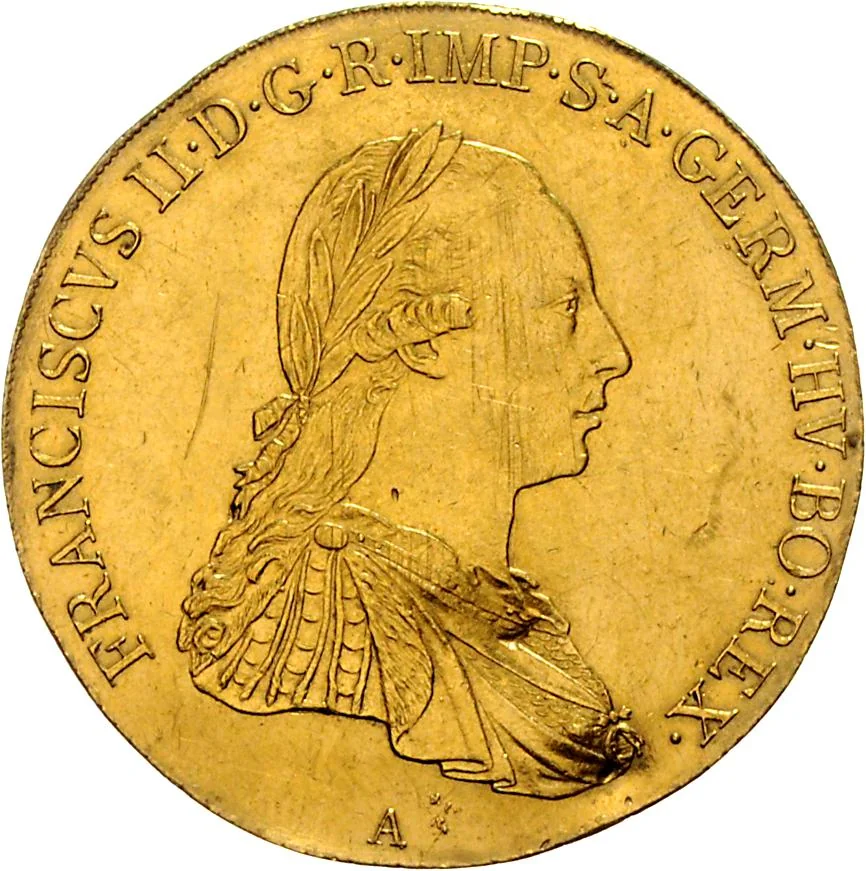
4 ducats – Austrian Empire
Add to wishlist
Austria
Context
Years: 1801–1804
Country: Austria
Issuer: Austrian Empire
Ruler: Francis II
Currency:
(1754—1857)
Demonetized: Yes
Material
References
KM: #
Numista: #86707
Value
Bullion value: $2121.50
Obverse
Reverse
Description:
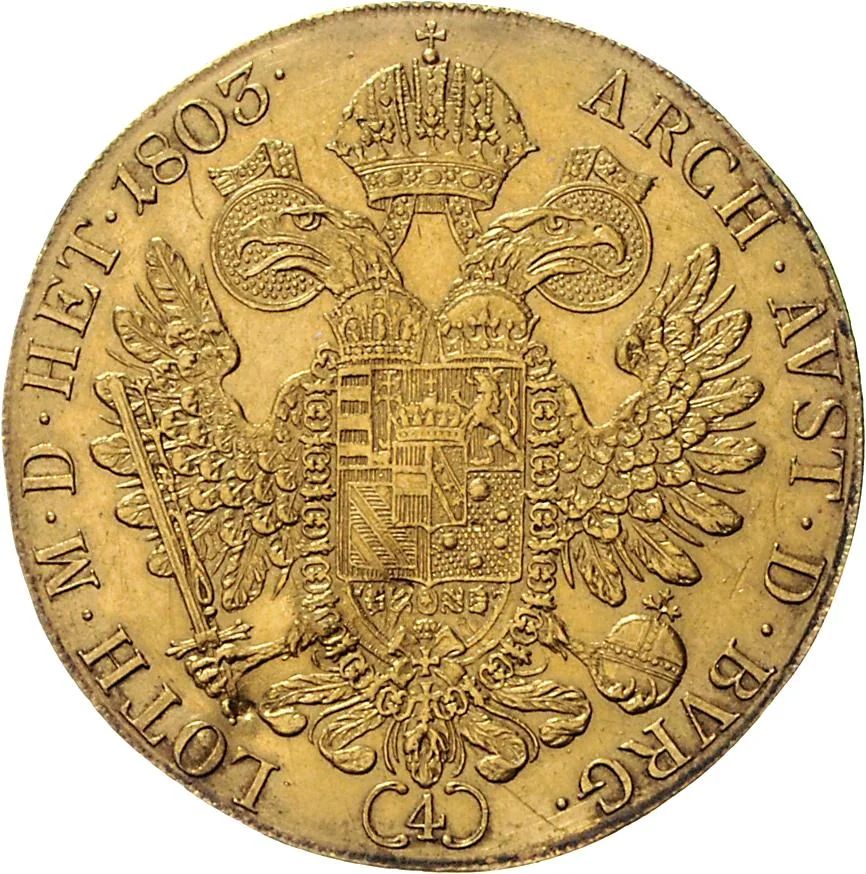
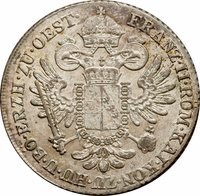
Imperial eagle with crown and shield, value in frame below. Legend begins at 1 o'clock.
Inscription:
ARCH AVST D BVRG (4) LOTH M D HET 1803
Script: Latin
Edge
Plain
Mints
| Name | Mark |
|---|---|
| Münze Österreich | A |
Historical background
In 1801, the currency situation in the Austrian Empire was one of profound instability and complexity, a direct legacy of the costly wars against Revolutionary France. To finance these conflicts, the state had heavily relied on the expedient of printing paper money, known as Bancozettel. Initially introduced in 1762 and backed by the state-owned Wiener Stadtbanco, these notes had become effectively irredeemable for specie (silver or gold coin), leading to a severe loss of public confidence and rampant inflation. By the turn of the century, a chaotic multi-currency system was in place, with a wide gap between the depreciating paper gulden and the much more valuable silver Conventionsthaler, causing confusion in trade and daily commerce.
The government, under Emperor Francis II, recognized the crisis and attempted reform with the Bankozettelpatent of 1800. This law aimed to stabilize the currency by fixing the exchange rate between paper and silver and committing to a gradual reduction of the paper money in circulation. However, the peace proved fleeting, and the resumption of war with France in 1801 doomed these efforts. The state's desperate need for funds forced it to abandon its own redemption policies and continue printing Bancozettel, accelerating depreciation. Consequently, the empire operated with a devalued and untrustworthy paper currency for large transactions, while precious metal coins were hoarded or used for international trade, creating a crippling shortage of sound money for the populace.
This monetary disarray had severe economic and social consequences. Prices soared unpredictably, harming wage-earners and those on fixed incomes, while creating opportunities for speculators. It undermined long-term investment, hampered efficient tax collection as the value of payments eroded, and weakened the overall fiscal health of the empire. Thus, in 1801, Austria was trapped in a vicious cycle: war necessitated inflationary finance, which wrecked the currency, which in turn further strained the empire's capacity to wage war, setting the stage for the state bankruptcy (Staatsbankrott) that would be declared in 1811.
The government, under Emperor Francis II, recognized the crisis and attempted reform with the Bankozettelpatent of 1800. This law aimed to stabilize the currency by fixing the exchange rate between paper and silver and committing to a gradual reduction of the paper money in circulation. However, the peace proved fleeting, and the resumption of war with France in 1801 doomed these efforts. The state's desperate need for funds forced it to abandon its own redemption policies and continue printing Bancozettel, accelerating depreciation. Consequently, the empire operated with a devalued and untrustworthy paper currency for large transactions, while precious metal coins were hoarded or used for international trade, creating a crippling shortage of sound money for the populace.
This monetary disarray had severe economic and social consequences. Prices soared unpredictably, harming wage-earners and those on fixed incomes, while creating opportunities for speculators. It undermined long-term investment, hampered efficient tax collection as the value of payments eroded, and weakened the overall fiscal health of the empire. Thus, in 1801, Austria was trapped in a vicious cycle: war necessitated inflationary finance, which wrecked the currency, which in turn further strained the empire's capacity to wage war, setting the stage for the state bankruptcy (Staatsbankrott) that would be declared in 1811.
✨ Legendary