

5 Pesos – Mexico
Circulating commemorative coins
Commemoration: Opening of the Southeastern Railroad
Mexico
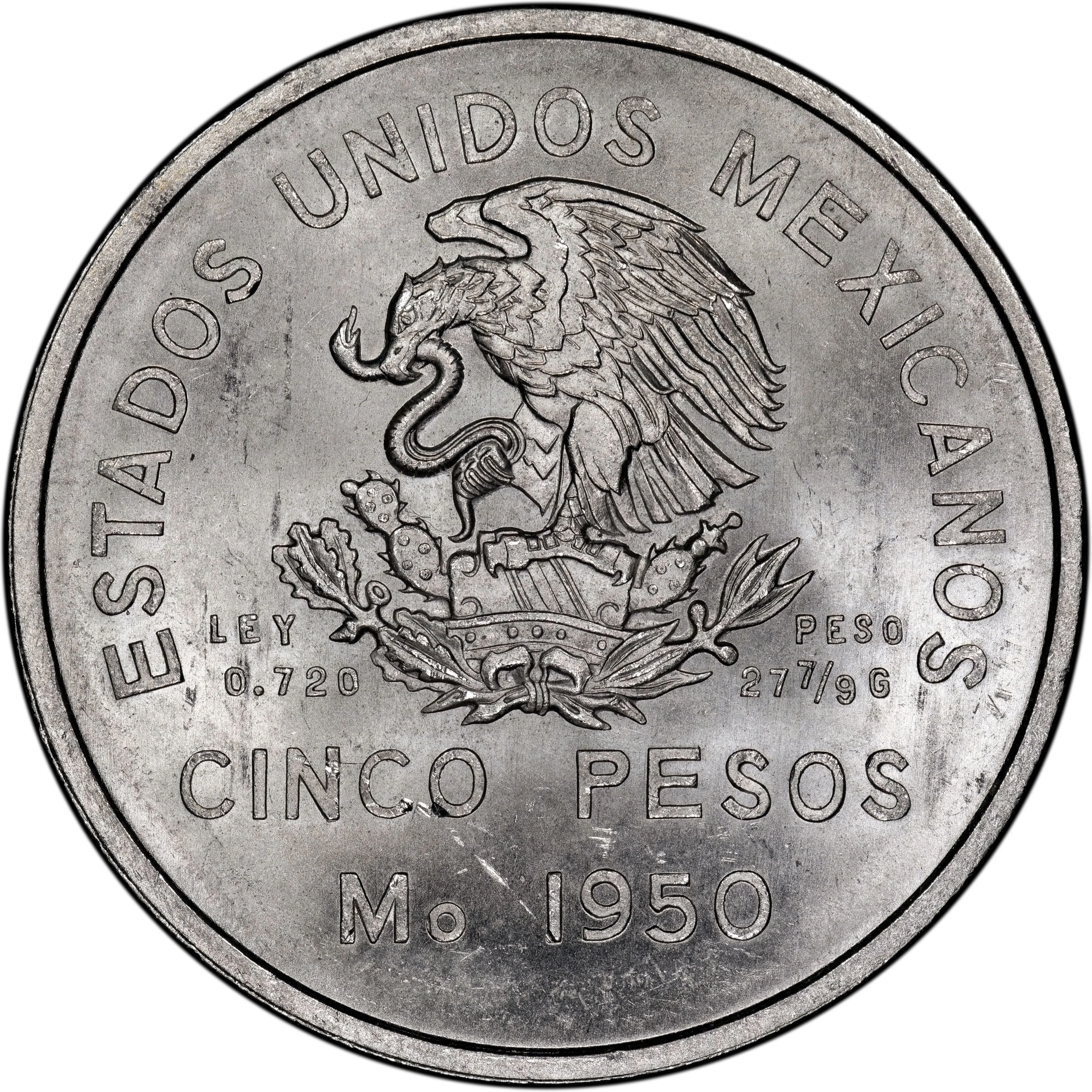
Obverse
Description:
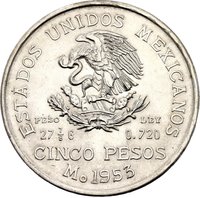
Eagle on a cactus, holding a snake.
Inscription:
ESTADOS UNIDOS MEXICANOS
LEY PESO
.720 277/9 g
CINCO PESOS
Mo 1950
LEY PESO
.720 277/9 g
CINCO PESOS
Mo 1950
Translation:
UNITED MEXICAN STATES
LAW PESO
.720 277/9 g
FIVE PESOS
Mo 1950
LAW PESO
.720 277/9 g
FIVE PESOS
Mo 1950
Script: Latin
Language: Spanish
Engraver: Manuel L. Negrete
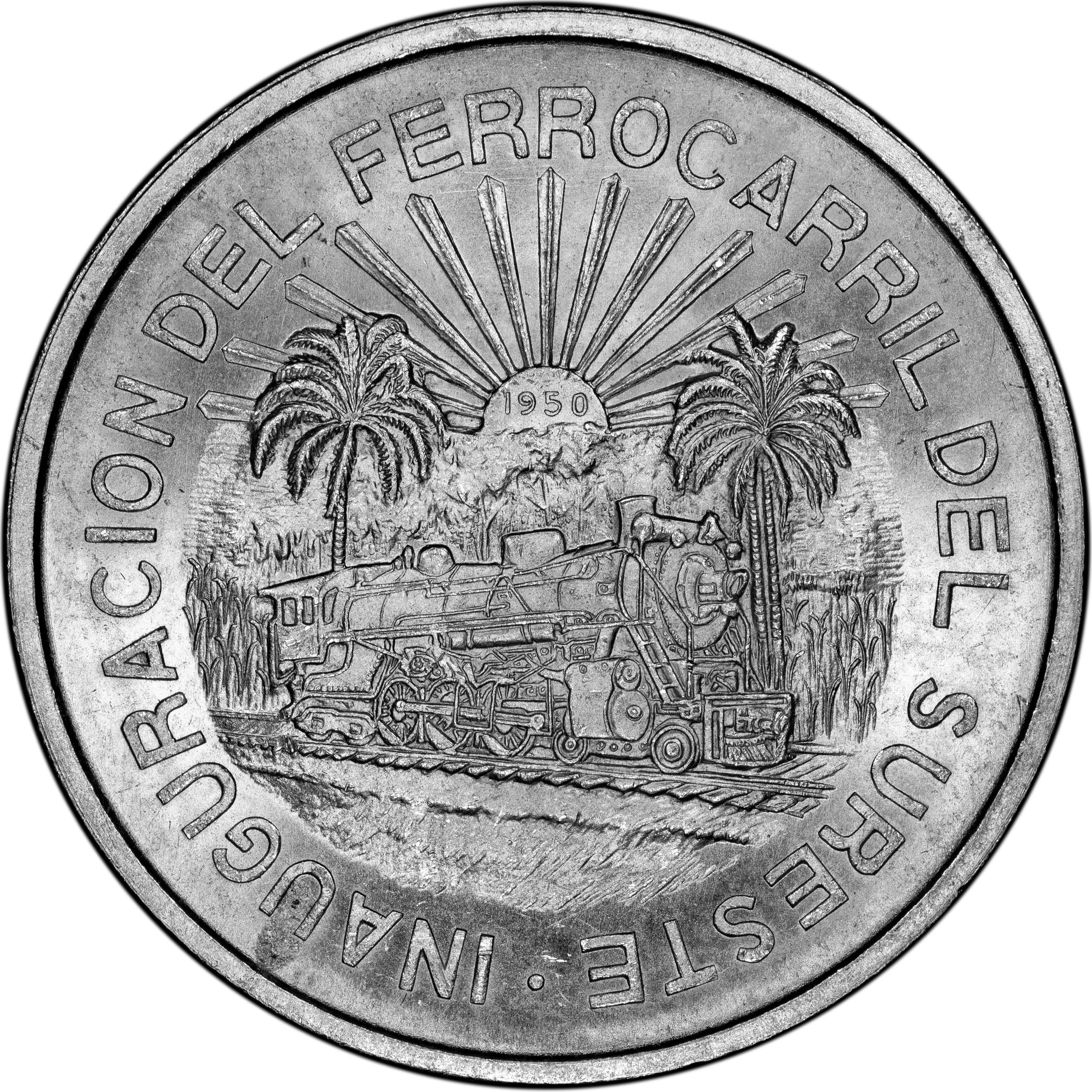
Reverse
Description:
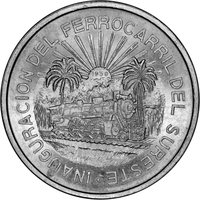
1950 rising sun over a train and palm trees, commemorating the Mexico City to Yucatán railway opening.
Inscription:
INAUGURACION DEL FERROCARRIL DEL SURESTE
1950
1950
Script: Latin
Engraver: Manuel L. Negrete
Edge
Plain with lettering
Legend:
AGRICULTURA INDUSTRIA COMERCIO
Translation:
Agriculture Industry Commerce
Language: Spanish
Categories
| Plant> Tree |
| Transportation> Train |
Mints
| Name | Mark |
|---|---|
| Mexican Mint | (Mo) |
Mintings
| Year | Mint Mark | Mintage | Quality | Collection |
|---|---|---|---|---|
| 1950 | Mo | 200,000 |
Historical background
In 1950, Mexico's currency situation was defined by a period of relative stability and controlled management under the Bretton Woods system. The Mexican peso was pegged to the U.S. dollar at a fixed exchange rate of 8.65 pesos per dollar, a parity established in 1949 and maintained until 1954. This stability was a deliberate policy outcome of the desarrollo estabilizador (stabilizing development) model, which prioritized low inflation, fiscal discipline, and a predictable exchange rate to foster industrial growth and attract foreign investment. The Banco de México, regaining its autonomy in the late 1940s, managed this peg by holding substantial reserves, primarily in U.S. dollars and gold.
This stable monetary environment was underpinned by a strong post-war economic performance. Robust exports from Mexico's agricultural and mining sectors, coupled with a burgeoning tourism industry, generated a steady inflow of dollars. Furthermore, the rapid expansion of import-substitution industrialization (ISI) was facilitated by the predictable peso, which allowed Mexican businesses to import machinery and raw materials with confidence. The government, under Presidents Miguel Alemán and his successor Adolfo Ruiz Cortines, exercised capital controls and careful monetary policy to defend the peg, creating an era of rare financial predictability for a country with a history of monetary turbulence.
However, this stability masked underlying pressures that would eventually lead to a significant devaluation. The fixed exchange rate, overvalued to curb inflation for urban consumers and industrialists, began to hurt agricultural exports by making them less competitive. Simultaneously, the ISI model increased demand for imported capital goods, while consumer goods imports were restricted, leading to a growing trade imbalance. By the early 1950s, inflation began to outpace that of the United States, eroding Mexico's competitiveness. These accumulating strains would culminate in a pivotal devaluation in April 1954, when the peso was abruptly adjusted to 12.50 per dollar, marking the end of this specific phase of monetary management and ushering in a new economic reality.
This stable monetary environment was underpinned by a strong post-war economic performance. Robust exports from Mexico's agricultural and mining sectors, coupled with a burgeoning tourism industry, generated a steady inflow of dollars. Furthermore, the rapid expansion of import-substitution industrialization (ISI) was facilitated by the predictable peso, which allowed Mexican businesses to import machinery and raw materials with confidence. The government, under Presidents Miguel Alemán and his successor Adolfo Ruiz Cortines, exercised capital controls and careful monetary policy to defend the peg, creating an era of rare financial predictability for a country with a history of monetary turbulence.
However, this stability masked underlying pressures that would eventually lead to a significant devaluation. The fixed exchange rate, overvalued to curb inflation for urban consumers and industrialists, began to hurt agricultural exports by making them less competitive. Simultaneously, the ISI model increased demand for imported capital goods, while consumer goods imports were restricted, leading to a growing trade imbalance. By the early 1950s, inflation began to outpace that of the United States, eroding Mexico's competitiveness. These accumulating strains would culminate in a pivotal devaluation in April 1954, when the peso was abruptly adjusted to 12.50 per dollar, marking the end of this specific phase of monetary management and ushering in a new economic reality.
🌱 Fairly Common