

5 Pesos – Mexico
Circulating commemorative coins
Commemoration: Bicentennial of Hidalgo's Birth
Mexico
Obverse
Reverse
Description:
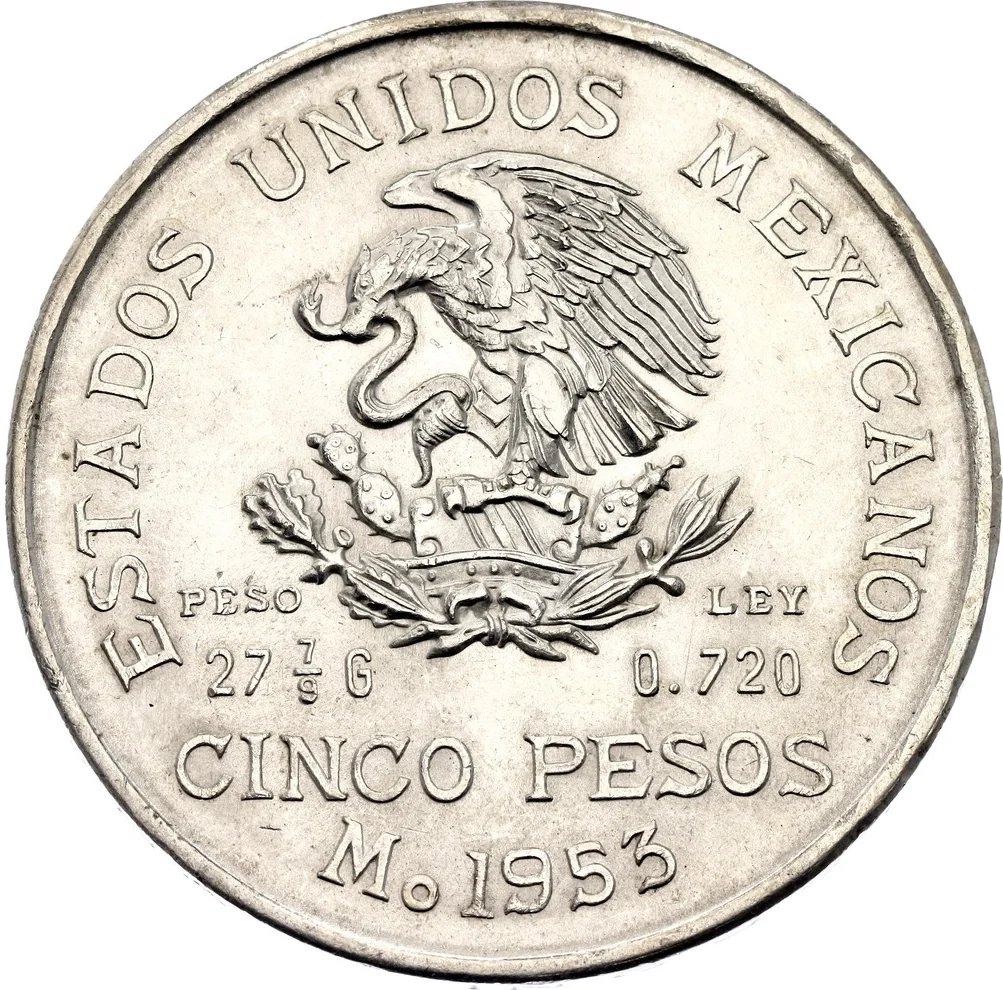
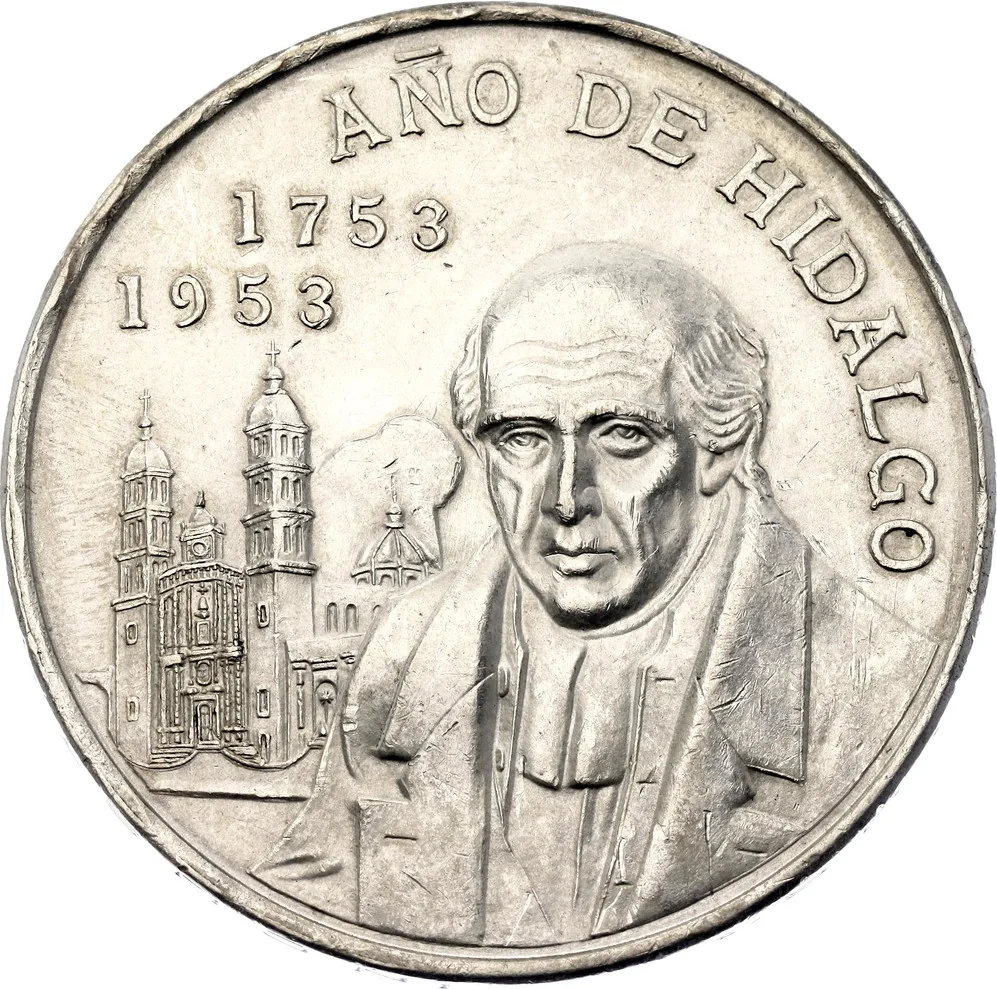
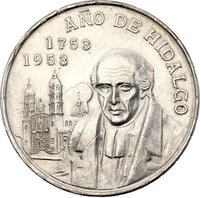
Miguel Hidalgo y Costilla with the Parroquia de Dolores church behind him to the left.
Inscription:
AÑO DE HIDALGO
1753
1953
1753
1953
Translation:
Year of Hidalgo
1753
1953
1753
1953
Script: Latin
Language: Spanish
Designer and engraver: Lorenzo Rafael
Edge
Plain with incuse lettering
Legend:
AGRICULTURA INDUSTRIA COMERCIO
Translation:
Agriculture Industry Commerce
Language: Spanish
Categories
| Building> Religious building |
| Event> Birth anniversary |
Mintings
| Year | Mint Mark | Mintage | Quality | Collection |
|---|---|---|---|---|
| 1953 | Mo | 1,000,000 |
Historical background
In 1953, Mexico's currency situation was characterized by stability under a managed exchange rate system, a notable achievement following decades of post-revolutionary turbulence. The peso was fixed to the U.S. dollar at a rate of 8.65 pesos per dollar, a parity established in 1949 and maintained through the early 1950s. This stability was underpinned by a period of sustained economic growth known as the "Mexican Miracle," driven by industrialization, agricultural expansion, and significant public investment in infrastructure. The Banco de México, as the central bank, managed the fixed rate by holding substantial dollar reserves, which provided confidence and facilitated international trade and investment.
This monetary stability, however, existed within a framework of strict capital controls and import licensing requirements. The government, adhering to an import-substitution industrialization (ISI) model, actively managed the balance of payments to protect domestic industries. While the fixed rate provided predictability for businesses, it also required careful management to avoid overvaluation, which could make Mexican exports less competitive. The system's health was therefore directly tied to continued export earnings, primarily from agricultural goods and a growing industrial sector, alongside a steady inflow of foreign capital.
Looking ahead, the stability of 1953 was somewhat fragile, predicated on consistent economic performance. The fixed exchange rate regime would eventually face mounting pressures later in the decade and into the 1960s, as public spending increased and trade deficits began to emerge. Nevertheless, in 1953, the currency situation was a point of relative strength, reflecting a period of controlled growth and financial discipline that contrasted sharply with the inflationary bouts of the past and the devaluations that would follow in subsequent decades.
This monetary stability, however, existed within a framework of strict capital controls and import licensing requirements. The government, adhering to an import-substitution industrialization (ISI) model, actively managed the balance of payments to protect domestic industries. While the fixed rate provided predictability for businesses, it also required careful management to avoid overvaluation, which could make Mexican exports less competitive. The system's health was therefore directly tied to continued export earnings, primarily from agricultural goods and a growing industrial sector, alongside a steady inflow of foreign capital.
Looking ahead, the stability of 1953 was somewhat fragile, predicated on consistent economic performance. The fixed exchange rate regime would eventually face mounting pressures later in the decade and into the 1960s, as public spending increased and trade deficits began to emerge. Nevertheless, in 1953, the currency situation was a point of relative strength, reflecting a period of controlled growth and financial discipline that contrasted sharply with the inflationary bouts of the past and the devaluations that would follow in subsequent decades.
🌱 Common