

25 centimos – Spain
Add to wishlist
Spain
Context
Year: 1927
Issuer: Spain
Ruler: Alfonso XIII
Currency:
(1868—2001)
Demonetization: 1 July 1951
Total mintage: 12,000,042
Material
Diameter: 25 mm
Weight: 7 g
Thickness: 1.6 mm
Shape: Round with a round hole
Technique: Milled
Alignment: Coin alignment
flip
References
KM: #
Numista: #2372
Value
Exchange value: 0.25 ESP
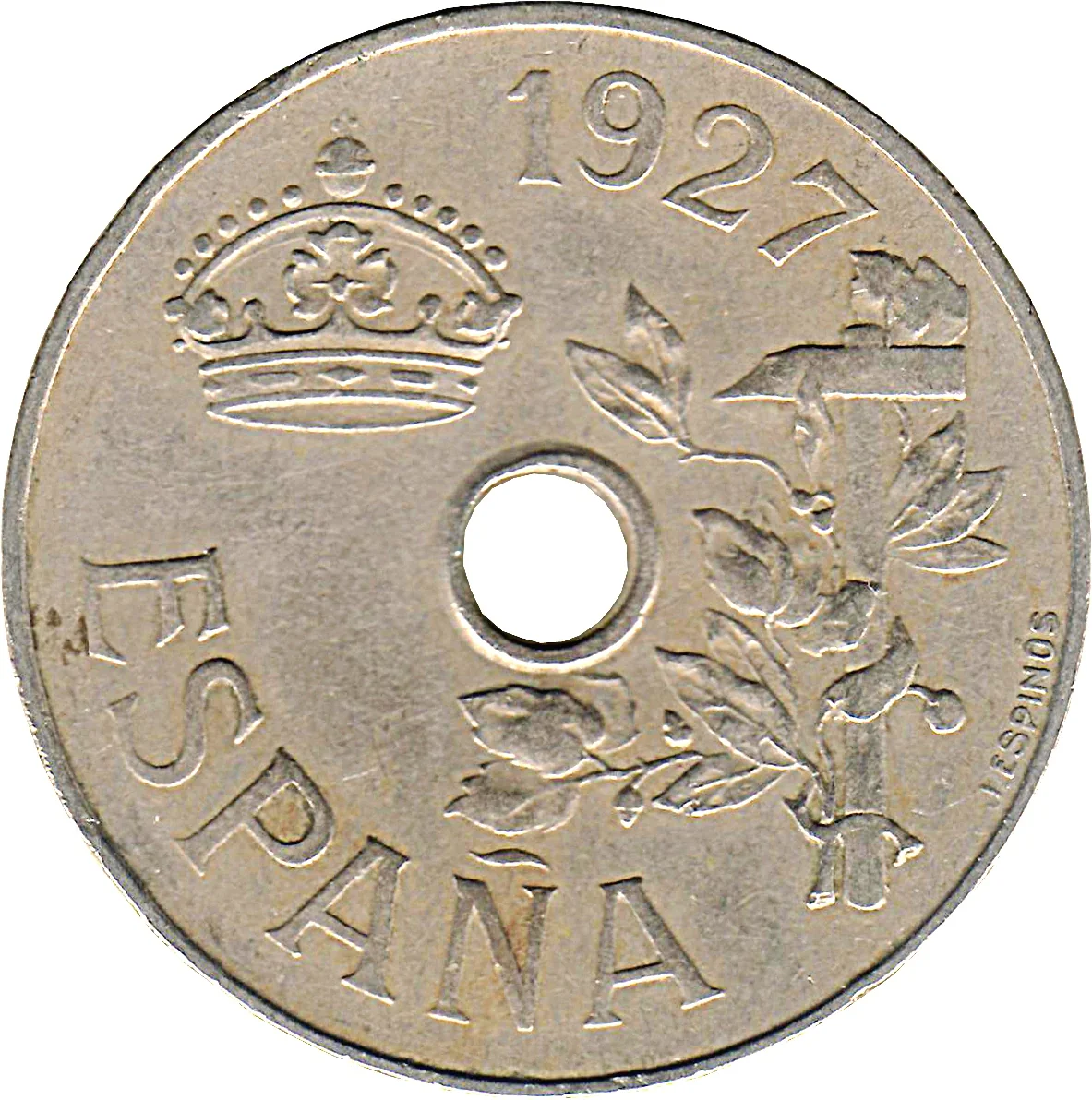
Obverse
Description:
Vine-wrapped hammer, left crown, central hole.
Inscription:
1927
ESPAÑA
J. ESPINÓS
ESPAÑA
J. ESPINÓS
Translation:
1927
SPAIN
J. ESPINÓS
SPAIN
J. ESPINÓS
Script: Latin
Language: Spanish
Engraver: José Eusebio Espinós Gisbert
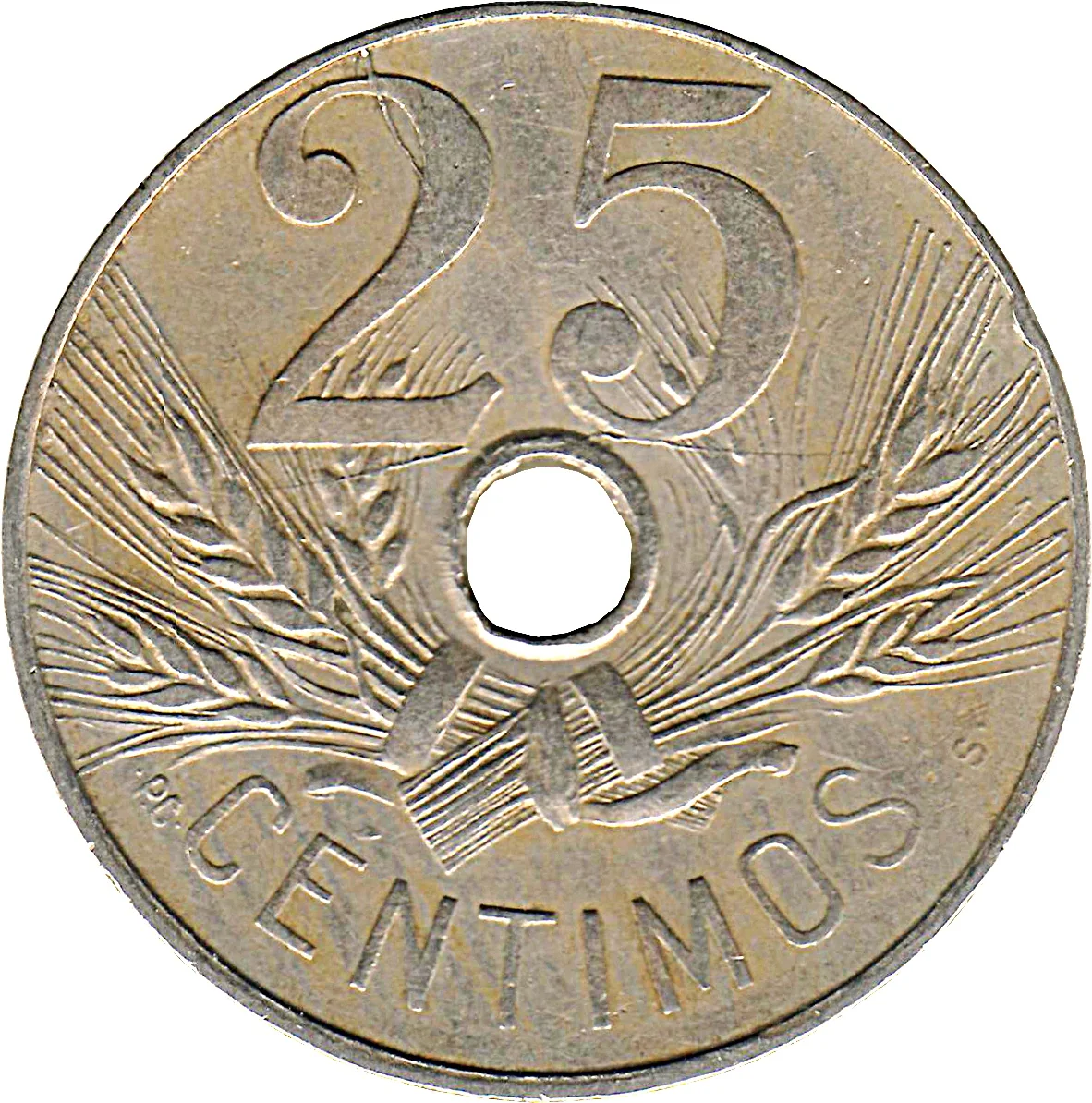
Reverse
Description:
Face value over oats, central hole.
Inscription:
25
· P . C · CÉNTIMOS · S ·
· P . C · CÉNTIMOS · S ·
Translation:
25 Céntimos S
Script: Latin
Language: Spanish
Engraver: José Eusebio Espinós Gisbert
Edge
Plain
Mints
| Name | Mark |
|---|---|
| Royal Mint of Madrid | — |
Mintings
| Year | Mint Mark | Mintage | Quality | Collection |
|---|---|---|---|---|
| 1927 | — | 12,000,042 |
Historical background
In 1927, Spain's currency situation was defined by the prolonged struggle to stabilize the peseta and return to the gold standard, an effort spearheaded by the Primo de Rivera dictatorship. The peseta had been in a state of depreciation since the late 19th century, a decline accelerated by the financial burdens of the Rif War in Morocco and post-World War I inflation. The government's primary objective was to halt this slide and restore international confidence, seeing a strong currency as essential for modernizing the economy and legitimizing the regime.
To achieve this, the regime implemented a strict deflationary policy under the guidance of Finance Minister José Calvo Sotelo. This involved balancing the budget through new taxes and spending cuts, alongside the creation of a currency stabilization fund. The most significant measure was the Decree-Law of Monetary Reform of 1927, which legally defined a new gold-backed peseta at roughly one-third of its pre-1914 value, effectively devaluing it to a more realistic parity. This move aimed to halt speculation and create a credible basis for eventual convertibility.
While these policies succeeded in temporarily stabilizing the exchange rate and boosting foreign investment, the stabilization was fragile and built on precarious foundations. It relied heavily on capital inflows and loans, rather than a fundamental improvement in Spain's trade balance or industrial competitiveness. The apparent success in 1927 proved short-lived; the peseta came under severe renewed pressure with the onset of the Great Depression in 1929, leading to a collapse of the stabilization plan and a sharp devaluation in the early 1930s, undoing the regime's central economic achievement.
To achieve this, the regime implemented a strict deflationary policy under the guidance of Finance Minister José Calvo Sotelo. This involved balancing the budget through new taxes and spending cuts, alongside the creation of a currency stabilization fund. The most significant measure was the Decree-Law of Monetary Reform of 1927, which legally defined a new gold-backed peseta at roughly one-third of its pre-1914 value, effectively devaluing it to a more realistic parity. This move aimed to halt speculation and create a credible basis for eventual convertibility.
While these policies succeeded in temporarily stabilizing the exchange rate and boosting foreign investment, the stabilization was fragile and built on precarious foundations. It relied heavily on capital inflows and loans, rather than a fundamental improvement in Spain's trade balance or industrial competitiveness. The apparent success in 1927 proved short-lived; the peseta came under severe renewed pressure with the onset of the Great Depression in 1929, leading to a collapse of the stabilization plan and a sharp devaluation in the early 1930s, undoing the regime's central economic achievement.
🌱 Very Common