

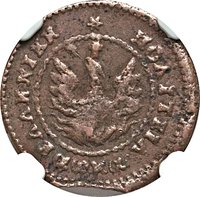
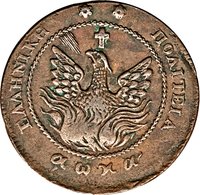
Obverse
Description:
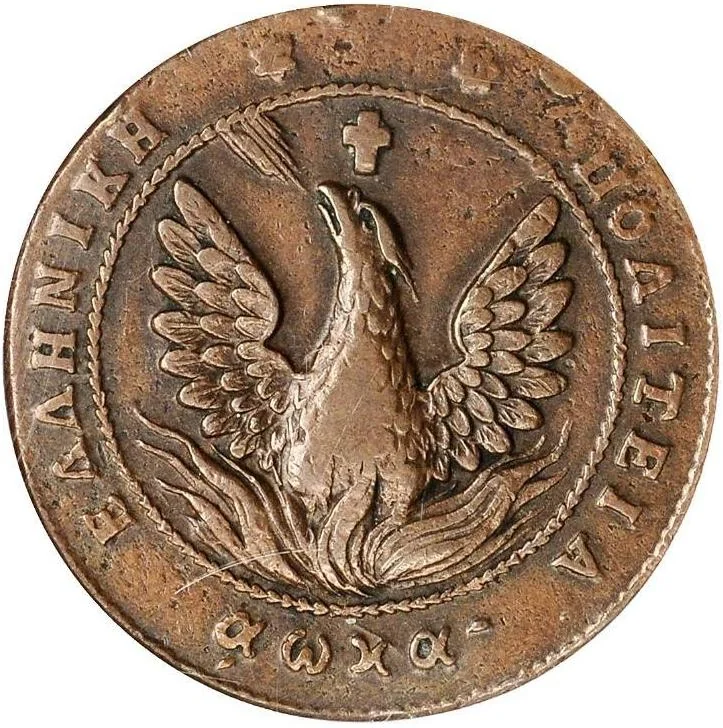
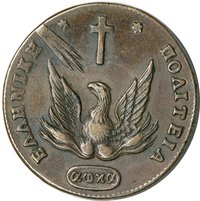
Phoenix with cross and sun rays inside a pearl circle.
Inscription:
ΕΛΛΗΝΙΚΗ ΠΟΛΙΤΕΙΑ
αωκα΄
αωκα΄
Translation:
HELLENIC REPUBLIC
1971
1971
Script: Greek
Language: Greek
Engraver: Georgios Papakonstantopoulos
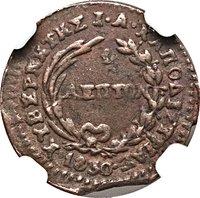
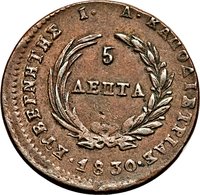
Reverse
Description:
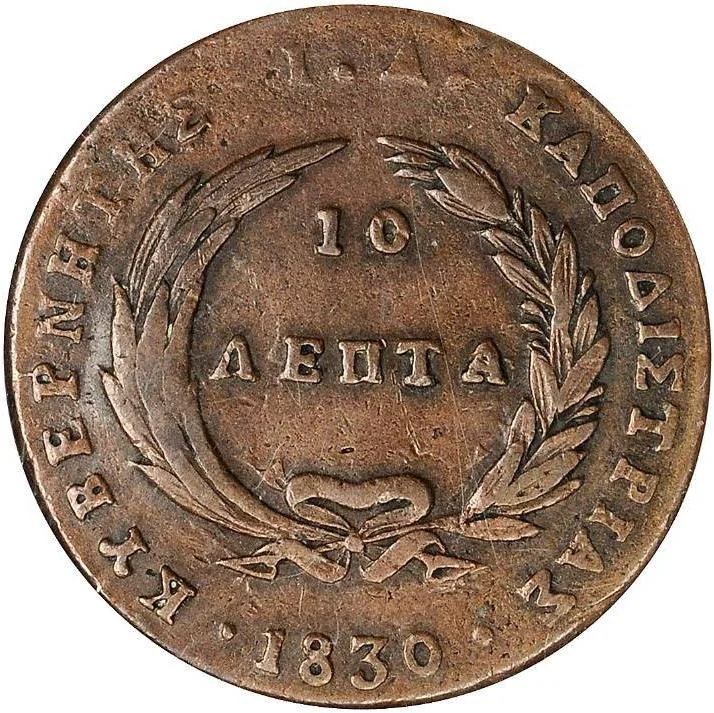
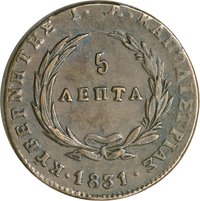
Laurel and olive branches encircling the denomination.
Inscription:
• ΚΥΒΕΡΝΗΤΗΣ Ι• Α• ΚΑΠΟΔΙΣΤΡΙΑΣ •
10
ΛΕΠΤΑ
1830
10
ΛΕΠΤΑ
1830
Translation:
Governor I. A. Kapodistrias
10
Lepta
1830
10
Lepta
1830
Script: Greek
Language: Greek
Engraver: Georgios Papakonstantopoulos
Edge
Plain
Mints
| Name | Mark |
|---|---|
| National mint of Aegina Mint | — |
Mintings
| Year | Mint Mark | Mintage | Quality | Collection |
|---|---|---|---|---|
| 1830 | — | 1,200,000 |
Historical background
Upon achieving independence from the Ottoman Empire in 1830, Greece inherited a chaotic and fragmented monetary landscape. The new state's territory circulated a bewildering array of currencies, reflecting its recent history. These included Ottoman kuruş and piastres, various European coins (especially French francs and British sovereigns), and even the heavily debased "kondylatos" coins from the revolutionary period. This lack of a unified national currency severely hampered trade, state administration, and economic development, as exchange rates fluctuated wildly and confidence in any single medium was low.
The first governor, Ioannis Kapodistrias, immediately recognized the urgent need for monetary order. In 1831, he attempted to introduce a national currency, the phoenix, named symbolically after the mythical bird of rebirth. The phoenix was pegged to the silver French franc, but the project faced crippling obstacles. The state treasury was virtually empty, drained by the long war, and Greece lacked the precious metal reserves to mint sufficient quantities of coins. Consequently, few phoenix coins entered circulation, and the older, heterogeneous currencies remained dominant.
Thus, in 1830, Greece was in a transitional and precarious monetary state. While the political will for a national currency existed, the practical means were absent. The failed phoenix experiment highlighted the profound challenges of state-building: without financial stability and international credit, monetary sovereignty was unattainable. This unstable situation would persist until the arrival of King Otto in 1833, whose Bavarian advisors would spearhead the introduction of a new, durable currency—the drachma—in 1833, finally establishing a unified monetary system backed by an international loan.
The first governor, Ioannis Kapodistrias, immediately recognized the urgent need for monetary order. In 1831, he attempted to introduce a national currency, the phoenix, named symbolically after the mythical bird of rebirth. The phoenix was pegged to the silver French franc, but the project faced crippling obstacles. The state treasury was virtually empty, drained by the long war, and Greece lacked the precious metal reserves to mint sufficient quantities of coins. Consequently, few phoenix coins entered circulation, and the older, heterogeneous currencies remained dominant.
Thus, in 1830, Greece was in a transitional and precarious monetary state. While the political will for a national currency existed, the practical means were absent. The failed phoenix experiment highlighted the profound challenges of state-building: without financial stability and international credit, monetary sovereignty was unattainable. This unstable situation would persist until the arrival of King Otto in 1833, whose Bavarian advisors would spearhead the introduction of a new, durable currency—the drachma—in 1833, finally establishing a unified monetary system backed by an international loan.
⭐ Rare