



Obverse
Description:
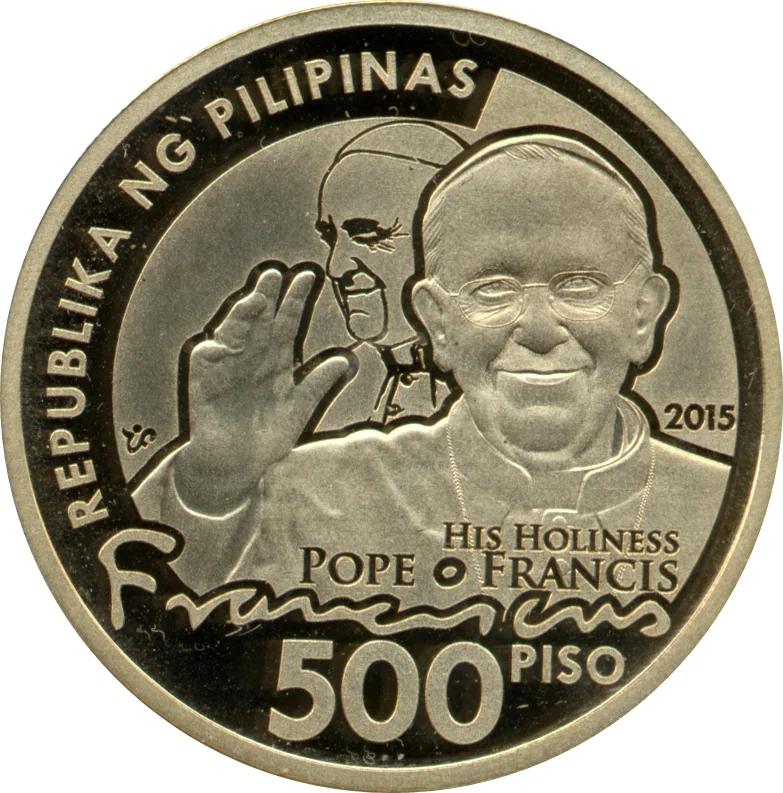
Pope Francis bust facing forward, wearing zucchetto, right hand raised. His profile faces left in background. Signature above value.
Inscription:
REPUBLIKA NG PILIPINAS
2015
HIS HOLINESS POPE FRANCIS
Franciscus
500 PISO
PI
2015
HIS HOLINESS POPE FRANCIS
Franciscus
500 PISO
PI
Translation:
REPUBLIC OF THE PHILIPPINES
2015
HIS HOLINESS POPE FRANCIS
Franciscus
500 PESOS
2015
HIS HOLINESS POPE FRANCIS
Franciscus
500 PESOS
Script: Latin
Reverse
Description:
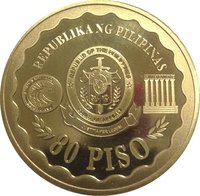
Bank seal right, papal visit logo left.
Inscription:
PAPAL VISIT PHILIPPINES
JANUARY 15-19, 2015
BANGKO SENTRAL NG PILIPINAS
Mercy and Compassion
JANUARY 15-19, 2015
BANGKO SENTRAL NG PILIPINAS
Mercy and Compassion
Translation:
Papal Visit Philippines
January 15-19, 2015
Bangko Sentral ng Pilipinas
Mercy and Compassion
January 15-19, 2015
Bangko Sentral ng Pilipinas
Mercy and Compassion
Script: Latin
Edge
Reeded
Categories
| Person> Religious figure |
Mints
| Name | Mark |
|---|---|
| BSP Security Plant Complex | (PI) |
Mintings
| Year | Mint Mark | Mintage | Quality | Collection |
|---|---|---|---|---|
| 2015 | PI | — |
Historical background
In 2015, the Philippine peso (PHP) demonstrated notable resilience amidst significant global and domestic headwinds, averaging approximately 45.2 pesos to the US dollar for the year. This period was characterized by the Philippines' strong macroeconomic fundamentals, including consistent GDP growth above 6%, robust overseas Filipino worker (OFW) remittances, and a thriving business process outsourcing (BPO) sector. These steady inflows of foreign exchange provided a solid buffer, preventing the peso from experiencing the severe depreciation seen in other emerging markets. The Bangko Sentral ng Pilipinas (BSP) maintained a managed float regime, allowing market forces to determine the exchange rate while intervening occasionally to curb excessive volatility.
However, the currency faced downward pressure primarily from external factors. The dominant theme was the anticipation and eventual realization of the US Federal Reserve's first interest rate hike in nearly a decade in December 2015. This led to a strong US dollar globally as investors shifted capital towards dollar-denominated assets. Furthermore, concerns over a economic slowdown in China, a major trading partner, and prolonged low commodity prices weighed on regional currencies. Domestically, the country was running a sustained current account surplus, but this was offset by capital outflows linked to the global risk-off sentiment and the widening interest rate differential with the United States.
Overall, 2015 was a year of controlled depreciation for the peso. It ended the year slightly weaker, at around 47.0 to the dollar, compared to about 44.7 at the end of 2014, a depreciation of roughly 5%. The BSP's conservative monetary policy and substantial gross international reserves (exceeding $80 billion) provided ample ammunition to smooth out market fluctuations. The situation underscored the Philippine economy's growing insulation from pure speculative attacks, with the currency's movement largely reflecting broader global financial trends rather than domestic weaknesses.
However, the currency faced downward pressure primarily from external factors. The dominant theme was the anticipation and eventual realization of the US Federal Reserve's first interest rate hike in nearly a decade in December 2015. This led to a strong US dollar globally as investors shifted capital towards dollar-denominated assets. Furthermore, concerns over a economic slowdown in China, a major trading partner, and prolonged low commodity prices weighed on regional currencies. Domestically, the country was running a sustained current account surplus, but this was offset by capital outflows linked to the global risk-off sentiment and the widening interest rate differential with the United States.
Overall, 2015 was a year of controlled depreciation for the peso. It ended the year slightly weaker, at around 47.0 to the dollar, compared to about 44.7 at the end of 2014, a depreciation of roughly 5%. The BSP's conservative monetary policy and substantial gross international reserves (exceeding $80 billion) provided ample ammunition to smooth out market fluctuations. The situation underscored the Philippine economy's growing insulation from pure speculative attacks, with the currency's movement largely reflecting broader global financial trends rather than domestic weaknesses.


⭐ Somewhat Rare