



80 pesos (Court of Appeals) – Philippines
Add to wishlist
Non-circulating coins
Commemoration: 80th Anniversary of Court of Appeals
Philippines
Context
Material
Diameter: 34 mm
Weight: 15 g
Thickness: 2.4 mm
Shape: Round
Composition: Nordic gold
Magnetic: No
Technique: Milled
Alignment: Coin alignment
flip

References
KM: #
Numista: #136611
Value
Exchange value: 80 PHP
Obverse
Description:
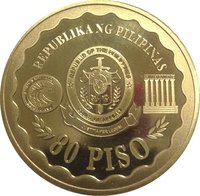
Court of Appeals seal centre, bank seal left, pillars right within scalloped border.
Inscription:
REPUBLIKA NG PILIPINAS
BANGKO SENTRAL NG PILIPINAS
REPUBLIC OF THE PHILIPPINES
COURT OF APPEALS
JUSTITIA PER LEGEM
80 PISO
BANGKO SENTRAL NG PILIPINAS
REPUBLIC OF THE PHILIPPINES
COURT OF APPEALS
JUSTITIA PER LEGEM
80 PISO
Translation:
REPUBLIC OF THE PHILIPPINES
CENTRAL BANK OF THE PHILIPPINES
REPUBLIC OF THE PHILIPPINES
COURT OF APPEALS
JUSTICE THROUGH LAW
80 PESOS
CENTRAL BANK OF THE PHILIPPINES
REPUBLIC OF THE PHILIPPINES
COURT OF APPEALS
JUSTICE THROUGH LAW
80 PESOS
Script: Latin
Reverse
Description:
Laurel branches around an anniversary motif, with a gavel, law book, and scales below, all within a scalloped border.
Inscription:
COURT OF APPEALS
COURT OF APPEALS AT 80:
"REACHING JUDICIAL EXCELLENCE"
80TH
ANNIVERSARY
1936-2016
LAW
PI
COURT OF APPEALS AT 80:
"REACHING JUDICIAL EXCELLENCE"
80TH
ANNIVERSARY
1936-2016
LAW
PI
Script: Latin
Edge
Reeded
Mints
| Name | Mark |
|---|---|
| BSP Security Plant Complex | (PI) |
Mintings
| Year | Mint Mark | Mintage | Quality | Collection |
|---|---|---|---|---|
| 2016 | PI | 5,000 |
Historical background
The Philippines entered 2016 with a period of relative currency stability under President Benigno Aquino III's administration. The Philippine Peso (PHP) had been one of Asia's more resilient currencies in the preceding years, trading in a band of roughly 45 to 47 pesos per US dollar. This strength was underpinned by robust economic growth averaging over 6%, strong inflows from Business Process Outsourcing (BPO) and overseas Filipino worker (OFW) remittances, and improved investor confidence due to fiscal discipline and credit rating upgrades. The central bank, Bangko Sentral ng Pilipinas (BSP), maintained a market-determined exchange rate policy, intervening only to smooth excessive volatility.
However, 2016 was a year of significant political transition with the May election of President Rodrigo Duterte, which introduced a new layer of uncertainty. While the peso remained stable for the first half of the year, it began a notable depreciation trend in the latter months, weakening to over 48 pesos per dollar by year-end. This pressure was driven by a combination of domestic and external factors: heightened risk aversion globally following the Brexit vote, expectations of faster US Federal Reserve interest rate hikes which strengthened the dollar, and concerns from some international investors regarding Duterte's controversial policies and rhetoric.
Despite the peso's depreciation, the broader economic fundamentals remained sound. The BSP viewed the movement as a market-driven adjustment and emphasized its ample foreign exchange reserves to manage disorderly conditions. The weakening currency was a double-edged sword; it increased the cost of imports and debt servicing but also boosted the peso value of vital OFW remittances and made Philippine exports more competitive. Thus, the currency situation at the close of 6 was one of managed depreciation within a still-growing economy, setting the stage for further monetary policy adjustments in the face of persistent external headwinds.
However, 2016 was a year of significant political transition with the May election of President Rodrigo Duterte, which introduced a new layer of uncertainty. While the peso remained stable for the first half of the year, it began a notable depreciation trend in the latter months, weakening to over 48 pesos per dollar by year-end. This pressure was driven by a combination of domestic and external factors: heightened risk aversion globally following the Brexit vote, expectations of faster US Federal Reserve interest rate hikes which strengthened the dollar, and concerns from some international investors regarding Duterte's controversial policies and rhetoric.
Despite the peso's depreciation, the broader economic fundamentals remained sound. The BSP viewed the movement as a market-driven adjustment and emphasized its ample foreign exchange reserves to manage disorderly conditions. The weakening currency was a double-edged sword; it increased the cost of imports and debt servicing but also boosted the peso value of vital OFW remittances and made Philippine exports more competitive. Thus, the currency situation at the close of 6 was one of managed depreciation within a still-growing economy, setting the stage for further monetary policy adjustments in the face of persistent external headwinds.

✨ Legendary