

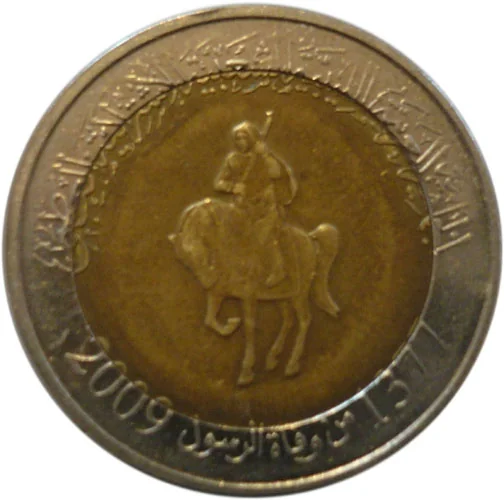
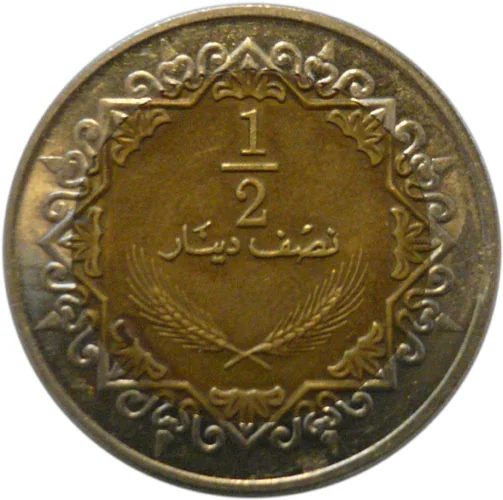
½ dinar – Libya
Add to wishlist
Libya
Context
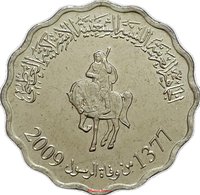
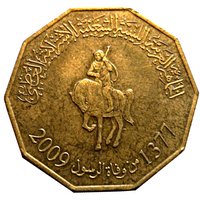
Year: 2009
Islamic - Muhammad posthumous era Year:: 1377
Issuer: Libya
Period:
(1977—2011)
Currency:
(since 1971)
Demonetized: Yes
Total mintage: 10,000,000
Material
References
KM: #
Numista: #18489
Value
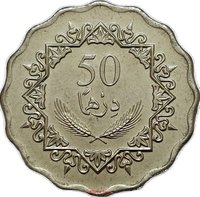
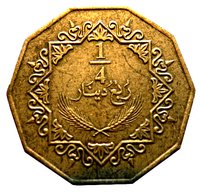
Exchange value: ½ LYD
Obverse
Reverse
Edge
Reeded
Mintings
| Year | Mint Mark | Mintage | Quality | Collection |
|---|---|---|---|---|
| 2009 | — | 10,000,000 |
Historical background
In 2009, Libya's currency situation was characterized by strict state control and relative stability, underpinned by the nation's vast oil wealth. The Libyan Dinar (LYD) was not a freely convertible currency; its exchange rate was pegged to the Special Drawing Rights (SDR) basket of the International Monetary Fund, with a heavy weighting towards the US Dollar. This peg, maintained by the Central Bank of Libya, resulted in an official exchange rate of approximately 1.25 LYD to 1 USD, a rate that was artificially strong and did not reflect market pressures. Foreign exchange transactions were tightly regulated, requiring approval from the central bank, which managed the country's substantial foreign reserves accumulated from hydrocarbon exports.
This rigid system functioned to control inflation and maintain economic sovereignty, but it also fostered a significant black market for currency. The disparity between the official rate and the informal market rate, where dinars traded for less than their official value, emerged due to restrictions on access to foreign currency for imports and travel, as well as capital controls. While the gap was not as extreme as in later years of conflict, it indicated underlying economic distortions and the limitations of a state-dominated economy under Muammar Gaddafi's rule, where political priorities often dictated financial policy.
Overall, the pre-2011 currency regime reflected Libya's centralized economy. Stability was artificially maintained through oil revenue and control, masking inefficiencies and a lack of financial liberalization. The system was vulnerable to external shocks, a weakness that would be catastrophically exposed following the 2011 revolution and the subsequent collapse of unified state institutions, leading to monetary fragmentation and severe devaluation in the years that followed.
This rigid system functioned to control inflation and maintain economic sovereignty, but it also fostered a significant black market for currency. The disparity between the official rate and the informal market rate, where dinars traded for less than their official value, emerged due to restrictions on access to foreign currency for imports and travel, as well as capital controls. While the gap was not as extreme as in later years of conflict, it indicated underlying economic distortions and the limitations of a state-dominated economy under Muammar Gaddafi's rule, where political priorities often dictated financial policy.
Overall, the pre-2011 currency regime reflected Libya's centralized economy. Stability was artificially maintained through oil revenue and control, masking inefficiencies and a lack of financial liberalization. The system was vulnerable to external shocks, a weakness that would be catastrophically exposed following the 2011 revolution and the subsequent collapse of unified state institutions, leading to monetary fragmentation and severe devaluation in the years that followed.
🌱 Common