

Obverse
Description:
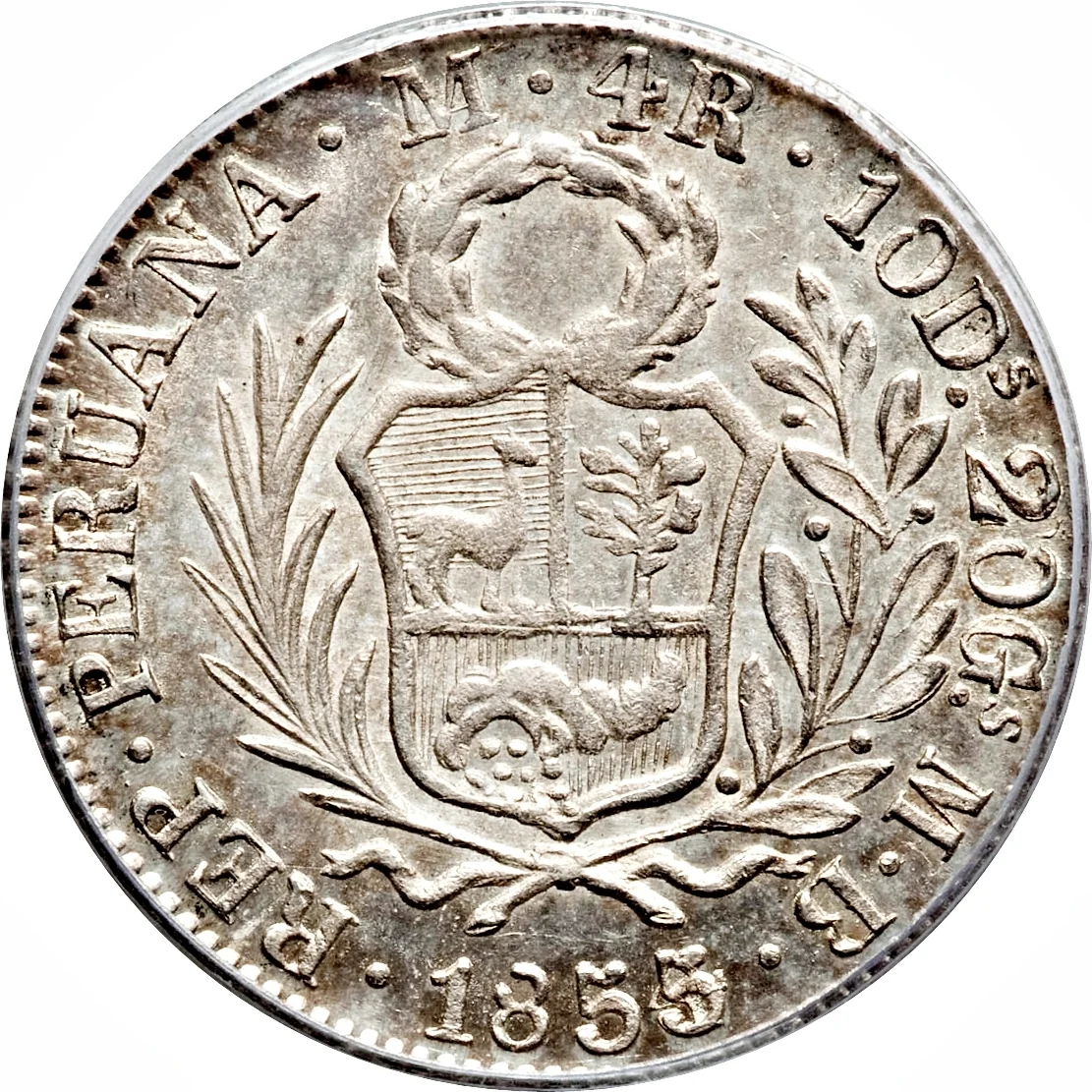
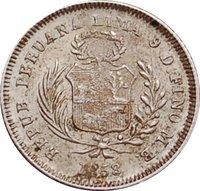
Wreath above arms, flanked by sprigs, date beneath.
Inscription:
REP . PERUANA MA 4R 10D.s 20G.s M. B. 1855
Script: Latin
Reverse
Edge
Mintings
| Year | Mint Mark | Mintage | Quality | Collection |
|---|---|---|---|---|
| 1842 | LIMA | — | ||
| 1843 | PASCO | — | ||
| 1843 | LIMA | — | ||
| 1844 | PASCO | — | ||
| 1845 | LIMA | — | ||
| 1845 | PASCO | — | ||
| 1846 | LIMA | — | ||
| 1848 | LIMA | — | ||
| 1849 | LIMA | — | ||
| 1850 | LIMA | — | ||
| 1851 | LIMA | — | ||
| 1854 | LIMA | — | ||
| 1855 | LIMA | — | ||
| 1856 | PASCO | — | ||
| 1856 | LIMA | — | ||
| 1857 | PASCO | — |
Historical background
In 1842, Peru was navigating a complex and challenging monetary landscape in the wake of its costly War of Independence (1821-1824) and the subsequent period of political instability. The young republic inherited a fragmented currency system, with a mixture of Spanish colonial coins, such as pesos and reales, circulating alongside a limited supply of new republican coinage minted in Lima and Potosí. This lack of a unified, state-controlled currency undermined economic confidence and complicated both domestic commerce and international trade, as the value and silver content of coins could vary.
The situation was severely exacerbated by a profound fiscal crisis. Years of war and internal conflict had left the Peruvian treasury depleted, leading to significant domestic and foreign debt. To meet immediate obligations, the government, under President Agustín Gamarra, resorted to issuing paper money known as billetes fiscales (fiscal notes). However, these notes were not backed by precious metal reserves and were not universally accepted, leading to rapid depreciation and a loss of public trust. This experiment with fiat currency proved disastrous, creating a sharp divide between a devalued paper currency for government transactions and the preferred hard silver coins used in everyday business.
Consequently, by 1842, Peru was effectively operating with a dual and unstable monetary system. The forced circulation of depreciating paper money caused inflation and economic distortion, while the scarcity of sound silver coinage hindered recovery. This chaotic currency environment reflected the broader struggles of state-building and fiscal management in early republican Peru, acting as a significant drag on economic development and highlighting the urgent need for monetary reform and stability, which would only begin to be addressed in the subsequent decades.
The situation was severely exacerbated by a profound fiscal crisis. Years of war and internal conflict had left the Peruvian treasury depleted, leading to significant domestic and foreign debt. To meet immediate obligations, the government, under President Agustín Gamarra, resorted to issuing paper money known as billetes fiscales (fiscal notes). However, these notes were not backed by precious metal reserves and were not universally accepted, leading to rapid depreciation and a loss of public trust. This experiment with fiat currency proved disastrous, creating a sharp divide between a devalued paper currency for government transactions and the preferred hard silver coins used in everyday business.
Consequently, by 1842, Peru was effectively operating with a dual and unstable monetary system. The forced circulation of depreciating paper money caused inflation and economic distortion, while the scarcity of sound silver coinage hindered recovery. This chaotic currency environment reflected the broader struggles of state-building and fiscal management in early republican Peru, acting as a significant drag on economic development and highlighting the urgent need for monetary reform and stability, which would only begin to be addressed in the subsequent decades.
💎 Very Rare