

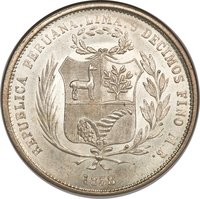
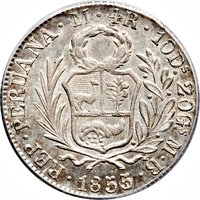
Obverse
Description:
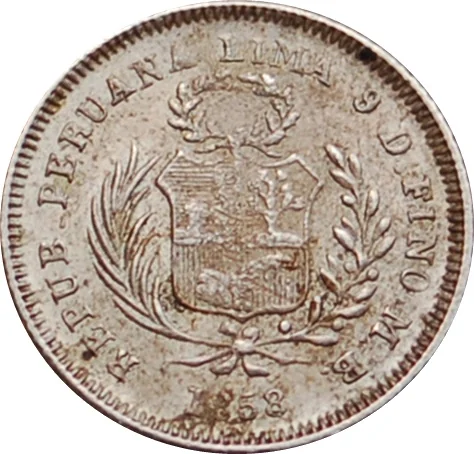
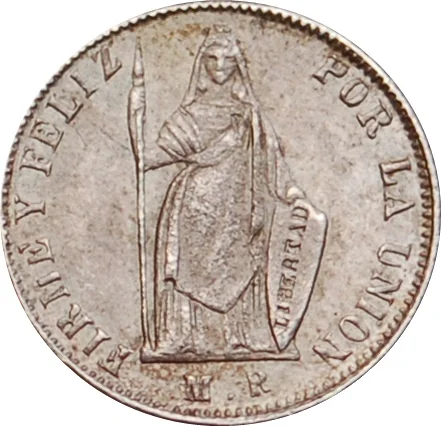
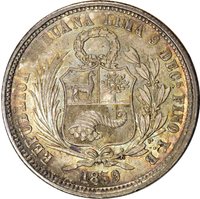
Peruvian coat of arms
Inscription:
REPUB. PERUANA LIMA 9 D. FINO M.B.
1858
1858
Script: Latin
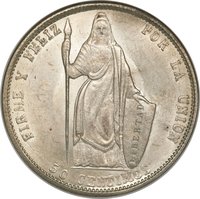
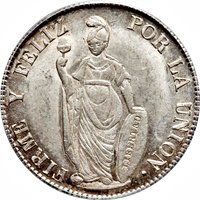
Reverse
Edge
Reeded
Mintings
| Year | Mint Mark | Mintage | Quality | Collection |
|---|---|---|---|---|
| 1858 | LIMA | — | ||
| 1868 | — | — |
Historical background
In 1858, Peru's currency system was a complex and unstable mixture of colonial legacy, economic ambition, and fiscal strain. The primary unit was the silver sol, a direct descendant of the Spanish colonial real, which formed the backbone of everyday commerce. However, the monetary landscape was fragmented, with both domestic and foreign coins—especially Bolivian, Chilean, and British—circulating freely, leading to confusion over values and exchange rates. This period followed the chaotic early republic decades, where successive governments had struggled to establish a unified and trusted national currency, leaving Peru without a central mint until the Casa Nacional de Moneda in Lima reopened in 1857 after years of inactivity.
The government of President Ramón Castilla, in a period known as the "Guano Era," was attempting to use vast revenues from guano exports to modernize the state and its economy. Part of this project involved monetary reform. The reopening of the Lima mint aimed to increase the supply of standardized Peruvian coinage and assert national sovereignty over the monetary system. However, efforts to introduce a bimetallic standard, pegging silver soles to gold, faced practical difficulties due to fluctuating global precious metal values and the overwhelming prevalence of silver in circulation. The state's finances, though flush with guano income, were also heavily committed to foreign debt payments and large infrastructure projects, limiting its ability to fully control or stabilize the currency.
Consequently, the currency situation in 1858 was one of transition and underlying vulnerability. While steps were being taken toward a more orderly system, the reality was a still-disjointed circulation where the value of money could vary by region and transaction. The economy's deep dependence on a single export commodity (guano) meant that the perceived strength of the sol was tied to volatile international commodity prices and credit. Thus, despite Castilla's stabilizing governance, Peru's monetary foundation was not yet fully secure, setting the stage for future crises when the guano boom eventually collapsed.
The government of President Ramón Castilla, in a period known as the "Guano Era," was attempting to use vast revenues from guano exports to modernize the state and its economy. Part of this project involved monetary reform. The reopening of the Lima mint aimed to increase the supply of standardized Peruvian coinage and assert national sovereignty over the monetary system. However, efforts to introduce a bimetallic standard, pegging silver soles to gold, faced practical difficulties due to fluctuating global precious metal values and the overwhelming prevalence of silver in circulation. The state's finances, though flush with guano income, were also heavily committed to foreign debt payments and large infrastructure projects, limiting its ability to fully control or stabilize the currency.
Consequently, the currency situation in 1858 was one of transition and underlying vulnerability. While steps were being taken toward a more orderly system, the reality was a still-disjointed circulation where the value of money could vary by region and transaction. The economy's deep dependence on a single export commodity (guano) meant that the perceived strength of the sol was tied to volatile international commodity prices and credit. Thus, despite Castilla's stabilizing governance, Peru's monetary foundation was not yet fully secure, setting the stage for future crises when the guano boom eventually collapsed.
💎 Very Rare