

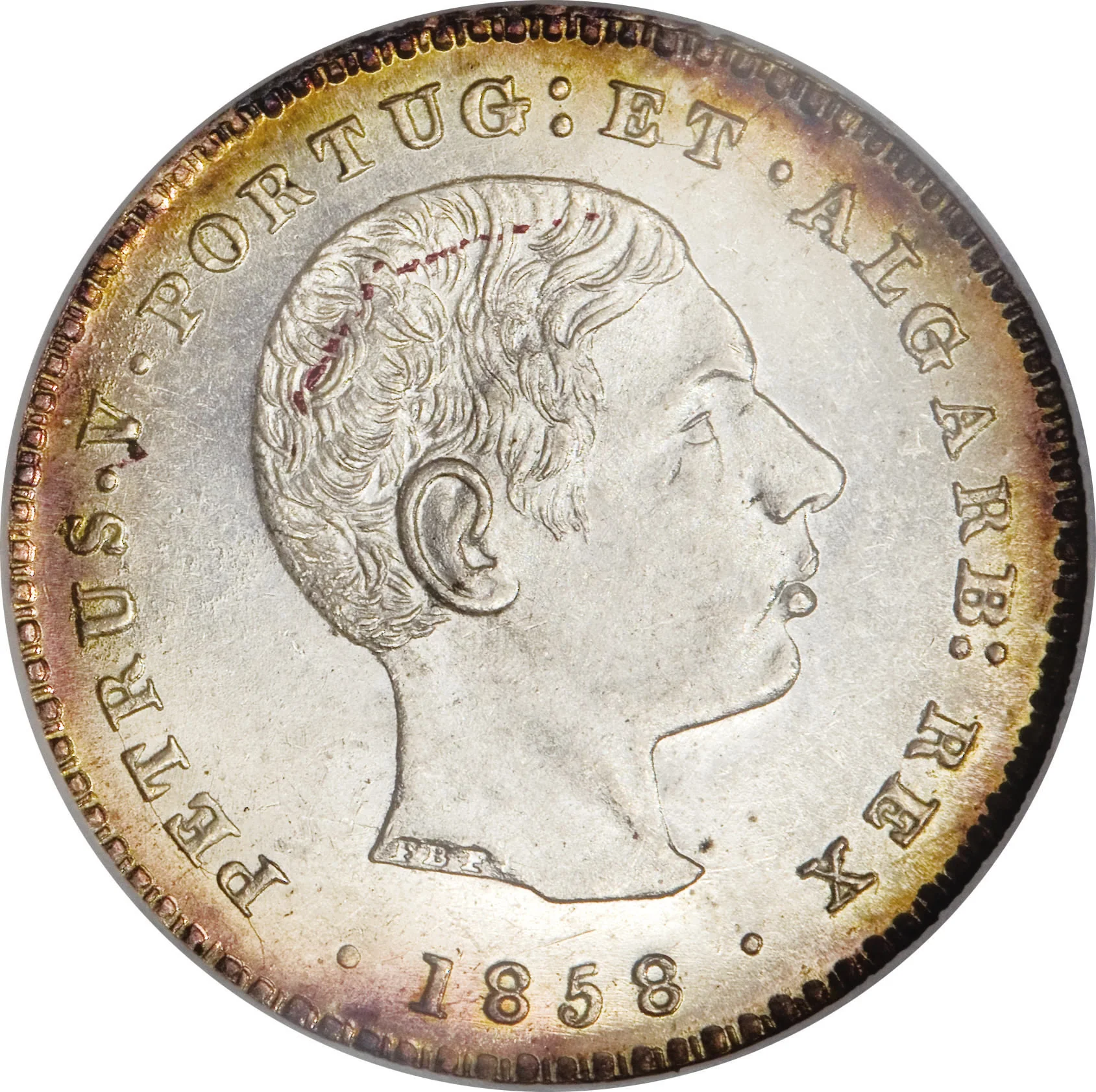
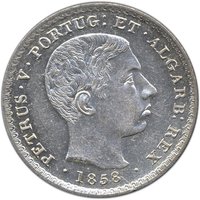
Obverse
Description:
King Peter V of Portugal, right effigy.
Inscription:
PETRUS·V·PORTUG:ET·ALGARB·REX
·1858·
·1858·
Script: Latin
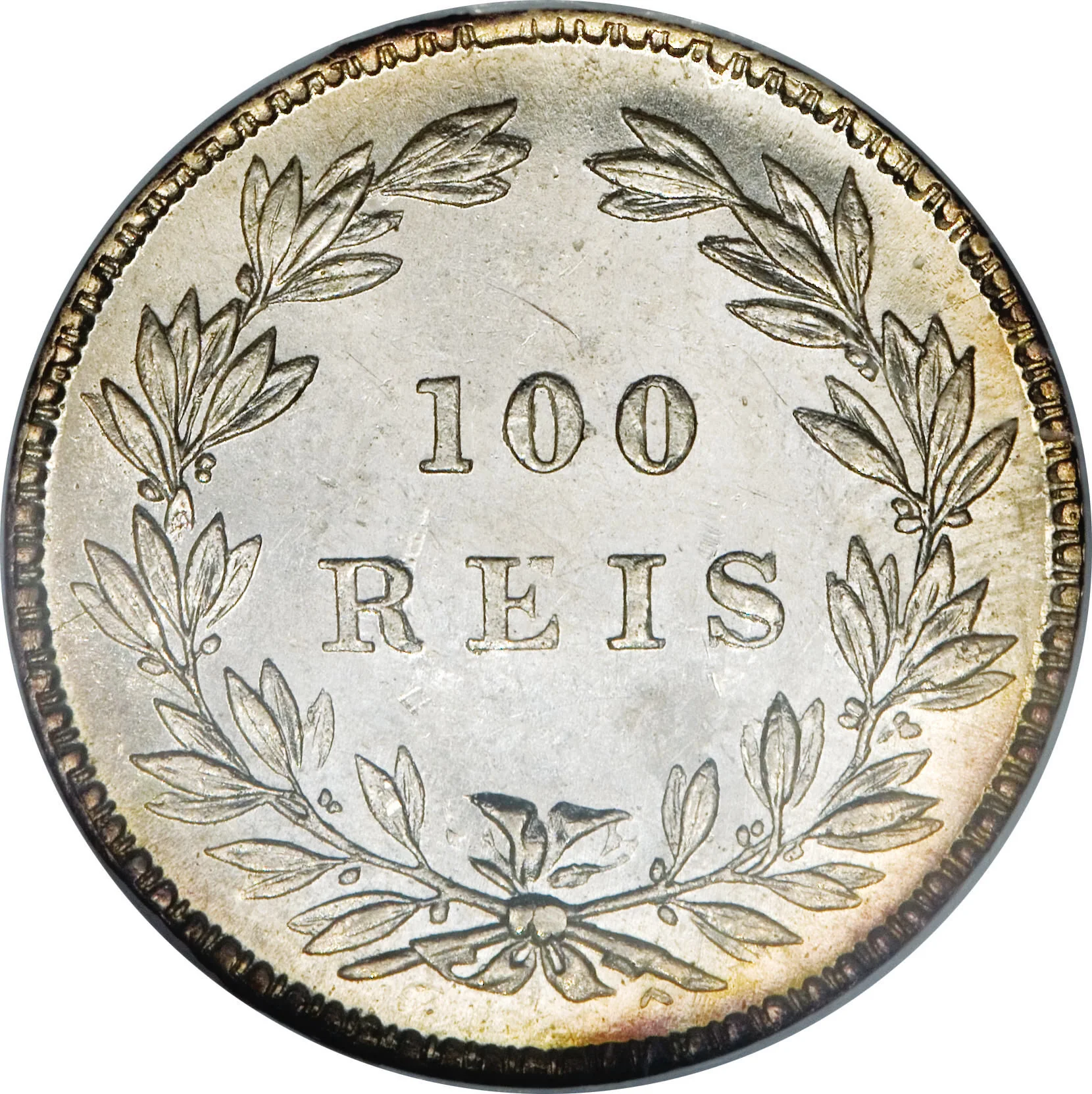
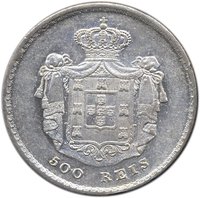
Reverse
Inscription:
100 REIS
Script: Latin
Edge
Reeded
Mints
| Name | Mark |
|---|---|
| Imprensa Nacional - Casa da Moeda | — |
Mintings
| Year | Mint Mark | Mintage | Quality | Collection |
|---|---|---|---|---|
| 1857 | — | 43,000 | ||
| 1858 | — | — | ||
| 1859 | — | 455,000 | ||
| 1859 | — | — | Proof | |
| 1861 | — | 762,000 | ||
| 1861 | — | — | Proof |
Historical background
In 1857, Portugal's currency system was in a state of transition and considerable complexity, rooted in the legacy of its colonial empire and domestic economic instability. The official currency was the Portuguese real (plural: réis), a monetary unit that had been in use for centuries. However, the system was cumbersome due to its very high denominations (transactions were often quoted in milréis, or 1,000 réis), and the nation's money supply was a chaotic mix of domestic and foreign coinage. Crucially, a severe shortage of small-denomination copper and silver coins for everyday transactions plagued the economy, leading to widespread use of worn, clipped, and even counterfeit coins, as well as private tokens issued by merchants and municipalities to facilitate trade.
This monetary disarray was a symptom of deeper fiscal problems. The state treasury was chronically depleted following the Liberal Wars, and the government had a long history of debasing the coinage to finance deficits. Furthermore, the circulation was flooded with foreign coins, particularly from Brazil (which used the real as its currency until 1942) and other trading partners, their values fluctuating unpredictably. This environment created significant challenges for commerce, banking, and public trust in the currency, hindering both domestic economic activity and Portugal's integration into the growing international financial system.
The situation in 1857 was on the cusp of change. Recognizing the need for modernization and stability, Portuguese authorities were actively planning a comprehensive monetary reform. This effort would culminate just a few years later, in 1854, with the adoption of a decimal-based system, introducing the escudo as a unit of account (worth 1,000 réis), though the real would remain the official currency until 1911. Therefore, the currency landscape of 1857 represents the final years of an antiquated system, characterized by fragmentation and inflation, immediately preceding a pivotal shift toward a standardized, decimal currency intended to stabilize the Portuguese economy.
This monetary disarray was a symptom of deeper fiscal problems. The state treasury was chronically depleted following the Liberal Wars, and the government had a long history of debasing the coinage to finance deficits. Furthermore, the circulation was flooded with foreign coins, particularly from Brazil (which used the real as its currency until 1942) and other trading partners, their values fluctuating unpredictably. This environment created significant challenges for commerce, banking, and public trust in the currency, hindering both domestic economic activity and Portugal's integration into the growing international financial system.
The situation in 1857 was on the cusp of change. Recognizing the need for modernization and stability, Portuguese authorities were actively planning a comprehensive monetary reform. This effort would culminate just a few years later, in 1854, with the adoption of a decimal-based system, introducing the escudo as a unit of account (worth 1,000 réis), though the real would remain the official currency until 1911. Therefore, the currency landscape of 1857 represents the final years of an antiquated system, characterized by fragmentation and inflation, immediately preceding a pivotal shift toward a standardized, decimal currency intended to stabilize the Portuguese economy.
🌟 Limited