

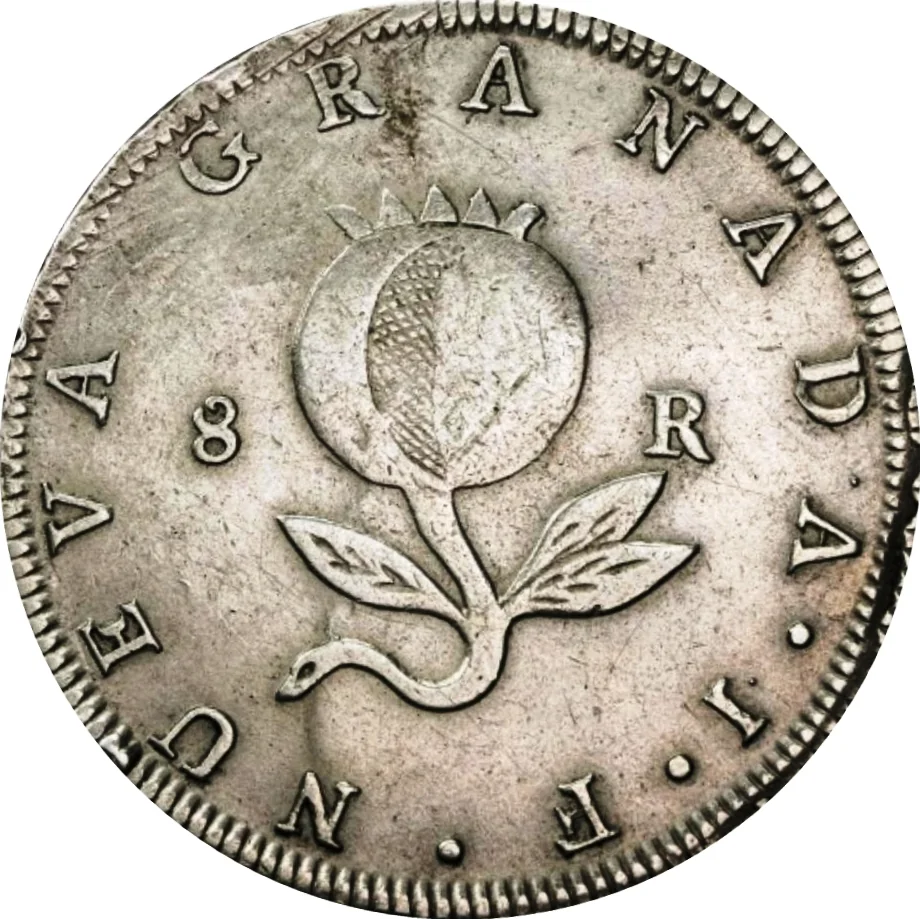
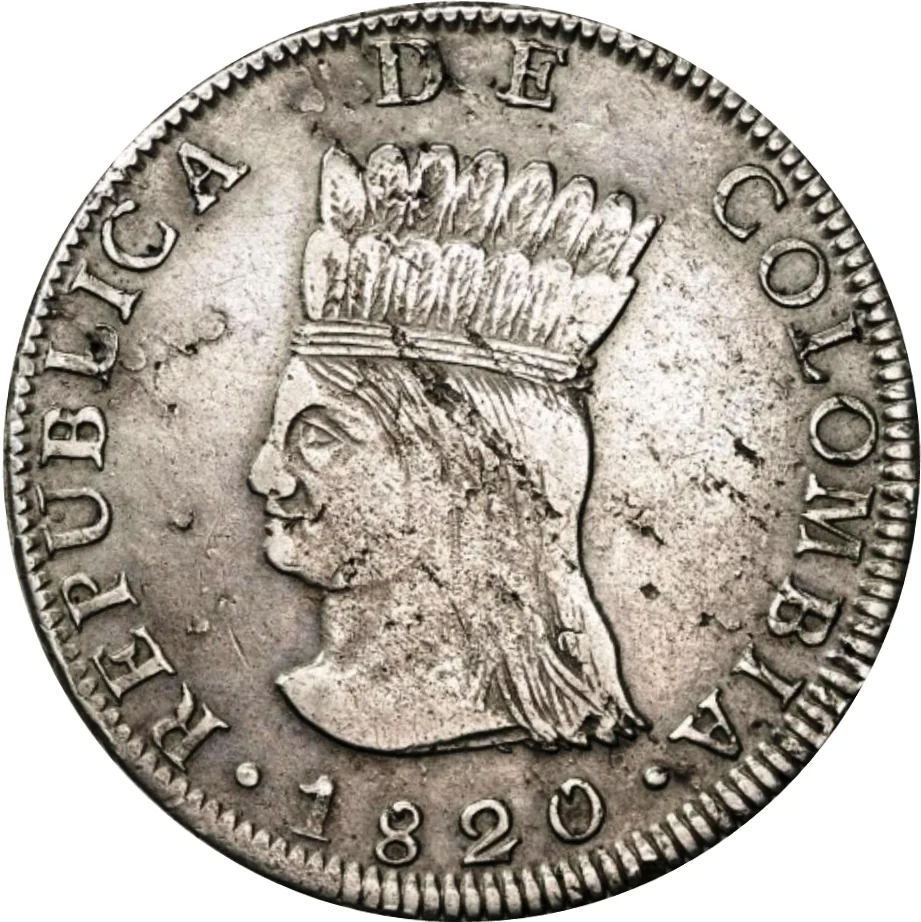
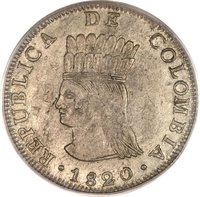
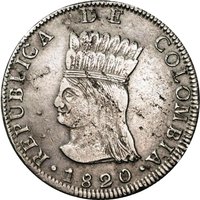
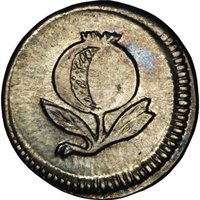
Obverse
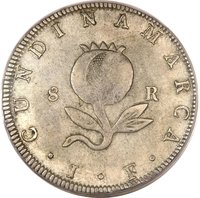
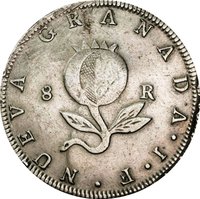
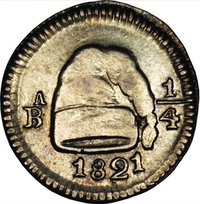
Reverse
Edge
Mintings
| Year | Mint Mark | Mintage | Quality | Collection |
|---|---|---|---|---|
| 1820 | JF | — |
Historical background
In 1820, Colombia was in the turbulent early years of the Republic of Gran Colombia, a fragile union born from the wars of independence against Spain. The currency situation was one of profound disorder and transition. The Spanish colonial monetary system, based on the silver real and gold escudo, had collapsed with the royalist administration, but no unified national system had yet taken its place. In practice, a chaotic mix of Spanish coins, crude locally minted coins (known as macuquinas or "cobs"), and even coins from other nations circulated, their values fluctuating wildly by region and the whims of local merchants.
This monetary anarchy was exacerbated by the financial ruin of the independence struggle. The new government, led by Simón Bolívar, was crippled by debt and had resorted to printing paper money (papel moneda) since 1819 to fund the ongoing military campaigns. This unbacked fiat currency rapidly depreciated, causing inflation and deep public distrust. Simultaneously, the war had devastated mining, the traditional source of precious metals for coinage, leading to a severe shortage of reliable specie. The result was a dual crisis: a lack of sound physical currency and a collapsing fiduciary system.
Recognizing the crisis, the Gran Colombian government began to lay the groundwork for reform. Plans were initiated to establish a national mint and create a new decimal-based currency, the real colombiano, to replace the old Spanish denominations. However, in 1820, these plans were largely aspirational. The immediate reality was a fragmented and unstable monetary landscape that reflected the broader challenges of forging a nation from the ruins of empire, where economic stability would remain an elusive goal for years to come.
This monetary anarchy was exacerbated by the financial ruin of the independence struggle. The new government, led by Simón Bolívar, was crippled by debt and had resorted to printing paper money (papel moneda) since 1819 to fund the ongoing military campaigns. This unbacked fiat currency rapidly depreciated, causing inflation and deep public distrust. Simultaneously, the war had devastated mining, the traditional source of precious metals for coinage, leading to a severe shortage of reliable specie. The result was a dual crisis: a lack of sound physical currency and a collapsing fiduciary system.
Recognizing the crisis, the Gran Colombian government began to lay the groundwork for reform. Plans were initiated to establish a national mint and create a new decimal-based currency, the real colombiano, to replace the old Spanish denominations. However, in 1820, these plans were largely aspirational. The immediate reality was a fragmented and unstable monetary landscape that reflected the broader challenges of forging a nation from the ruins of empire, where economic stability would remain an elusive goal for years to come.
✨ Legendary