

5 milliemes – Egypt
Add to wishlist
Circulating commemorative coins
Commemoration: International Women's Year
Series: International Women's Year
Egypt
Context
Year: 1975
Islamic (Hijri) Year:: 1395
Issuer: Egypt
Period:
(since 1971)
Currency:
(since 1916)
Demonetized: Yes
Total mintage: 10,000,000
Material
Diameter: 18 mm
Weight: 2 g
Thickness: 1.3 mm
Shape: Round
Composition: Aluminium bronze
Magnetic: No
Technique: Milled
Alignment: Medal alignment
flip
References
KM: #
Numista: #1824
Value
Exchange value: 0.005 EGP
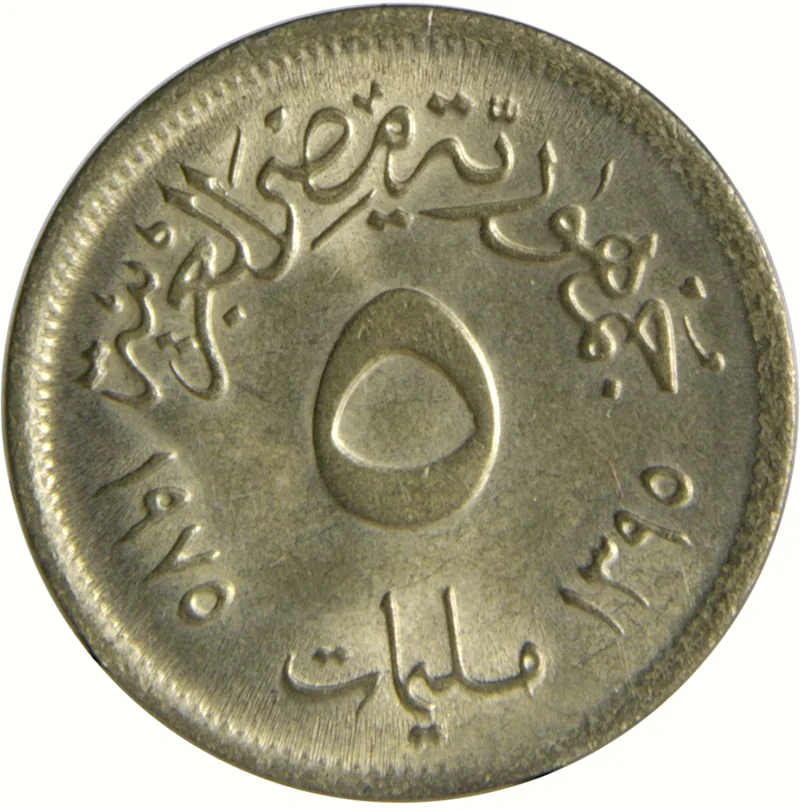
Obverse
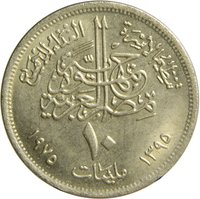
Description:
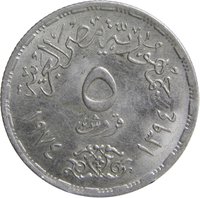
Denomination splits dates, legend atop.
Inscription:
جمهورية مصر العربية
٥
مليمات
١٣٩٥ ١٩٧٥
٥
مليمات
١٣٩٥ ١٩٧٥
Translation:
Arab Republic of Egypt
5
Millimes
1395 1975
5
Millimes
1395 1975
Language: Arabic
Reverse
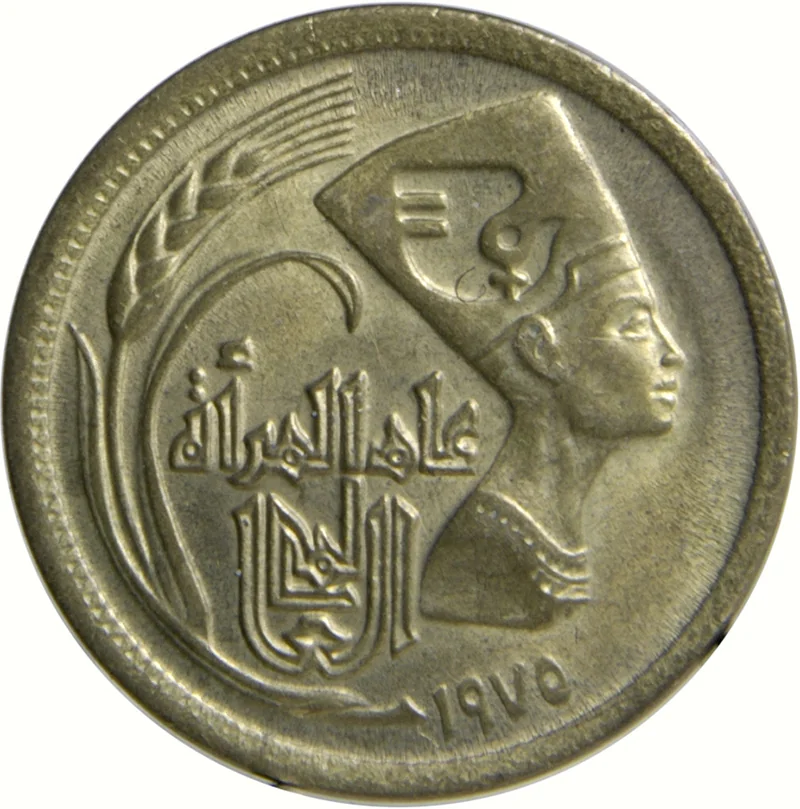
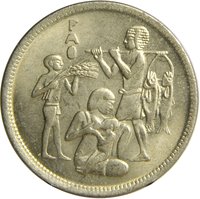
Description:
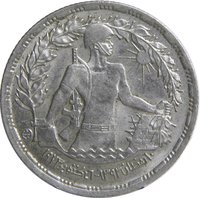
Nefertiti facing grain sprig.
Inscription:
عامـ المرأة
العالمي
١٩٧٥
العالمي
١٩٧٥
Translation:
International Women's Year
1975
1975
Language: Arabic
Edge
Plain
Categories
| Organization> FAO |
| Organization> United Nations |
| History> Feminism |
Mints
| Name | Mark |
|---|---|
| Egyptian Mint Authority | — |
Mintings
| Year | Mint Mark | Mintage | Quality | Collection |
|---|---|---|---|---|
| 1975 | — | 10,000,000 |
Historical background
By 1975, Egypt's currency situation was characterized by the severe strains of the Infitah (Economic Open Door Policy) launched by President Anwar Sadat in 1974. This policy aimed to liberalize the state-dominated economy, attract foreign investment, and pivot away from Soviet influence towards the West. However, a critical and immediate problem was the existence of a complex multi-tier exchange rate system. The official rate was fixed at an overvalued Egyptian Pound (EGP) to the US Dollar, which was used for government transactions and imports of essential goods like food and fuel. Alongside this, a parallel "own-exchange" rate and a thriving black market reflected the currency's true, much weaker value, creating distortions, encouraging corruption, and deterring honest foreign investment.
The root causes of this instability were profound. Years of costly conflict, including the 1973 war, massive subsidies on basic commodities, and a bloated public sector had led to persistent budget deficits, high inflation, and a growing balance of payments crisis. Foreign reserves were critically low. The overvalued official rate acted as an implicit tax on key exports like cotton, making them uncompetitive, while making imports artificially cheap, which drained reserves further. This unsustainable system created severe shortages of foreign currency for the private sector, stifling the very economic activity the Infitah sought to promote.
Consequently, 1975 was a pivotal year of mounting pressure that forced initial, hesitant reforms. Under guidance from the International Monetary Fund (IMF), which Egypt began engaging with in 1974, the government took its first steps toward unification. It introduced a more flexible "parallel" rate for non-essential imports and certain transactions, effectively a controlled devaluation. This move acknowledged the market reality and was a precursor to the more significant devaluations and structural adjustments that would follow later in the decade, setting Egypt on a long, difficult path toward currency liberalization and economic restructuring.
The root causes of this instability were profound. Years of costly conflict, including the 1973 war, massive subsidies on basic commodities, and a bloated public sector had led to persistent budget deficits, high inflation, and a growing balance of payments crisis. Foreign reserves were critically low. The overvalued official rate acted as an implicit tax on key exports like cotton, making them uncompetitive, while making imports artificially cheap, which drained reserves further. This unsustainable system created severe shortages of foreign currency for the private sector, stifling the very economic activity the Infitah sought to promote.
Consequently, 1975 was a pivotal year of mounting pressure that forced initial, hesitant reforms. Under guidance from the International Monetary Fund (IMF), which Egypt began engaging with in 1974, the government took its first steps toward unification. It introduced a more flexible "parallel" rate for non-essential imports and certain transactions, effectively a controlled devaluation. This move acknowledged the market reality and was a precursor to the more significant devaluations and structural adjustments that would follow later in the decade, setting Egypt on a long, difficult path toward currency liberalization and economic restructuring.
Series: International Women's Year

🌱 Very Common