

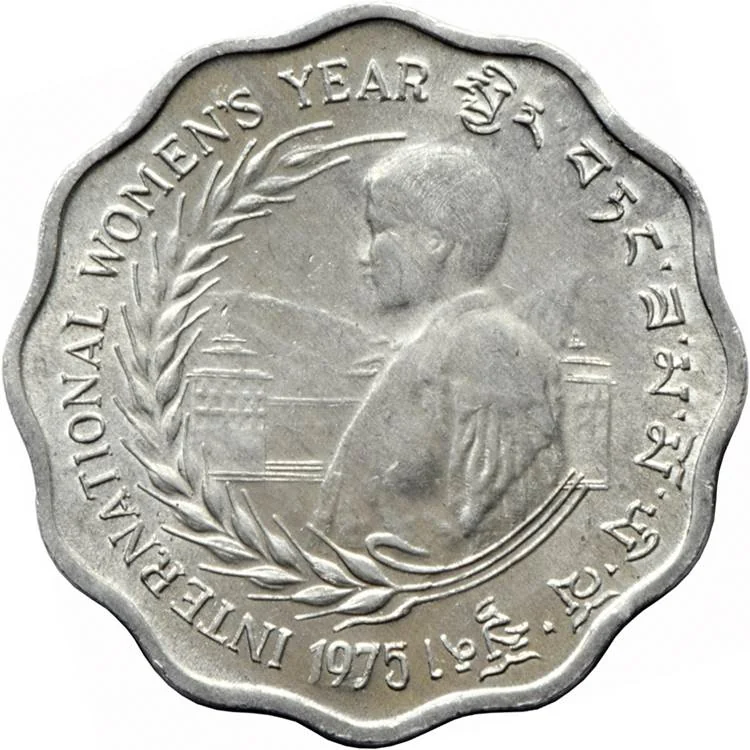
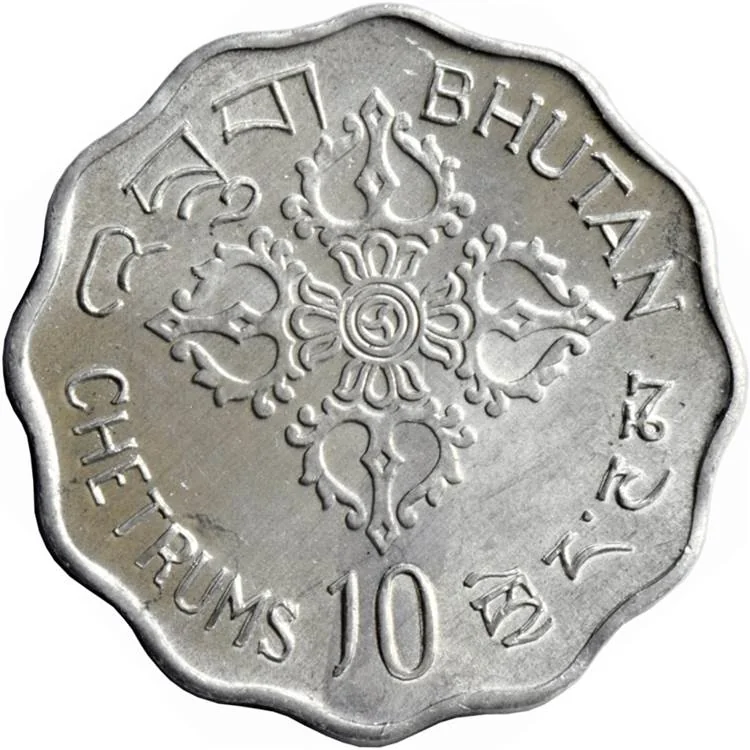
10 chetrums – Bhutan
Add to wishlist
Circulating commemorative coins
Commemoration: FAO - International Women's Year
Series: International Women's Year
Bhutan
Context
Material
References
KM: #
Numista: #6168
Value
Exchange value: 0.10 BTN
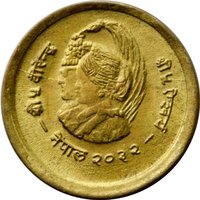
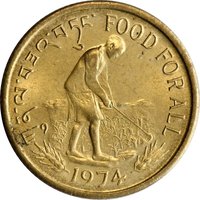
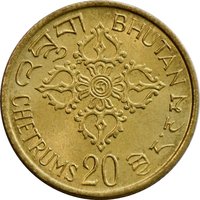
Obverse
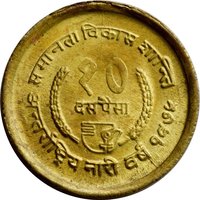
Reverse
Edge
Plain
Categories
| Building> Palace |
| Organization> FAO |
| Organization> United Nations |
| Symbols> Coat of Arms |
Mints
| Name | Mark |
|---|---|
| Mumbai / Bombay | — |
Mintings
| Year | Mint Mark | Mintage | Quality | Collection |
|---|---|---|---|---|
| 1975 | — | — | Proof | |
| 1975 | — | 4,000,000 |
Historical background
In 1975, Bhutan’s currency situation was characterized by a dual monetary system, a legacy of its historical and economic ties to India. The Indian rupee remained the dominant medium of exchange for most everyday transactions and trade, as Bhutan’s economy was deeply integrated with India's. Alongside the rupee, Bhutan’s own national currency, the Ngultrum (BTN), introduced in 1974, was in its very early stages of circulation. The two currencies were (and remain) pegged at par (1:1), ensuring stability but underscoring Bhutan’s dependence on Indian monetary policy.
This period followed a significant milestone: the establishment of the Royal Monetary Authority of Bhutan (RMA) in 1982, which would later become the central bank. In 1975, however, monetary authority was still managed under the Royal Government’s Ministry of Finance. The introduction of the Ngultrum was a symbolic and practical step toward greater economic sovereignty, part of a broader modernization drive under the Fourth King, Jigme Singye Wangchuck. Yet, in practice, the rupee’s widespread use meant the Ngultrum’s adoption was gradual, primarily used for government transactions and in areas closer to administrative centers.
The currency scenario reflected Bhutan’s cautious approach to development and its unique geopolitical position. While fostering a distinct national identity through its own currency, Bhutan pragmatically maintained the rupee’s legal tender status to avoid disrupting vital cross-border trade and investment, upon which its fledgling economy relied. Thus, 1975 represents a transitional year where the tools for future monetary independence were newly minted, but the practical reality was still one of a closely managed, India-anchored currency regime.
This period followed a significant milestone: the establishment of the Royal Monetary Authority of Bhutan (RMA) in 1982, which would later become the central bank. In 1975, however, monetary authority was still managed under the Royal Government’s Ministry of Finance. The introduction of the Ngultrum was a symbolic and practical step toward greater economic sovereignty, part of a broader modernization drive under the Fourth King, Jigme Singye Wangchuck. Yet, in practice, the rupee’s widespread use meant the Ngultrum’s adoption was gradual, primarily used for government transactions and in areas closer to administrative centers.
The currency scenario reflected Bhutan’s cautious approach to development and its unique geopolitical position. While fostering a distinct national identity through its own currency, Bhutan pragmatically maintained the rupee’s legal tender status to avoid disrupting vital cross-border trade and investment, upon which its fledgling economy relied. Thus, 1975 represents a transitional year where the tools for future monetary independence were newly minted, but the practical reality was still one of a closely managed, India-anchored currency regime.
Series: International Women's Year

🌱 Common