

2 kroner (Reign) – Denmark
Add to wishlist
Circulating commemorative coins
Commemoration: 25th Anniversary of Reign
Denmark
Obverse
Description:
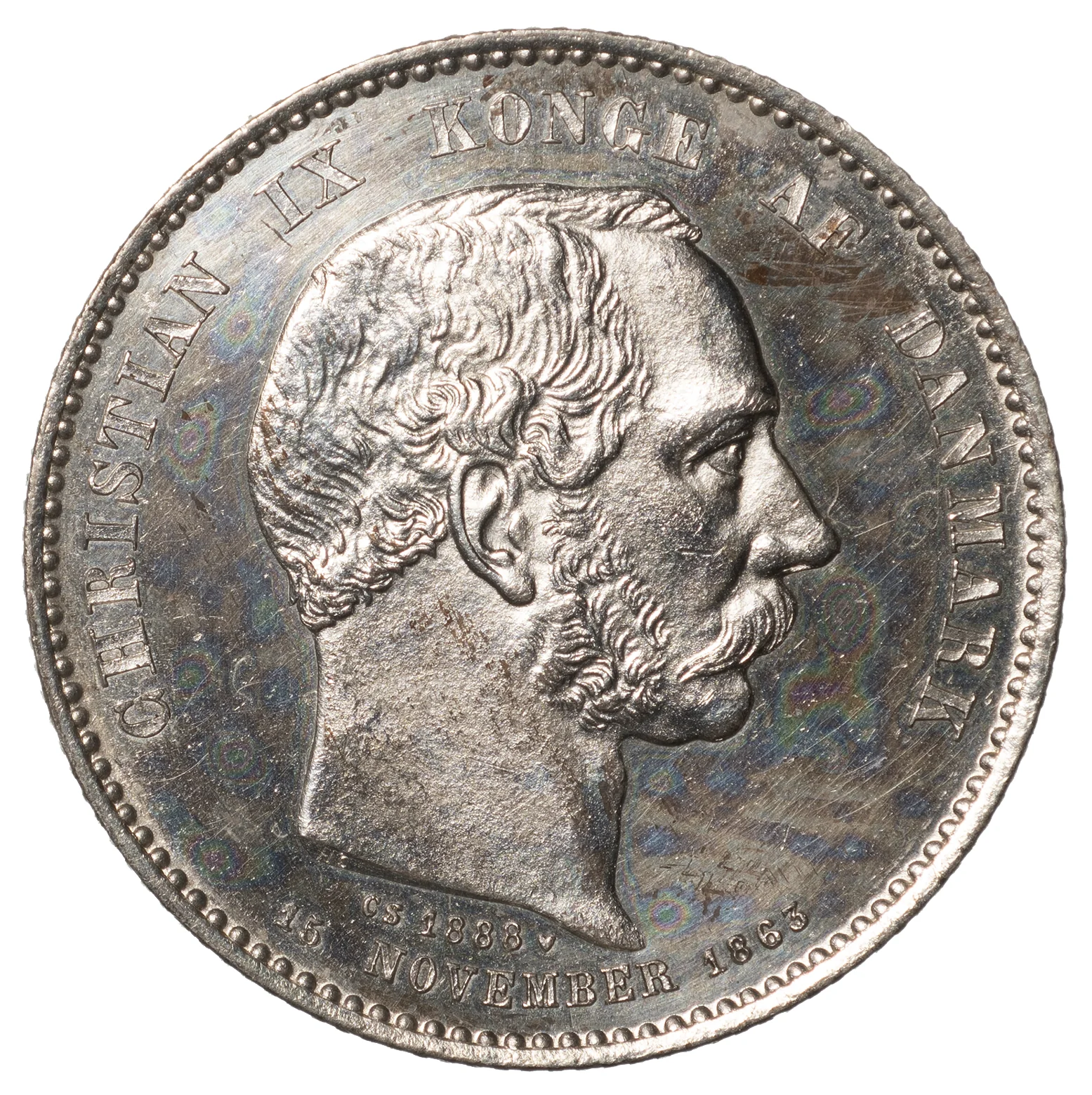
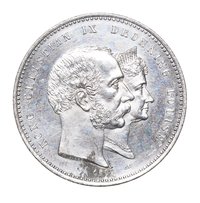
King Christian IX facing right. Below, the date with mintmark (heart) and Mint Master initials. Along the rim, his enthronement date.
Inscription:
CHRISTIAN IX KONGE AF DANMARK
CS 1888 ♥
15 NOVEMBER 1863
CS 1888 ♥
15 NOVEMBER 1863
Translation:
Christian IX King of Denmark
CS 1888 ♥
15 November 1863
CS 1888 ♥
15 November 1863
Script: Latin
Reverse
Edge
Reeded
Mints
| Name | Mark |
|---|---|
| Royal Danish Mint | ♥ |
Mintings
| Year | Mint Mark | Mintage | Quality | Collection |
|---|---|---|---|---|
| 1888 | ♥ | 101,000 |
Historical background
In 1888, Denmark was a participant in the Scandinavian Monetary Union (SMU), established in 1873 with Sweden and joined by Norway in 1875. This union created a unified currency system based on the gold standard, where the Danish krone, Swedish krona, and Norwegian krone were fixed at parity with each other (1:1:1) and fully convertible into gold. The system facilitated seamless trade and financial transactions across the three nations, as their gold-backed coins and certain banknotes were accepted as legal tender in all member countries. For Denmark, this integration provided monetary stability and strengthened economic ties with its Nordic neighbors, anchoring its currency to a robust international standard.
Domestically, the Danish economy in the late 1880s was undergoing a significant transformation. The agricultural sector, long the cornerstone of the economy, was recovering from a severe depression in the 1870s and 1880s caused by a global grain glut and competition from the Americas. This crisis had accelerated a shift from grain cultivation to dairy and meat production, a change that required substantial investment and modernization. The stable krone provided by the SMU and the gold standard was crucial during this period of restructuring, as it ensured low inflation and reliable access to international capital markets for financing this agricultural revolution.
However, the system was not without its underlying tensions. While the union functioned smoothly on the surface in 1888, the member countries retained their separate central banks and issued their own banknotes. These notes were legally required to be accepted across borders, but in practice, they often circulated back to their country of origin for redemption, testing the commitment to mutual acceptance. Furthermore, the rigid gold standard limited the ability of the Danish government to independently manage its monetary policy in response to domestic economic fluctuations. These structural frailties would later be exposed under the strain of World War I, but in 1888, the Danish krone stood as a symbol of Nordic cooperation and monetary stability, providing a firm foundation for the nation's economic modernization.
Domestically, the Danish economy in the late 1880s was undergoing a significant transformation. The agricultural sector, long the cornerstone of the economy, was recovering from a severe depression in the 1870s and 1880s caused by a global grain glut and competition from the Americas. This crisis had accelerated a shift from grain cultivation to dairy and meat production, a change that required substantial investment and modernization. The stable krone provided by the SMU and the gold standard was crucial during this period of restructuring, as it ensured low inflation and reliable access to international capital markets for financing this agricultural revolution.
However, the system was not without its underlying tensions. While the union functioned smoothly on the surface in 1888, the member countries retained their separate central banks and issued their own banknotes. These notes were legally required to be accepted across borders, but in practice, they often circulated back to their country of origin for redemption, testing the commitment to mutual acceptance. Furthermore, the rigid gold standard limited the ability of the Danish government to independently manage its monetary policy in response to domestic economic fluctuations. These structural frailties would later be exposed under the strain of World War I, but in 1888, the Danish krone stood as a symbol of Nordic cooperation and monetary stability, providing a firm foundation for the nation's economic modernization.
🌱 Fairly Common