

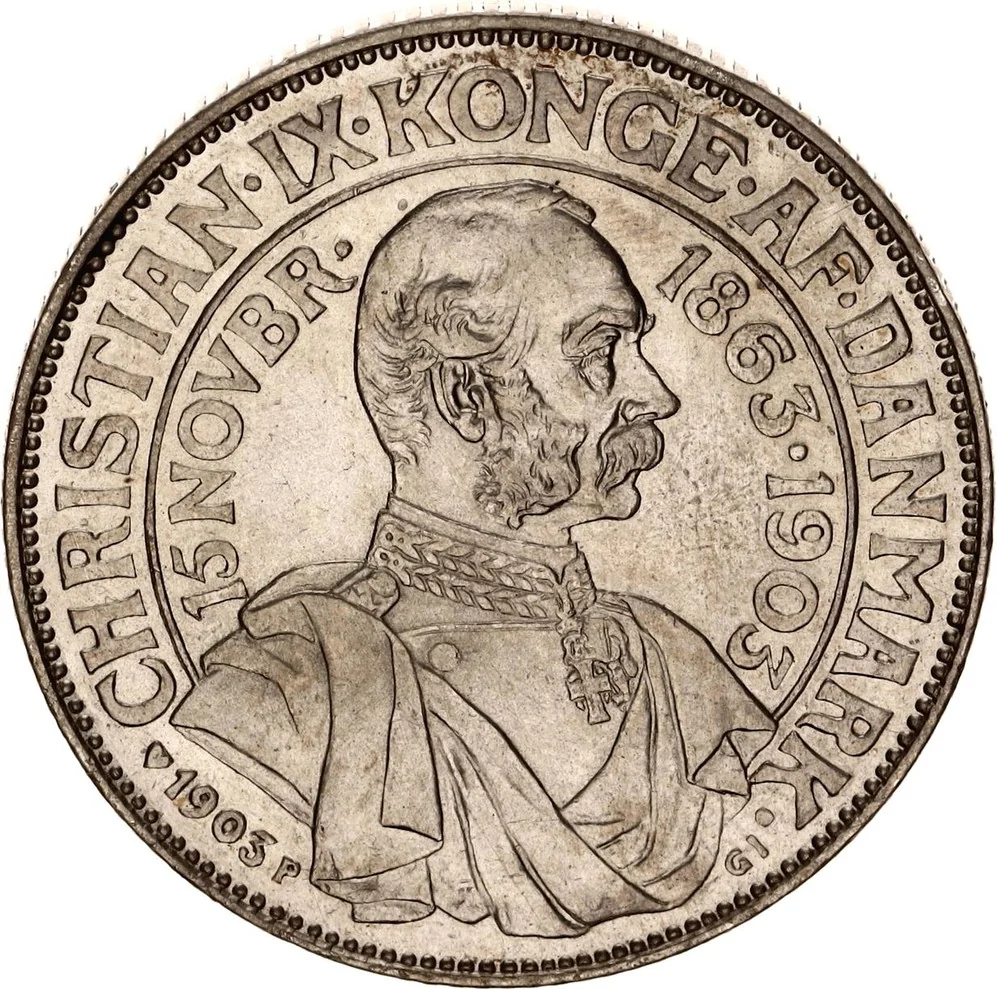
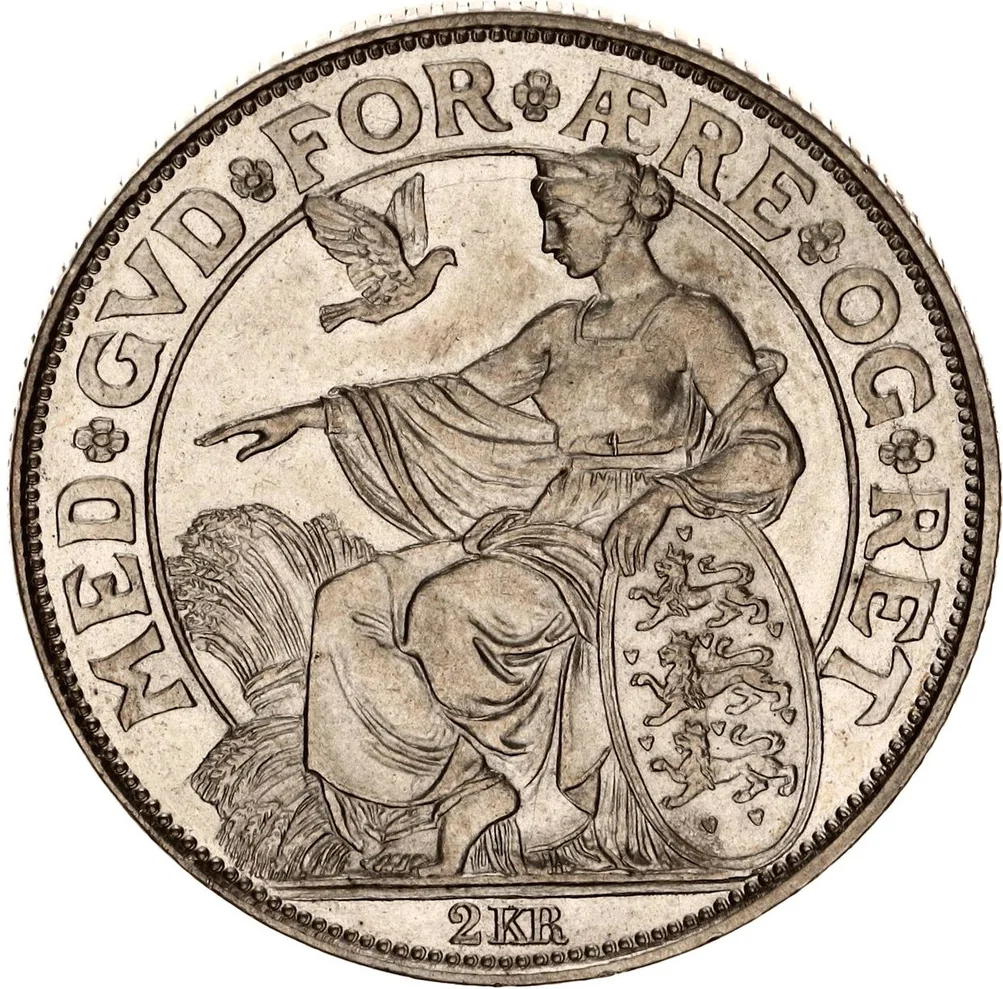
2 kroner (Reign) – Denmark
Add to wishlist
Circulating commemorative coins
Commemoration: 40th Anniversary of Reign
Denmark
Obverse
Description:
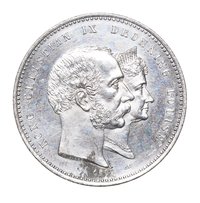
Armored bust right, titles and anniversary dates above, date and "P" below.
Inscription:
CHRISTIAN • IX • KONGE • AF • DANMARK •
Translation:
CHRISTIAN • IX • KING • OF • DENMARK •
Script: Latin
Language: Danish
Engravers: Vilhelm Burchard Poulsen, Knud Gunnar Jensen
Reverse
Edge
Reeded
Mints
| Name | Mark |
|---|---|
| Royal Danish Mint | — |
Mintings
| Year | Mint Mark | Mintage | Quality | Collection |
|---|---|---|---|---|
| 1903 | P | 103,392 |
Historical background
In 1903, Denmark operated under the classical gold standard, a system it had adhered to since 1873. This meant the Danish krone was directly convertible into a fixed quantity of gold, and its value was pegged to other gold-backed currencies like the German mark and the British pound. The country was a member of the Scandinavian Monetary Union (SMU), established with Sweden in 1873 and joined by Norway in 1875. This union created a unified currency area where Danish, Swedish, and Norwegian kroner circulated freely at par value, backed by gold and accepted interchangeably in all three nations, facilitating trade and financial stability.
The period around 1903 was one of relative monetary stability for Denmark within this framework. The economy was primarily agricultural, with a growing industrial base, and the fixed exchange rates provided predictability for exporters and importers. However, the system's rigidity meant Denmark's monetary policy was largely dictated by international gold flows and the economic conditions of its major trading partners, particularly Germany and Britain. The National Bank of Denmark (Danmarks Nationalbank) was responsible for maintaining the gold convertibility, holding sufficient reserves to back the circulating notes.
Beneath this surface stability, the Scandinavian Monetary Union was beginning to show subtle strains by the early 1900s. The outbreak of war between Sweden and Norway in 1905 would soon create political tensions that tested the union's cohesion. Furthermore, the global gold standard itself placed constraints on domestic economic management, as defending the gold peg often took precedence over addressing internal financial needs. While 1903 itself was not a year of crisis, Denmark's currency situation existed within a framework that was soon to be challenged by the geopolitical and economic upheavals of the coming decades, culminating in the SMU's effective dissolution during World War I.
The period around 1903 was one of relative monetary stability for Denmark within this framework. The economy was primarily agricultural, with a growing industrial base, and the fixed exchange rates provided predictability for exporters and importers. However, the system's rigidity meant Denmark's monetary policy was largely dictated by international gold flows and the economic conditions of its major trading partners, particularly Germany and Britain. The National Bank of Denmark (Danmarks Nationalbank) was responsible for maintaining the gold convertibility, holding sufficient reserves to back the circulating notes.
Beneath this surface stability, the Scandinavian Monetary Union was beginning to show subtle strains by the early 1900s. The outbreak of war between Sweden and Norway in 1905 would soon create political tensions that tested the union's cohesion. Furthermore, the global gold standard itself placed constraints on domestic economic management, as defending the gold peg often took precedence over addressing internal financial needs. While 1903 itself was not a year of crisis, Denmark's currency situation existed within a framework that was soon to be challenged by the geopolitical and economic upheavals of the coming decades, culminating in the SMU's effective dissolution during World War I.
🌱 Fairly Common