

1 dime – United States
Add to wishlist
United States
Context
Years: 1860–1873
Issuer: United States
Period:
(since 1776)
Currency:
(since 1785)
Subdivision: 1 dime = 10 Cents
Total mintage: 9,568,420
Material
References
KM: #
Numista: #18058
Value
Exchange value: 0.1 USD = $0.10
Bullion value: $5.45
Obverse
Description:
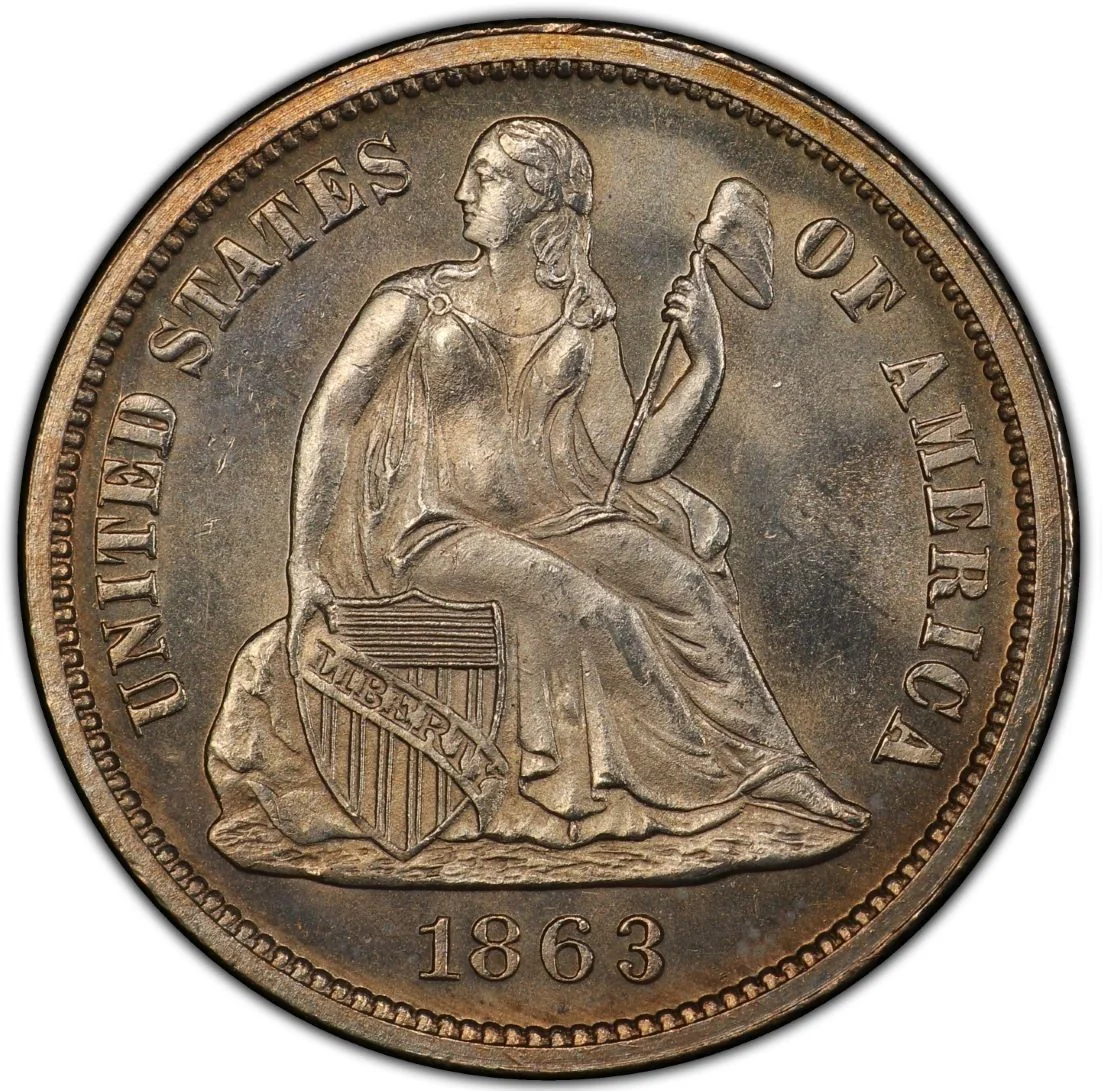
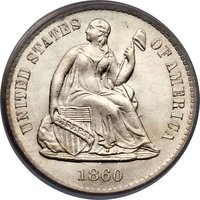
Liberty seated right, cap on pole, shield beside. Country name split around.
Inscription:
UNITED STATES OF AMERICA
1863
1863
Script: Latin
Engraver: Christian Gobrecht
Reverse
Description:
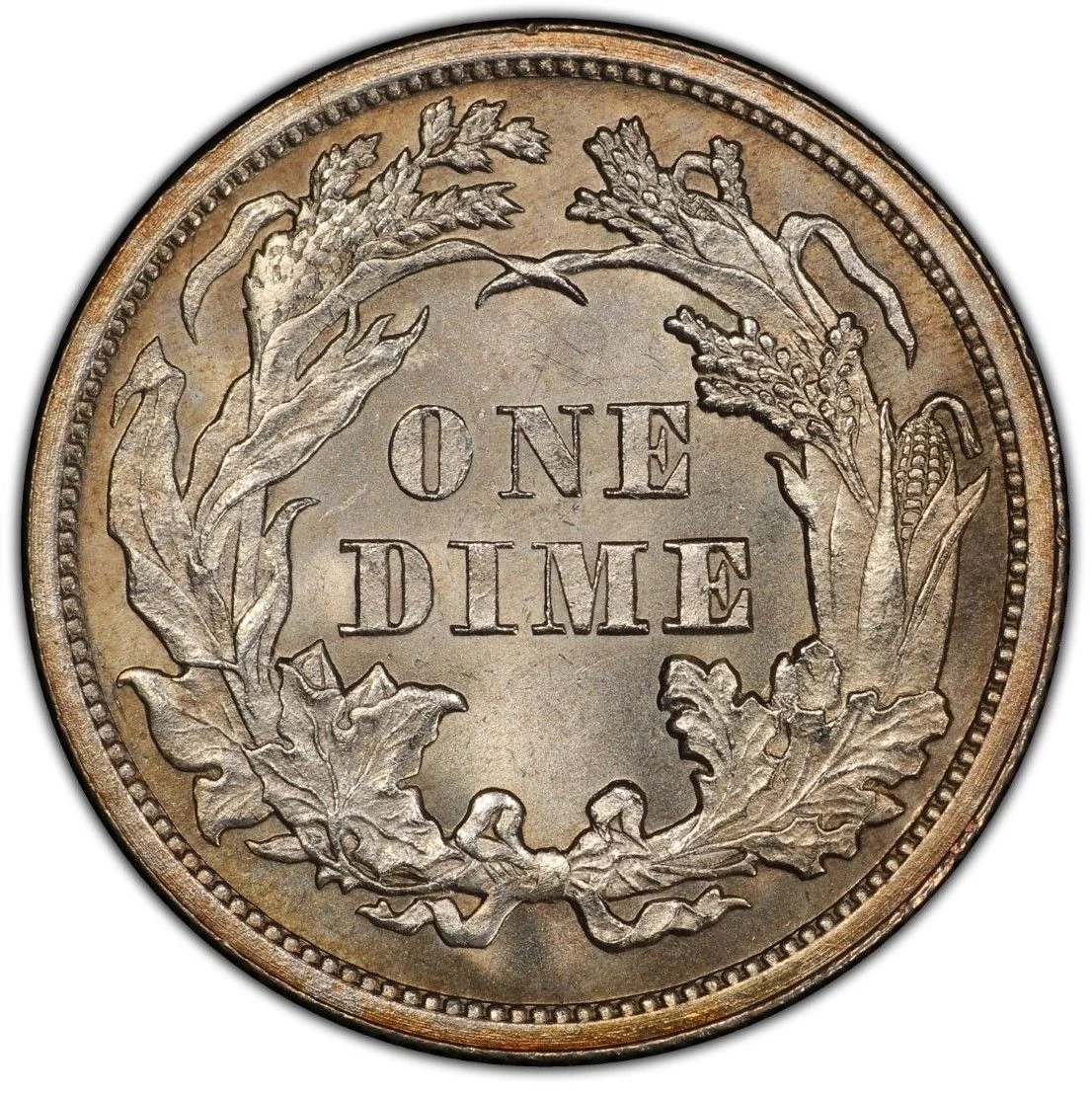
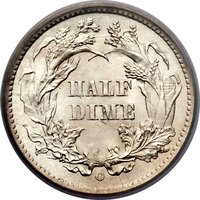
Denomination encircled by a wreath.
Inscription:
ONE DIME
Script: Latin
Engraver: Christian Gobrecht
Edge
Reeded
Mints
| Name | Mark |
|---|---|
| United States Mint of Philadelphia | — |
| United States Mint of Carson City | CC |
| United States Mint of New Orleans | O |
| United States Mint of San Francisco | S |
Mintings
| Year | Mint Mark | Mintage | Quality | Collection |
|---|---|---|---|---|
| 1860 | O | 40,000 | ||
| 1860 | — | 606,000 | ||
| 1860 | — | 1,000 | Proof | |
| 1861 | — | 1,883,000 | ||
| 1861 | — | 1,000 | Proof | |
| 1861 | S | 172,500 | ||
| 1862 | — | 847,000 | ||
| 1862 | — | 550 | Proof | |
| 1862 | S | 180,750 | ||
| 1863 | — | 14,000 | ||
| 1863 | — | 460 | Proof | |
| 1863 | S | 157,500 | ||
| 1864 | S | 230,000 | ||
| 1864 | — | 11,000 | ||
| 1864 | — | 470 | Proof | |
| 1865 | — | 10,000 | ||
| 1865 | — | 500 | Proof | |
| 1865 | S | 175,000 | ||
| 1866 | — | 8,000 | ||
| 1866 | — | 725 | Proof | |
| 1866 | S | 135,000 | ||
| 1867 | — | 6,000 | ||
| 1867 | — | 625 | Proof | |
| 1867 | S | 140,000 | ||
| 1868 | — | 464,000 | ||
| 1868 | — | 600 | Proof | |
| 1868 | S | 260,000 | ||
| 1869 | — | 256,000 | ||
| 1869 | — | 600 | Proof | |
| 1869 | S | 450,000 | ||
| 1870 | S | 50,000 | ||
| 1870 | — | 470,500 | ||
| 1870 | — | 1,000 | Proof | |
| 1871 | — | 906,750 | ||
| 1871 | — | 960 | Proof | |
| 1871 | CC | 20,100 | ||
| 1871 | S | 320,000 | ||
| 1872 | — | 950 | Proof | |
| 1872 | — | — | ||
| 1872 | CC | 35,480 | ||
| 1872 | S | 190,000 | ||
| 1873 | — | 1,507,400 | ||
| 1873 | — | 600 | Proof | |
| 1873 | CC | 12,400 |
Historical background
In 1860, the United States operated without a uniform national currency, creating a complex and often unstable monetary landscape. The federal government minted gold and silver coins, but the primary circulating medium consisted of thousands of different banknotes issued by over 1,500 state-chartered private banks. These notes were theoretically redeemable for specie (gold or silver) at the issuing bank, but their value and acceptance were highly inconsistent, depending on the perceived solvency of the bank and the distance from its location. This system led to widespread counterfeiting, confusion in commerce, and frequent bank failures that wiped out the value of people's paper money.
Underpinning this system was the official bimetallic standard, where both gold and silver were legal tender at a fixed ratio of 16-to-1. However, the discovery of vast gold deposits in California in 1848 had devalued gold relative to the government's fixed price, causing most silver coinage to be hoarded or exported. Consequently, the nation effectively functioned on a shaky gold standard, with a severe shortage of small-change coins for everyday transactions. The federal government had little control over the money supply, which was dictated by the decentralized banking system and international flows of precious metals.
This fragmented and unreliable currency system exacerbated the sectional tensions leading to the Civil War. Northern industrial and commercial interests increasingly advocated for a stronger central banking authority and a uniform national currency to facilitate trade and investment. Southern agricultural interests, deeply suspicious of centralized Northern financial power, largely opposed such reforms. The election of Abraham Lincoln in 1860 and the subsequent secession of Southern states would soon provide the political conditions for a radical transformation, leading to the Legal Tender Act of 1862 and the creation of a fiat national currency—the "greenback"—to finance the Union war effort.
Underpinning this system was the official bimetallic standard, where both gold and silver were legal tender at a fixed ratio of 16-to-1. However, the discovery of vast gold deposits in California in 1848 had devalued gold relative to the government's fixed price, causing most silver coinage to be hoarded or exported. Consequently, the nation effectively functioned on a shaky gold standard, with a severe shortage of small-change coins for everyday transactions. The federal government had little control over the money supply, which was dictated by the decentralized banking system and international flows of precious metals.
This fragmented and unreliable currency system exacerbated the sectional tensions leading to the Civil War. Northern industrial and commercial interests increasingly advocated for a stronger central banking authority and a uniform national currency to facilitate trade and investment. Southern agricultural interests, deeply suspicious of centralized Northern financial power, largely opposed such reforms. The election of Abraham Lincoln in 1860 and the subsequent secession of Southern states would soon provide the political conditions for a radical transformation, leading to the Legal Tender Act of 1862 and the creation of a fiat national currency—the "greenback"—to finance the Union war effort.
🌱 Fairly Common