

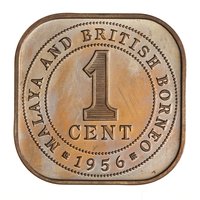
1 Cent – Malaya and British Borneo
Malaysia
Context
Years: 1956–1961
Country: Malaysia 
Issuer: Malaya and British Borneo
Ruler: Elizabeth II
Currency:
(1953—1967)
Demonetized: Yes
Total mintage: 33,750,000
Material
Weight: 4.21 g
Thickness: 1.5 mm
Shape: Square with rounded corners
Composition: Bronze
Magnetic: No
Technique: Milled
Alignment: Medal alignment
flip
References
KM: #Click to copy to clipboard5
Numista: #10712
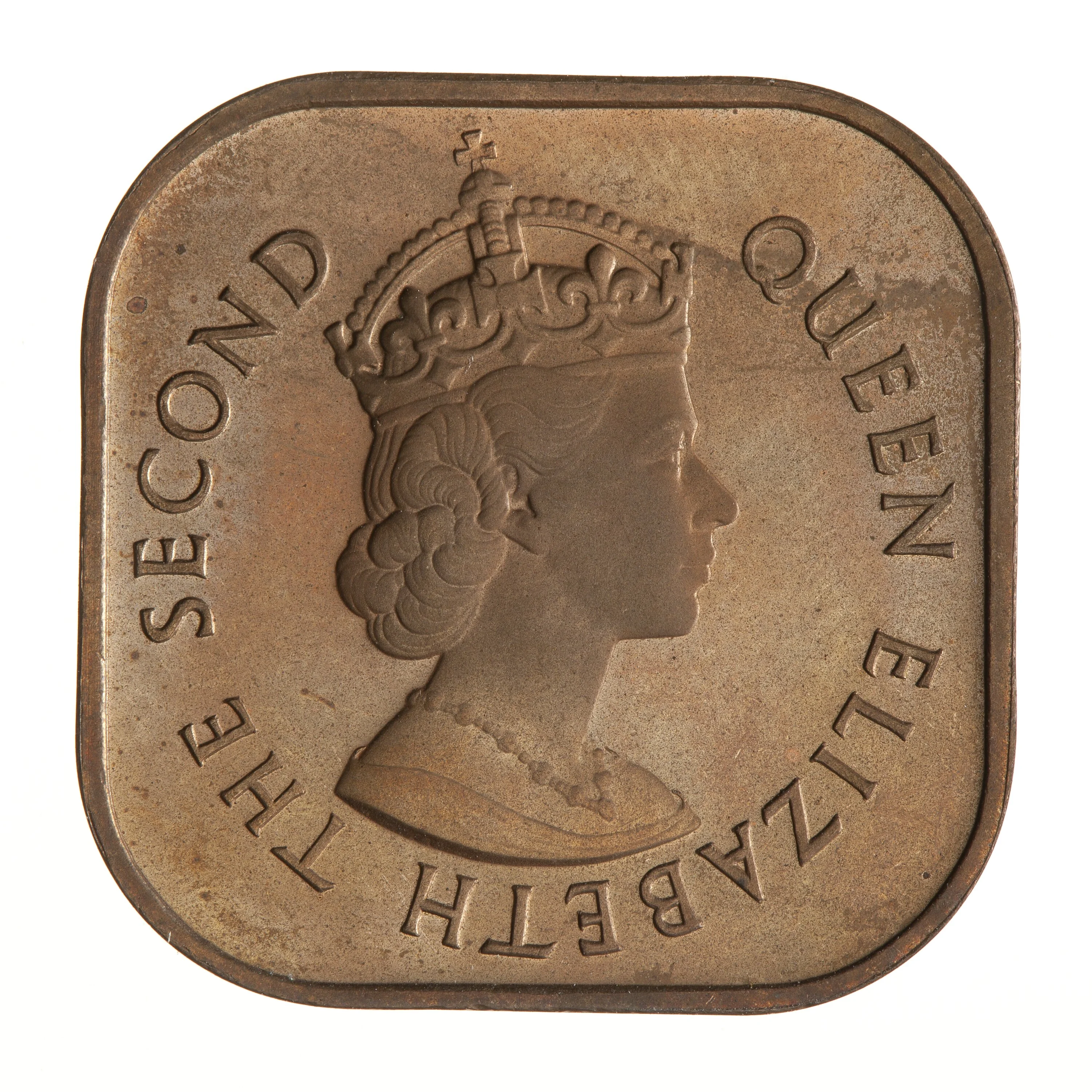
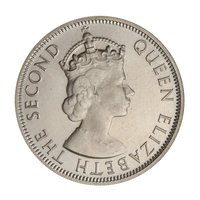
Obverse
Description:
Right-facing crowned bust.
Inscription:
QUEEN ELIZABETH THE SECOND
Script: Latin
Engraver: Cecil Thomas
Reverse
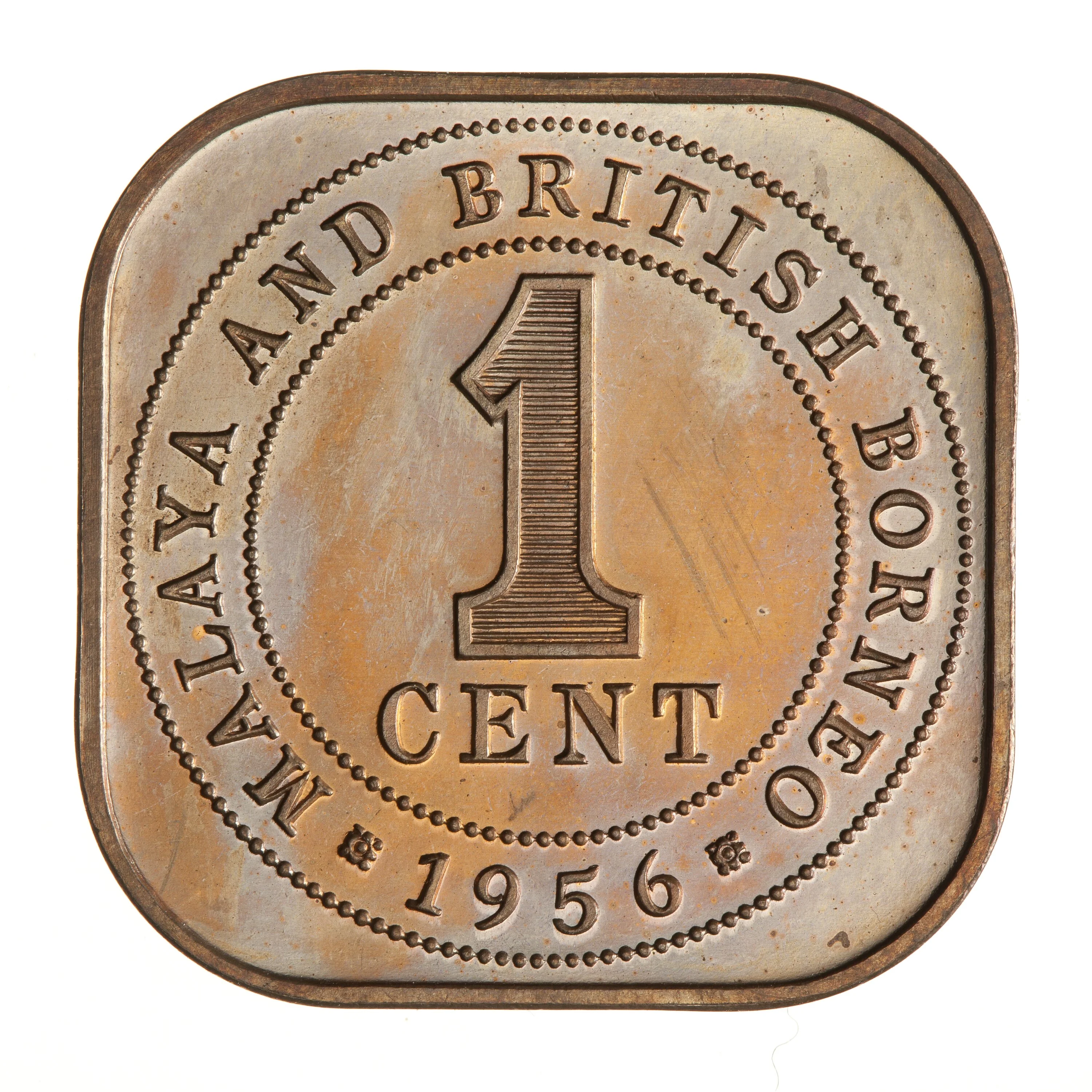
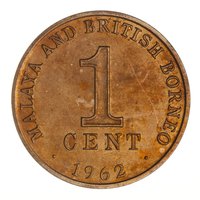
Description:
Beaded circle value
Inscription:
MALAYA AND BRITISH BORNEO
1 CENT
1961
1 CENT
1961
Script: Latin
Engraver: Cecil Thomas
Edge
Plain
Mints
| Name | Mark |
|---|---|
| Royal Mint (Tower Hill) | — |
Mintings
| Year | Mint Mark | Mintage | Quality | Collection |
|---|---|---|---|---|
| 1956 | — | 6,250,000 | ||
| 1956 | — | — | Proof | |
| 1957 | — | 12,500,000 | ||
| 1958 | — | — | Proof | |
| 1958 | — | 5,000,000 | ||
| 1961 | — | 10,000,000 | ||
| 1961 | — | — | Proof |
Historical background
In 1956, the currency situation in Malaya and British Borneo was defined by the operations of the Board of Commissioners of Currency, Malaya and British Borneo. Established in 1938, this unified currency board issued a common currency—the Malayan dollar (later the Malaya and British Borneo dollar)—for the Federation of Malaya, Singapore, Sarawak, North Borneo (now Sabah), and Brunei. This system ensured full sterling convertibility, as the currency was fully backed by sterling reserves held in London, guaranteeing fixed parity with the British pound. This provided monetary stability and facilitated trade within the region and with the British Empire, but it also meant monetary policy was entirely subservient to British economic interests, with no capacity for independent credit control or exchange rate adjustment.
Politically, this arrangement was under growing strain due to advancing decolonisation. The Federation of Malaya was on a clear path to independence (achieved in 1957), prompting serious discussions about establishing a national central bank and a distinct Malaysian currency. These talks, led by officials like Tan Siew Sin, were actively underway in 1956 and would culminate in the 1959 creation of Bank Negara Malaya. The currency board system, while efficient for a colonial trading bloc, was increasingly seen as incompatible with the sovereignty and economic development needs of an independent nation.
Consequently, 1956 represented a pivotal transitional year. The existing currency board system functioned smoothly, maintaining public confidence and stable exchange rates. However, it operated under the clear shadow of its impending dissolution for Malaya. The future for the Borneo territories remained more uncertain, as their political futures were still being determined. Thus, the monetary landscape was one of surface-level stability underpinned by intense planning for a fragmented system that would eventually see Malaya (and later Malaysia), Singapore, and Brunei each issue their own separate currencies in the 1960s.
Politically, this arrangement was under growing strain due to advancing decolonisation. The Federation of Malaya was on a clear path to independence (achieved in 1957), prompting serious discussions about establishing a national central bank and a distinct Malaysian currency. These talks, led by officials like Tan Siew Sin, were actively underway in 1956 and would culminate in the 1959 creation of Bank Negara Malaya. The currency board system, while efficient for a colonial trading bloc, was increasingly seen as incompatible with the sovereignty and economic development needs of an independent nation.
Consequently, 1956 represented a pivotal transitional year. The existing currency board system functioned smoothly, maintaining public confidence and stable exchange rates. However, it operated under the clear shadow of its impending dissolution for Malaya. The future for the Borneo territories remained more uncertain, as their political futures were still being determined. Thus, the monetary landscape was one of surface-level stability underpinned by intense planning for a fragmented system that would eventually see Malaya (and later Malaysia), Singapore, and Brunei each issue their own separate currencies in the 1960s.
🌱 Very Common