

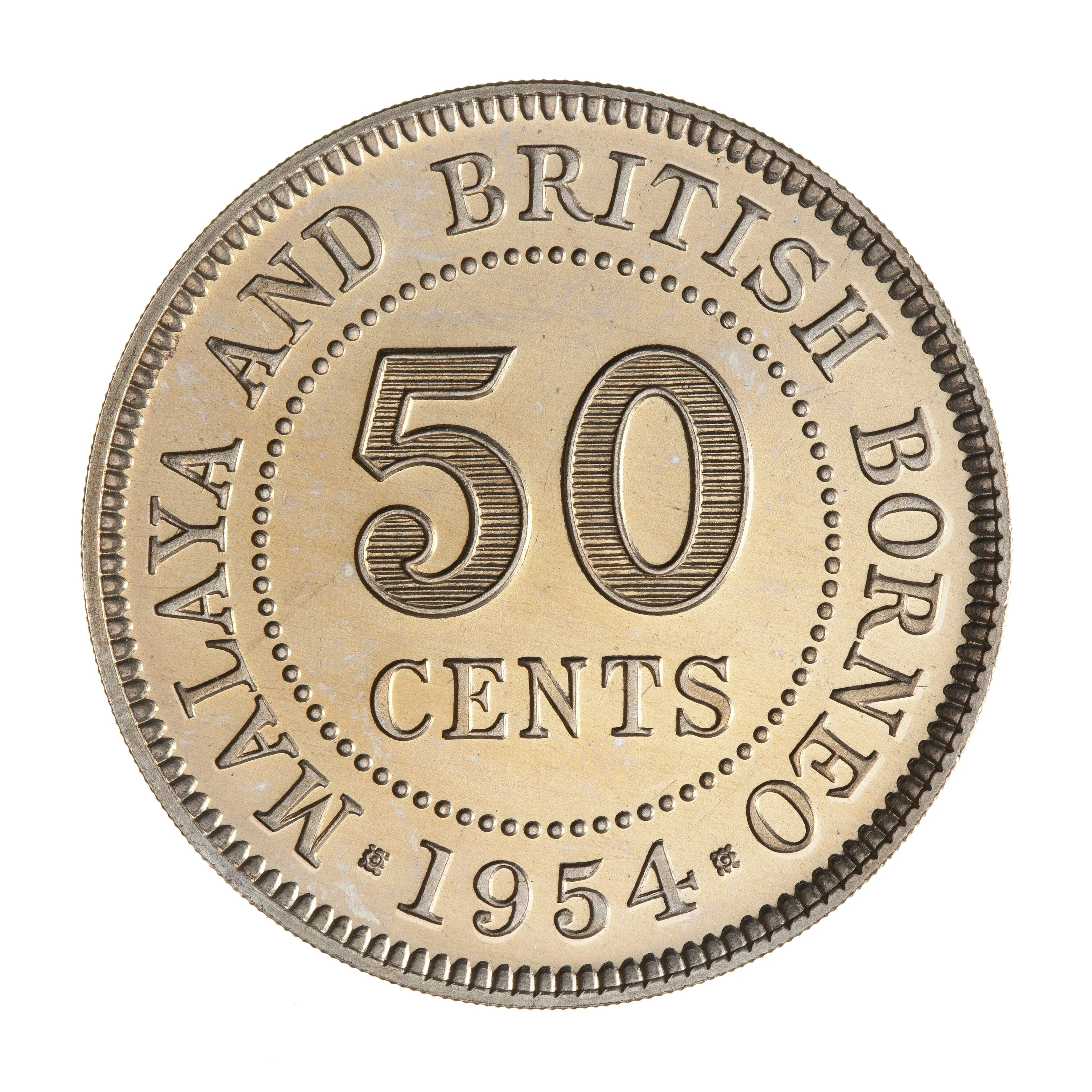
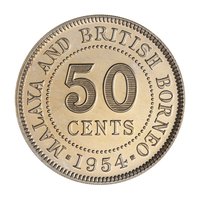
50 Cents – Malaya and British Borneo
Malaysia
Context
Years: 1954–1961
Country: Malaysia 
Issuer: Malaya and British Borneo
Ruler: Elizabeth II
Currency:
(1953—1967)
Demonetized: Yes
Total mintage: 44,440,000
Material
Diameter: 27.76 mm
Weight: 9.34 g
Thickness: 2.4 mm
Shape: Round
Composition: Copper-nickel
Technique: Milled
Alignment: Medal alignment
flip
References
KM: #Click to copy to clipboard4
Numista: #9666
Obverse
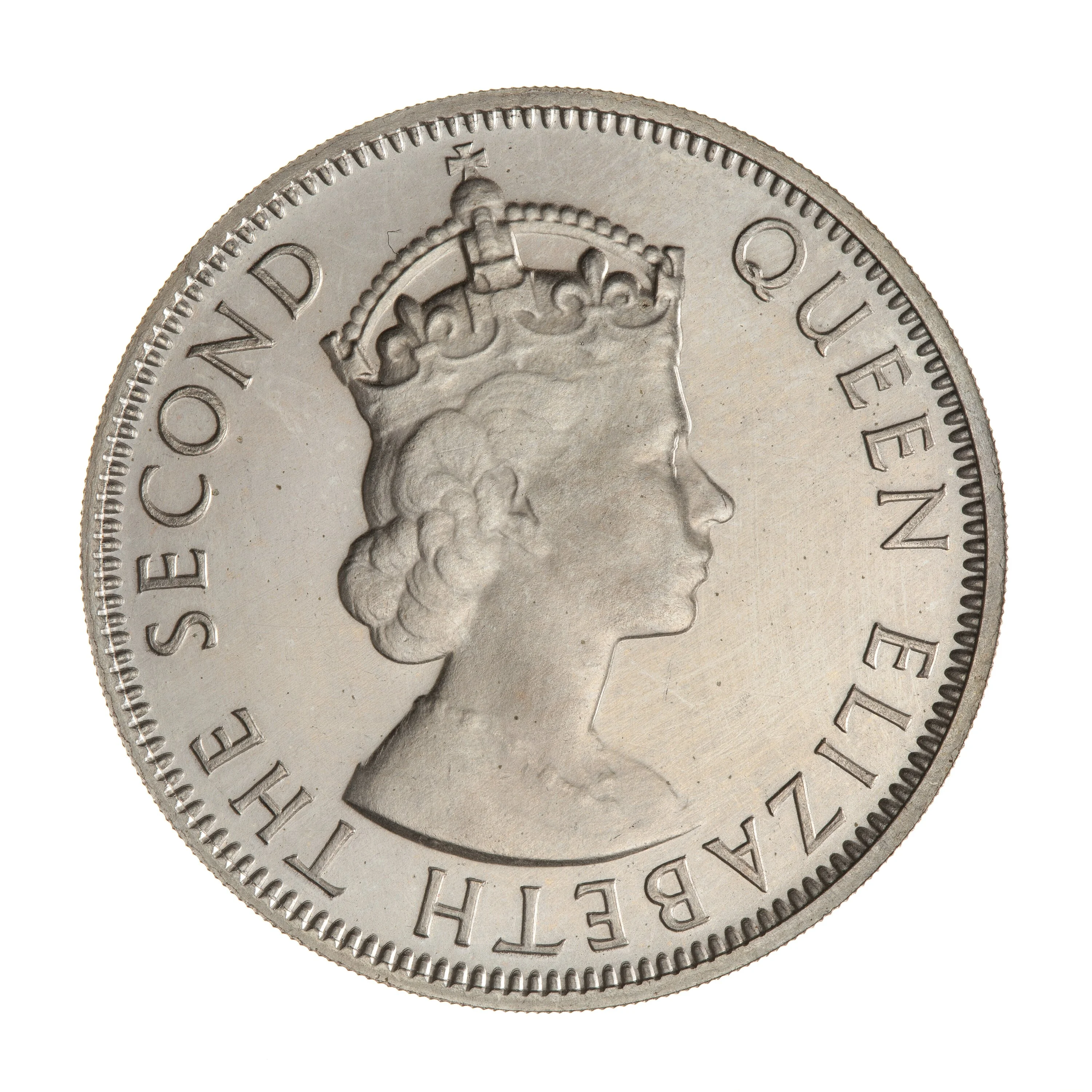
Description:
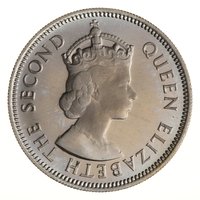
Right-facing crowned bust.
Inscription:
QUEEN ELIZABETH THE SECOND
Script: Latin
Engraver: Cecil Thomas
Reverse
Edge
Security edge
Mints
| Name | Mark |
|---|---|
| Royal Mint (Tower Hill) | — |
| Heaton and Sons / The Mint Birmingham | H |
| Kings Norton Metal Company | KN |
Mintings
Historical background
In 1954, the currency situation in Malaya and British Borneo was defined by the operations of the Board of Commissioners of Currency, Malaya and British Borneo. Established in 1952, this unified currency board issued the Malaya and British Borneo dollar, which served as the common legal tender across the Federation of Malaya, Singapore, Sarawak, North Borneo (now Sabah), and Brunei. This system provided crucial monetary stability, as the currency was fully backed by sterling reserves held in London, ensuring a fixed exchange rate of 2 shillings and 4 pence to the dollar and facilitating reliable trade within the region and with the British Empire.
The currency board system was a pragmatic solution for a region of diverse political entities, all of which were British dependencies or protectorates except for Thailand. It supported post-war reconstruction and the booming export economies, particularly Malaya's rubber and tin industries, by offering a stable and familiar monetary environment. The system's conservative, rule-based nature prevented inflationary financing and built confidence among merchants and international investors, which was vital for economic development during a period of rapid growth and increasing anti-colonial sentiment.
However, the political landscape was beginning to challenge this monetary unity. By 1954, moves towards self-government and independence were gaining momentum, most notably in the Federation of Malaya. The very success of the currency board in fostering economic integration could not indefinitely offset emerging national aspirations. While the system would remain functionally intact for another decade, the seeds of its eventual dissolution were being sown as local leaders began to consider monetary sovereignty an essential attribute of future nationhood.
The currency board system was a pragmatic solution for a region of diverse political entities, all of which were British dependencies or protectorates except for Thailand. It supported post-war reconstruction and the booming export economies, particularly Malaya's rubber and tin industries, by offering a stable and familiar monetary environment. The system's conservative, rule-based nature prevented inflationary financing and built confidence among merchants and international investors, which was vital for economic development during a period of rapid growth and increasing anti-colonial sentiment.
However, the political landscape was beginning to challenge this monetary unity. By 1954, moves towards self-government and independence were gaining momentum, most notably in the Federation of Malaya. The very success of the currency board in fostering economic integration could not indefinitely offset emerging national aspirations. While the system would remain functionally intact for another decade, the seeds of its eventual dissolution were being sown as local leaders began to consider monetary sovereignty an essential attribute of future nationhood.
🌱 Very Common